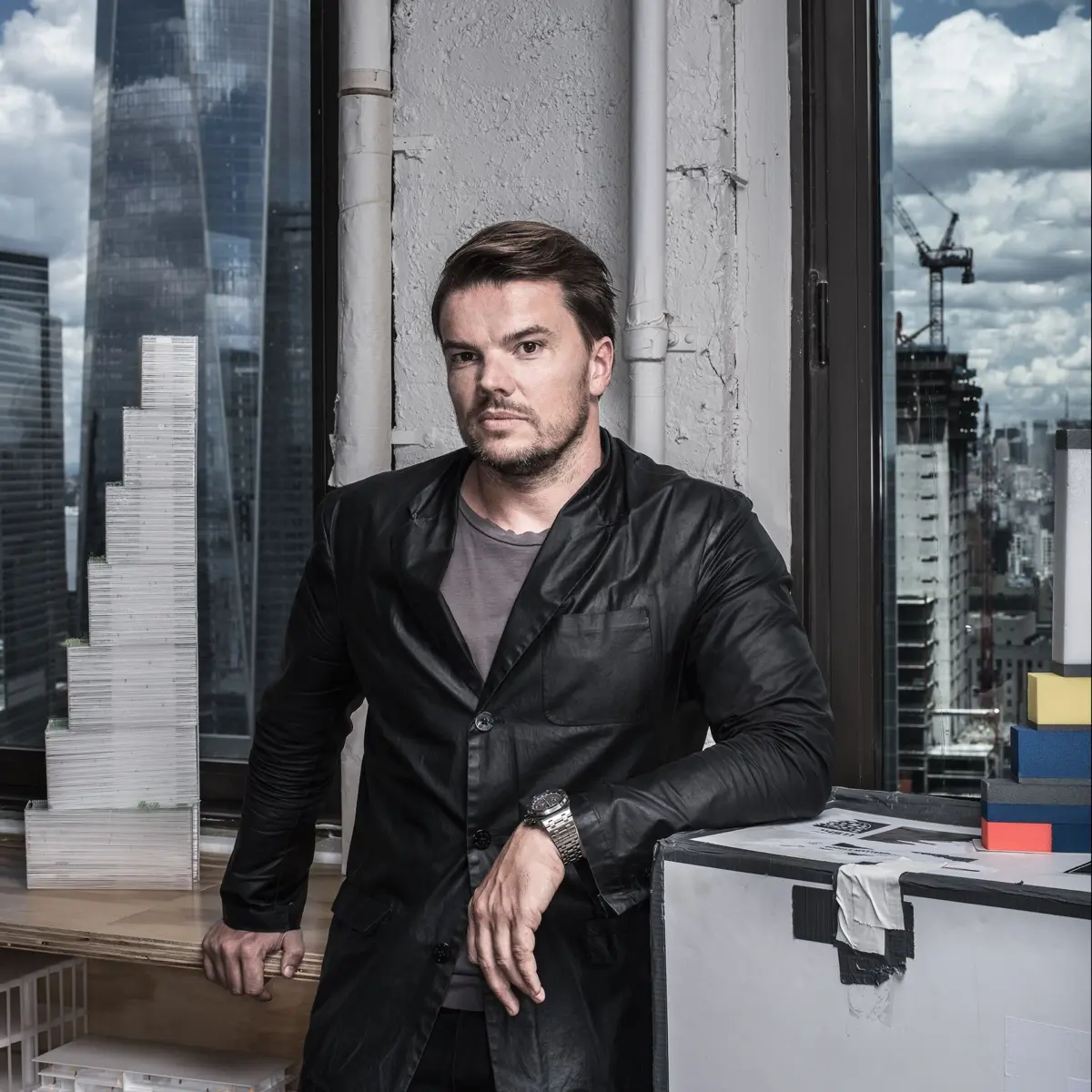
On a misty April morning in Lower Manhattan, Danish architect Bjarke Ingels stood on the roof of an old brick building with the collar of his black coat rakishly popped, filming a promotional video for the most consequential commission of his young career. He was presenting his design for Two World Trade Center, the final piece in the master plan to rebuild the site destroyed on September 11, 2001. At the time, the project was still a work in progress, and his primary client—media magnate Rupert Murdoch—had yet to formally sign off. Yet the hyper-eloquent 40-year-old architect refused to let doubt hinder his vision. He had obsessed over every line and image, directing the crew with the explicit goal of making viewers swoon.
While Murdoch’s plan to relocate his media empire remained one of New York real estate’s tightly guarded secrets, Ingels was practically ready to shout the news from the rooftops. Between takes, he pointed to a void in the densely packed Manhattan skyline, tracing the profile of a skyscraper that only he could see. From that vantage point, his design resembled a stack of seven asymmetric blocks, ascending like a staircase toward One World Trade Center, its monolithic neighbor.

"In a way, it is almost like a physical manifestation of the spirit of America," Ingels remarked, invoking the nation’s motto. "Out of many, one."
If completed, the tower would rank among the tallest buildings in New York City and stand as the final piece of the World Trade Center master plan. The surrounding ensemble would frame two cascading pools serving as a memorial to the roughly 3,000 people who died in the terrorist attacks. But Ingels was not focused on looking backward; he wanted to shape the future of the living city. "The memorial is about the memorial," he noted. "The tower should be about the living city."

The Art of Turning Fiction into Fact
Ingels frequently describes architecture as "the art of turning fiction into fact." He possesses manifold talents—as a draftsman, a salesman, and a charismatic cultivator of his own professional image—but his greatest asset is a remarkable gift for storytelling. He consistently weaves compelling narratives around practical necessities, often steering his designs in fantastical directions.
Among his global portfolio is a waste-to-energy plant under construction in Copenhagen featuring a slanted roof that doubles as a recreational ski slope, complete with a smokestack designed to puff a symbolic ring of steam every time it emits a ton of carbon dioxide. For a proposed expansion of Google’s campus in Mountain View, California, Ingels collaborated with designer Thomas Heatherwick on an elaborate complex of geodesic domes, envisioning a lifestyle of biking, hiking, and coding beneath sunlit glass terrariums.

Such imaginative flights have propelled Ingels to international fame at an age traditionally considered precocious within the architecture profession. However, fame can be a deceptive metric in the field, where an architect’s built work often takes years to materialize.
His largest project completed at the time—a striking pyramidal apartment building on Manhattan’s West Side Highway known as Via 57 West—was only about one-third the scale of Two World Trade Center. Ingels readily acknowledged the magnitude of the jump. While his firm was working seriously on one of downtown New York’s most daunting building proposals, they had yet to complete a full-scale skyscraper. With Two World Trade Center, Ingels aimed to transform a form that is traditionally vertical and hierarchical into a dynamic environment that fosters horizontal interaction. The challenge lay in proving he could turn that captivating narrative into hard reality.

Eclecticism on Demand
Playfully naming his firm BIG, Ingels often characterizes his architectural approach as "BIGamy." Rather than adhering to a rigid personal aesthetic, he tailors his ideas to meet the distinct demands of each client, resulting in structures unlike anything seen before.
Realizing the Two World Trade Center design, however, required constant negotiation with a pair of formidable octogenarians: Rupert Murdoch and Larry Silverstein, the developer controlling much of the World Trade Center rebuilding effort. For the $4 billion skyscraper to secure financing, Murdoch and Silverstein needed to finalize a long-term lease. Navigating the deal meant maneuvering through a volatile real estate market, the heavy political sensitivities of building on a site of mass trauma, and a complex bureaucratic landscape involving the Port Authority of New York and New Jersey.

For 14 years, these intersecting pressures had caused the redevelopment process to lurch forward unpredictably, derailing numerous architectural ambitions. Ingels’ design had actually displaced an earlier proposal by renowned architect Lord Norman Foster—a reversal of fortunes, given that Foster had previously pushed aside Ingels on a national library project in Kazakhstan. To avoid his predecessor’s fate, Ingels had to balance the conflicting priorities of Murdoch and Silverstein while managing a rapidly growing list of global clients.
Bridging Vision and Reality
The initial hurdle for Ingels at the World Trade Center was simple inertia. Silverstein was satisfied with Foster’s previous design and held deep reservations about Ingels’ stacked concept, fearing it looked asymmetrical and unstable from certain angles. Silverstein nearly walked away from the deal entirely before receiving reassuring endorsements from the architects behind the other World Trade Center towers.

Shortly after overcoming those initial doubts, Ingels faced a rigorous grilling from Rupert Murdoch himself during a high-stakes meeting at a conference room overlooking the site. Murdoch’s primary concern was structural: why the building appeared to lean. Assisted by David Childs, the architect of One World Trade Center, Ingels explained that the leaning effect was a deliberate optical illusion. The unorthodox stepped form emerged from positioning the inner elevator core off-center, creating expansive interior spaces for newsrooms, outdoor terraces, and sweeping views of the plaza for Fox News studios. The explanation won Murdoch over.
Ingels also found a vital internal ally in James Murdoch, Rupert’s son and corporate successor, who spearheaded the search for a new headquarters for 21st Century Fox and News Corp. Seeking an open, creative loft environment rather than a traditional corporate tower, James appreciated Ingels’ problem-solving ability.

Nevertheless, significant structural hurdles remained. Because of a political compromise between Silverstein and the Port Authority, Foster’s foundation had already been partially constructed to support an underground transportation hub. Piggybacking a new skyscraper onto that preexisting foundation created complex engineering challenges, particularly in aligning the loads of the lower floors. Furthermore, New York Police Department security standards mandated that all facades at the World Trade Center use heavy laminated safety glass to withstand potential explosions, eliminating Ingels’ initial plan to use thinner, less expensive materials on parts of the building.
As construction cost estimates climbed and negotiations between Silverstein and Murdoch grew tense, the architecture itself seemed momentarily caught in the balance. Yet through steady design adjustments and persistent collaboration with engineers, Ingels managed to preserve the core identity of his stepped tower.

Expanding Global Footprint
Beyond New York, BIG’s influence continues to expand rapidly across the globe. In Washington, D.C., the firm undertook a master plan to reimagine the Smithsonian Institution’s South Mall campus, while in New York, Ingels designed the Dryline—a 10-mile hybrid park and flood defense system intended to protect Lower Manhattan from future climate disasters following Hurricane Sandy.
Despite the inevitable political setbacks, design modifications, and the immense pressures of corporate architecture, Ingels remains committed to his philosophy that architecture can be both pragmatic and utopian. As his team continues to populate new offices near Wall Street with a growing international staff, Ingels views every challenge not as a roadblock, but as an opportunity to test the boundaries of what a modern city can achieve.