In software engineering and digital product design, few challenges are as notoriously persistent as establishing clear, intuitive names for interface elements, variables, and design assets. A fundamental principle of user experience and front-end architecture is that the language teams choose directly shapes how they think, collaborate, and build. When terminology diverges, communication breaks down across disciplines, resulting in fragmentation, slow development cycles, and end-user confusion.
The difficulty stems from a delicate balance: names that are too generic fail to convey functional intent, while names that are overly specific lack the flexibility required for system-wide reuse. Across modern product development organizations, design system lead practitioners, software engineers, and product strategists are actively seeking structured methodologies to resolve this issue. From global design token taxonomies to dedicated community repositories, a comprehensive collection of resources and frameworks has emerged to standardize how software teams name code variables, design layers, color schemes, and product features.
How to Approach General Naming in Code and Interface Design
Finding apt descriptors for HTML classes, CSS custom properties, and JavaScript functions often pushes developers into creative bottlenecks. When restricted to obvious functional terms, engineers frequently resort to repetitive or confusing naming conventions that impair code readability over time.

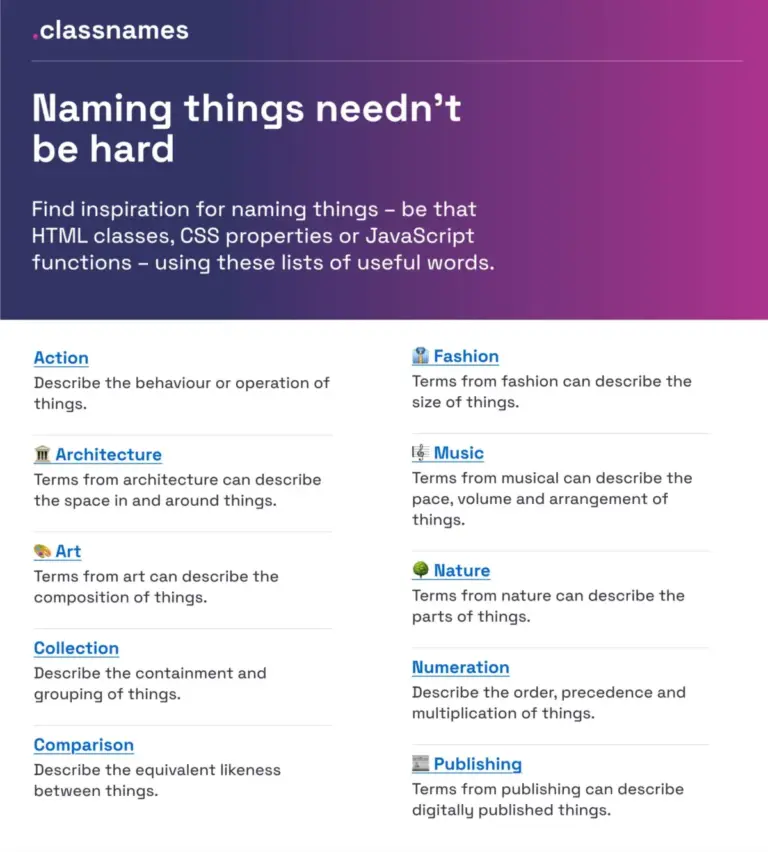
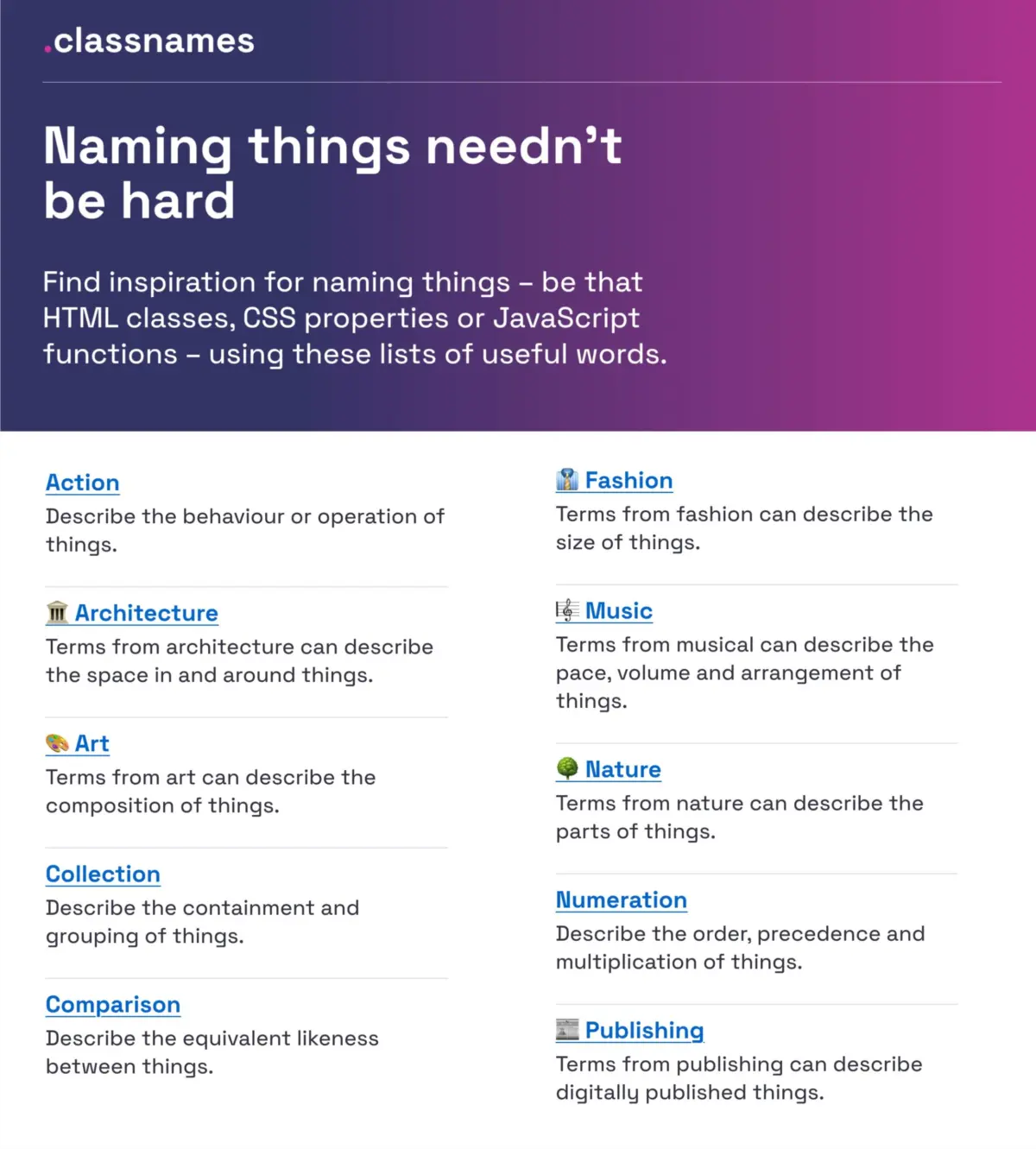
To address this challenge, creative tools such as Paul Robert Lloyd’s Classnames project offer alternative linguistic frameworks for front-end developers. The platform curated thematically grouped collections of terminology designed to encourage broader creative thinking when structuring stylesheets and scripts. Rather than relying strictly on technical jargon, the directory organizes words based on behavior, spatial orientation, relational association, and hierarchical ordering.
Furthermore, Classnames draws inspiration from non-digital domains including architecture, fashion, publishing, music, theater, art, and nature. By introducing metaphors and terminology from established physical disciplines, the resource helps engineers identify intuitive mental models for abstract layout structures, component states, and container relationships. This cross-disciplinary approach provides front-end teams with a structured vocabulary capable of describing complex layout behaviors clearly and concisely.
Establishing Precision in Color Palette Nomenclature
Assigning meaningful names to color palettes represents one of the most common friction points in design system maintenance. Abstract terms like blue-light or brand-accent-3 quickly lose clarity as design systems expand to support dark modes, high-contrast themes, and multi-brand applications.

A significant effort to resolve color nomenclature ambiguity comes from developer David Aerne, who curates an extensive open-source repository dedicated to color identification. Containing over 30,000 unique color names aggregated from diverse historical references, standardized registries, and community contributions, the project serves as a comprehensive index for digital color management.
To make this dataset actionable for design systems, the project includes interactive tools such as Color Parrot alongside dedicated color picker utilities and search engines. These applications allow designers and engineers to input raw hex codes, RGB values, or HSL strings to immediately retrieve distinct, human-readable names. By replacing ambiguous numeric sequences with recognized terms, design teams can maintain readable semantic layers and avoid collision errors across multi-themed codebases.
Best Practices for Organizing Design Files and Component Libraries
In design software such as Figma and Sketch, chaotic layer naming and disorganized component structures can severely disrupt collaboration. As design files pass between product designers, researchers, and front-end developers, unstandardized group layers like Frame 402 or Group 12 copy create technical debt and delay handoffs.

Design system strategist Javier Cuello outlined a comprehensive framework detailing naming best practices aimed at establishing scalable design asset hierarchies. According to his operational guidelines, effective names must follow a logical taxonomy, remain concise, convey meaningful functional intent, and remain universally understood by both design and engineering disciplines.
Crucially, Cuello emphasizes that functional names should never depend on transient visual properties. For example, naming a button layer based on its physical color or pixel size creates immediate errors if the design system introduces a dark mode or scales for mobile viewports. His documented guidance provides concrete examples of structural organization, helping teams standardize sizing logic, layer groupings, and component variants in a manner that directly aligns with modern front-end component architectures.
Scaling Token Taxonomies in Enterprise Design Systems
At the enterprise level, building a flexible design token architecture capable of serving diverse product suites presents significant structural challenges. Design tokens serve as the underlying visual subatomic units—representing color, typography, elevation, and spacing—that bridge design tools with production code.

This challenge was particularly acute for financial software provider Intuit, the parent company behind disparate platforms such as Mailchimp, QuickBooks, TurboTax, and Mint. Design system architect Nate Baldwin documented how the organization replaced its legacy architecture with a scalable, multi-product design token taxonomy. The objective was to create a unified foundational system that could support distinct brand identities without sacrificing systematic consistency.
The resulting case study details the evolution of Intuit’s token structure, highlighting the operational friction caused by rigid token structures and articulating the criteria required for modern enterprise multi-branding. By establishing clear token tiers—separating global primitive values from contextual semantic applications—Intuit established a model that allows individual product teams to maintain brand autonomy while consuming a shared core design system infrastructure.
Standardizing Common Interface Components
When defining component libraries, teams frequently struggle with terminology choices for foundational UI patterns. A single interactive element might be referred to as a "flyout," "popover," "drawer," or "modal" depending on an individual team member’s background, leading to inconsistent code interfaces and redundant documentation.

To resolve these discrepancies, digital creator Iain Bean compiled The Component Gallery, an extensive reference library that aggregates UI components from production design systems worldwide. The directory catalogues examples across more than 50 standard component categories, ranging from basic accordions and buttons to visually hidden utility wrappers.
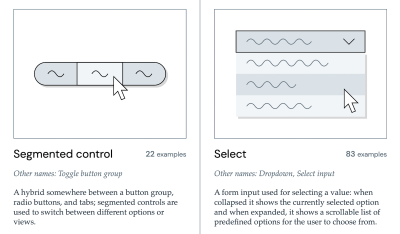
Each entry within The Component Gallery indexes alternative names used across major industry design systems, offering teams a data-driven look at prevailing industry conventions. Supplementary visual guides, such as Name That UI, further assist teams by providing a shared visual dictionary of standard interface components. By observing how leading software organizations name and document interface patterns, product teams can establish standardized component libraries based on broad industry consensus rather than isolated personal preferences.
Aligning Feature Naming with User Intent and Discoverability
While component naming focuses primarily on internal developer ergonomics, product feature naming directly impacts end-user engagement and adoption. Software features often suffer from low user engagement simply because their functional names fail to communicate value clearly or align with user mental models.
Product writer Erin Gannon addressed this operational challenge in a detailed practical analysis on feature nomenclature. Her research outlines the complete lifecycle of feature adoption, pointing out that before users can learn, trial, or integrate a feature into their daily routines, they must first discover and comprehend its intent.
Gannon’s framework demonstrates that successful feature names are explicitly grounded in user research and problem statements. Rather than relying on technical implementations or internal company jargon, feature names should reflect the specific outcome or "job-to-be-done" from the perspective of the customer. By conducting user interviews and capturing the precise language end-users employ when describing their workflows, product managers and UX writers can craft feature labels that improve natural discoverability and lower cognitive barriers to adoption.
Structuring Multi-Brand and Multi-Theme Variable Architectures
Managing complex design token systems across large-scale enterprise environments requires a rigorous organizational map. For organizations supporting multi-brand, multi-themed ecosystems, variable names must convey significant context—including component association, functional state, theme variant, and device platform—within a single standardized string.

A prominent example of structural variable organization comes from the Vodafone UK Design System team, who published their internal Variables Taxonomy Map as a community resource. Building upon foundational design token research by system strategist Nathan Curtis, Vodafone’s map illustrates the operational anatomy and hierarchical tiering of design tokens.
The taxonomy framework separates design variables into four distinct operational collections that govern the flow of data from primitive brand values to semantic interpretations and page-level component overrides. By establishing a explicit, rules-based naming convention, the taxonomy allows developers and designers to determine a token’s exact context, theme relationship, and functional scope simply by analyzing its text string.
Tools and Workflows for Building Token Architectures
To streamline the practical implementation of design token naming conventions, specialized tools have emerged to assist teams during the initial setup and inventory phases. Manually configuring token strings across complex component states often leads to human error and structural inconsistencies.

Design system specialist Romina Kavcic developed the Free Design Token Naming Guide + Builder, an interactive utility designed to help product teams define customized token structures. The tool allows creators to systematically configure token tiers by selecting specific variables for components, functional categories, interactive states, and semantic roles.
To complement the interactive builder, Kavcic created a design token inventory framework that organizes system variables into a clear four-tier spreadsheet model. This inventory system provides product managers and lead architects with a centralized overview of their complete token ecosystem. By establishing a structured spreadsheet format, teams can seamlessly filter variables, manage light and dark display modes, and introduce multi-brand themes without introducing structural errors into their design software or code repositories.
Strategic Resources for Brand and Service Naming
Beyond internal interface components and code variables, naming high-level products, commercial platforms, or corporate services represents a broader strategic challenge. Product leaders require structured methodologies for brainstorming, domain verification, linguistic vetting, and legal screening when launching new digital initiatives.

To aggregate resources for macro-level product naming, the open-source directory Onym serves as a curated repository of methodologies, tools, and literary guides. The platform organizes key steps in the naming lifecycle, providing practical tools for etymological research, brainstorming sprints, trademark vetting, and domain analysis.
By offering access to agency-grade frameworks, historical case studies, and practical exercise templates, Onym helps executive teams approach high-stakes product naming with structured rigor. The resource ensures that strategic naming decisions are informed by thorough linguistic and market considerations rather than subjective opinion.
Overcoming Dialects and Navigating Naming Conflicts
At its core, the persistent challenge of naming in digital product development is a communication problem. Friction frequently arises when different disciplines operate in siloed terminology domains—creating a designer dialect, an engineering dialect, a product manager dialect, and a customer dialect. When these communication layers fail to align, organizations experience misaligned specifications, redundant code, and degraded user experiences.

Resolving these discrepancies requires cross-functional alignment and a commitment to ongoing terminology management. When adoption rates for design systems or software features drop, team leads must evaluate whether unclear or conflicting names are driving the problem. Identifying naming debt, logging terminology conflicts in team backlogs, and establishing clear semantic guidelines allow software teams to streamline collaboration, eliminate cross-departmental confusion, and build more cohesive digital platforms.