Is fashion art? Does it truly belong within the hushed, reverent halls of a museum? In Paris, the answer has always been a resounding oui, but never more so than tonight, as the Musée des Arts décoratifs (MAD) flings open its doors to the fashion elite for one of its most ambitious exhibitions to date.
Titled “Look: 40 Years of Fashion at the Museum,” the blockbuster showcase brings together a meticulously curated selection of forty stellar fashions culled from decades of groundbreaking exhibitions past. The timeline of garments stretches from the intricate, refined elegance of 18th-century French court attire all the way to the bleeding edge of contemporary design. Among the newest additions is a striking Alainpaul ensemble drawn directly from the designer’s fall 2026 collection, a piece thoughtfully inspired by the very inner workings and institutional heartbeat of the MAD itself.
Yet, magnificent as these forty pieces are, they represent merely an infinitesimal fraction of a staggering museum collection that runs more than 80,000 pieces deep. For the institution, the exhibition is both a retrospective victory lap and an intimate exploration of how garments transition from commercial runways and private ateliers into the immortalized realm of cultural heritage.
“It’s like a major flashback,” curator Sophie Lemahieu remarked to press and colleagues during an exclusive early preview of the galleries. The overarching narrative arc of the show, she carefully explained, is designed to cover the entire biological and artistic lifespan of a garment. It begins deep inside a designer’s mind—examining how creative ideas are first conceived and shared, and what precisely happens behind closed doors in the atelier—before tracking how those physical creations ultimately arrive at a moment of cultural consecration, why they are selected to become part of a museum exhibition, and finally, what painstaking technical labor goes into preserving and valorizing them for future generations.
Wandering through the galleries reveals an astonishing array of rarely displayed treasures that illuminate the invisible stages of creation. Visitors can marvel at the scaled-down wooden mannequin that legendary couturière Madeleine Vionnet used to drape every single one of her revolutionary bias-cut creations. There are delicate, tissue paper-lined drawers brimming with bejeweled, sculptural shoes crafted by master footwear designer Roger Vivier.

The exhibition also grants unprecedented access to the ephemera of the modern creative process: the magical, deeply feminist mood board carefully assembled by Maria Grazia Chiuri for her historic very first Christian Dior haute couture show in the spring of 2017, and a veritable magpie’s dream of a “mood box” put together by Josephus Thimister during his influential tenure at Balenciaga in the 2010s, playfully stuffed with raw fabrics, experimental accessories, and shimmering silvery star sequins.
As visitors step into the museum’s central nave, they are immediately greeted by iconic, larger-than-life moments drawn directly from the intersection of the runway and pop culture history. Among them is a breathtaking haute couture black-and-gold kimono ensemble designed by John Galliano for Dior during his unforgettable spring 1998 collection. Nearby hangs the cheek-grazing, scandal-inducing backless black velvet dress by Guy Laroche that sent shockwaves through French society when actress Mireille Darc wore it onscreen in the 1972 film Le Grand Blond avec une chaussure noire.
The sprawling retrospective reads like a who’s who of fashion royalty. Seminal, museum-grade creations by visionaries such as Thierry Mugler, Yves Saint Laurent, Christian Dior, Hubert de Givenchy, Alexander McQueen, Christian Lacroix, Helmut Lang, Hussein Chalayan, Iris van Herpen, Valentino, Nicolas Ghesquière, Paco Rabanne, Rei Kawakubo, and Karl Lagerfeld for Chanel mingle effortlessly with pieces that achieved legendary status through memorable public wear.
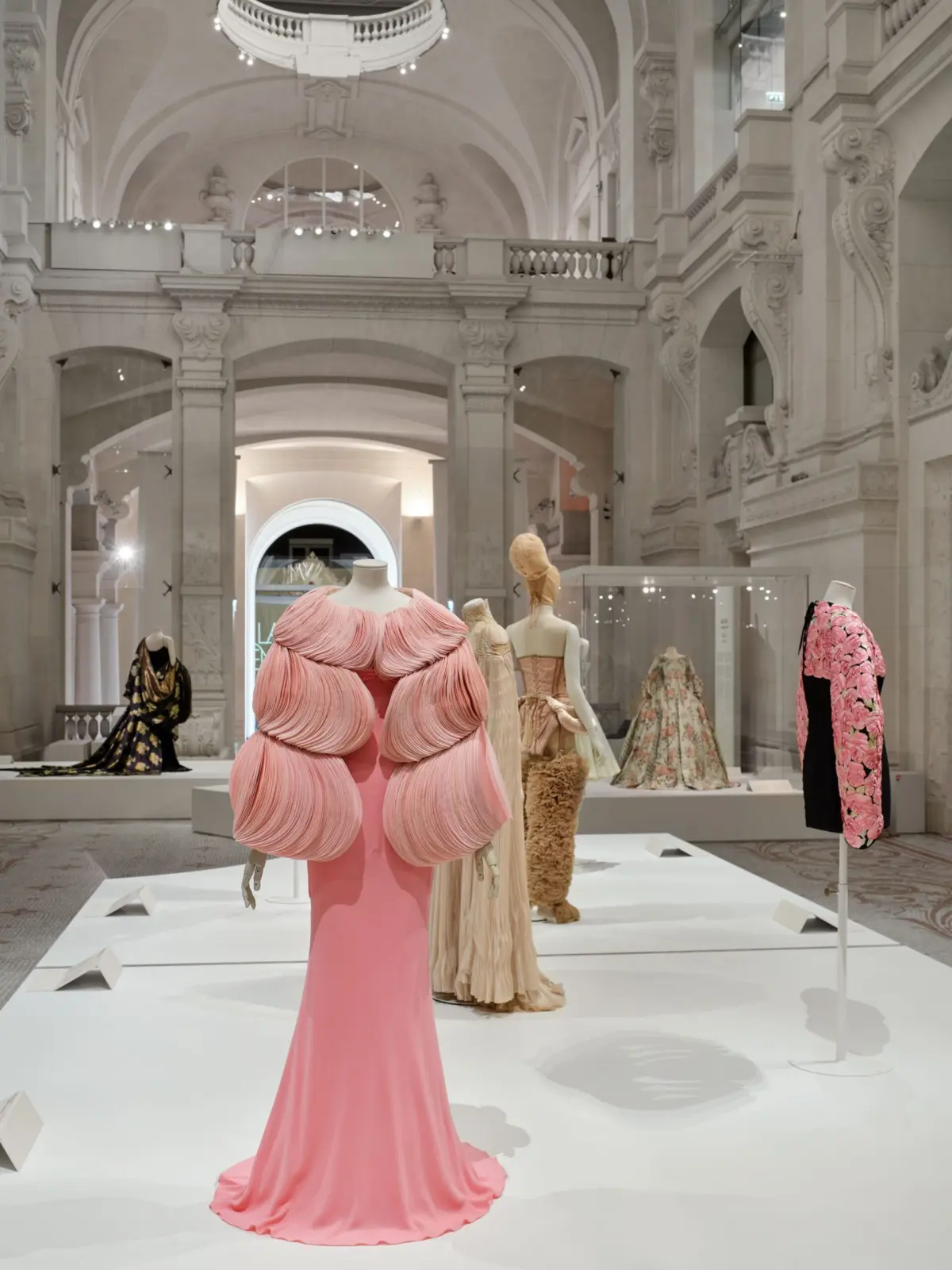
Among these cultural touchstones is a quilted satin corset and ruffled leg design by Jean Paul Gaultier, alongside the sculptural, sharp-shouldered black ruffled mini-dress from Alexandre Vauthier’s spring 2020 couture collection that music icon Rihanna memorably wore to the ultra-exclusive Oscars after-party hosted by Beyoncé and Jay-Z. Another standout visual anchoring the exhibition is a closeup of a dramatic pink cape and gown by Valentino—a staggering millefeuille confection crafted from layers of silk organza, crepe, and silk from the designer’s haute couture fall 2007 collection, originally featured in his celebrated 45th-anniversary exhibition and now starring on the official promotional poster for this current show.
Yet the scenography purposefully avoids remaining solely in the realm of high-drama haute couture and red-carpet glamour. The exhibition thoughtfully touches on fashion in its most grassroots, unexpected, and utilitarian expressions. Most notably, the display includes the original neon yellow safety vest that inadvertently sparked the widespread gilets jaunes (yellow vests) grassroots uprising across France in 2018. The inclusion nods to a brilliant historical irony: Karl Lagerfeld had previously worn one of the exact same vests for a high-profile French road safety campaign featuring the famously self-deprecating tagline, “It’s yellow, it’s ugly, it doesn’t go with anything—but it could save a life.”
Surrounding the major installations, the surrounding galleries function as an expansive cabinet of curiosities. Original fashion sketches, vintage advertising posters, doll-sized atelier mannequins, mood boards, fabric swatch albums, intricate paper patterns, bespoke buttons, elaborate embroideries, and preliminary cotton toiles are laid out to painstakingly retrace how fashion is physically brought into existence and, years later, meticulously preserved for posterity.

Spanning forty years of exhibition history—representing more than seventy distinct shows all told—the retrospective not only grants historic garments another theatrical encore in the spotlight, but also offers a rare, scholarly opportunity to revisit design inspirations that risk being forgotten by contemporary audiences.
The sense of cross-pollination across decades is particularly striking when observing the subtle threads of fashion history. Viewers can trace how a wildly experimental look from John Galliano’s viral Maison Margiela Artisanal couture show in the spring of 2024 connects directly back to a russet fringed silk couture dress presented by Madeleine Vionnet exactly one hundred years prior. Similarly, the exhibition demonstrates how a 19th-century textile motif filters down a century and a half later into a sophisticated contemporary ensemble by Dries Van Noten, who cleverly reprised both its classic tulip motif and the loose, hanging multicolored threads on its underside for a pair of coats in his spring 2014 collection.
Even forgotten names are brought back into the light. While few casual fashion observers today might recognize the once-prominent house of Maggy Rouff, a 1930s-era waxed silk satin slip dress attributed to the designer possesses an effortless, modern fluidity that looks as though it could have stepped off a contemporary runway yesterday.
“That’s the thing about the archives,” Lemahieu noted, reflecting on the endless depths of the institution’s holdings. “It’s not just about storage—every time we look at them, we discover something new.”
“Look: 40 Years of Fashion at the Museum” will run at the Musée des Arts décoratifs in Paris from September 30, 2026, through April 4, 2027.