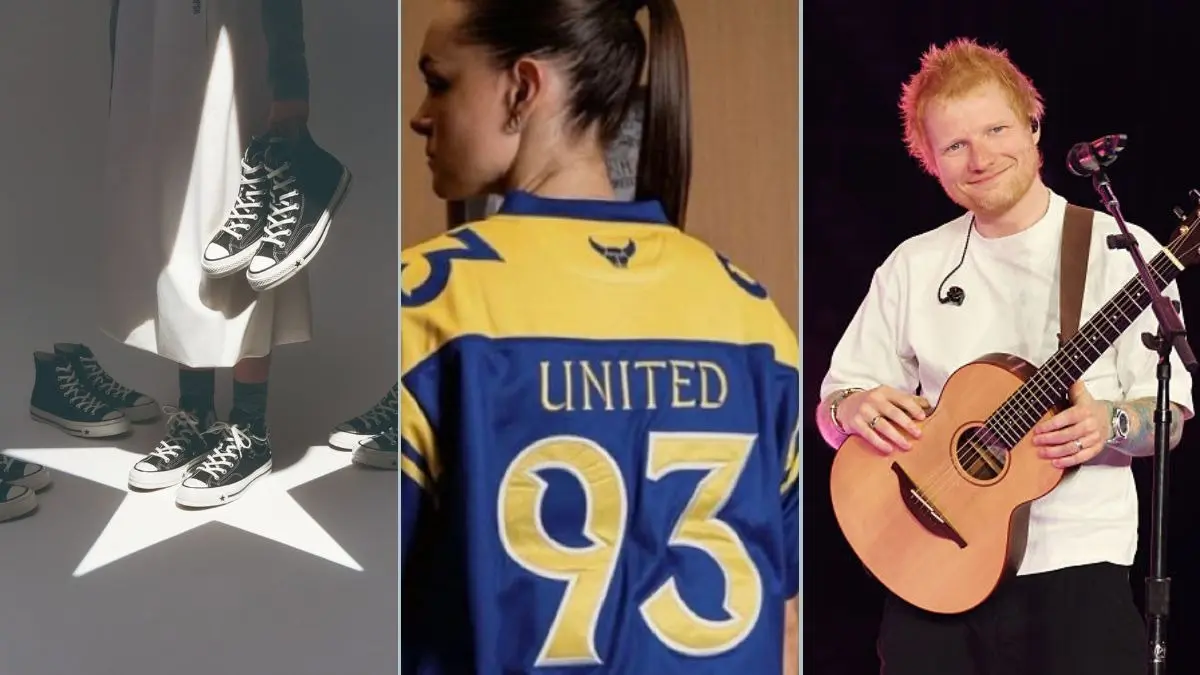
It was a remarkably difficult week for Converse. On September 3, the Nike-owned footwear giant rolled out a fresh digital marketing campaign on social media for its Chuck 70 X sneaker. The campaign was built around Karina, a prominent singer from the internationally renowned K-pop group aespa. In the campaign’s key promotional image, the pop star stood gracefully in a long white skirt, wearing the signature shoes while holding a second pair in one hand. She was artfully framed by a spotlight cut in the precise shape of the Converse star logo.
For two weeks, the campaign circulated without incident. Then, a social media user took a closer look and noted that the edge of the star projected onto her skirt bore a passing resemblance to a Ku Klux Klan hood. Concurrently, observers pointed out that the sneakers hanging loosely from her hand could be visually interpreted in a more sinister, bodily context. Shortly thereafter, a second promotional image surfaced, originating from Converse Malaysia. This secondary photo featured models standing on a ladder while reaching upward for sneakers strung delicately from a tree branch.
On the internet, these disparate visual elements were rapidly welded together into a singular, damning verdict. Converse, critics declared online, was running "the most racist ad of the season." The creative work was labeled "shocking," "abhorrent," and "repugnant." Commentators argued that even if the visual associations were entirely unintentional, the mere fact that the imagery had bypassed layers of legal, marketing, and corporate leadership review constituted an unforgivable institutional offense.
Converse moved swiftly, issuing a public apology within a day, pulling the campaign assets from all platforms, and promising to do better. For many, however, a corporate mea culpa was not nearly enough. Louisiana Congressman Troy Carter seized on the controversy, expressing profound outrage over the visuals.
"Lynching is not a creative concept. The Ku Klux Klan is not an aesthetic," Congressman Carter stated, condemning the rollout. "This campaign should never have been created, approved, or released." He added that Nike and Converse owed the public a transparent explanation of how such images had managed to pass through their internal approval processes unchecked.
If one steps back from the heated online rhetoric, a simpler reality emerges. It strains credulity to think that a Korean photographer, shooting a Korean pop star for the Korean consumer market, was intentionally evoking American history related to the Ku Klux Klan. The resemblance was an accident of angles, lighting, and digital interpretation. The instant the claims were raised, Converse apologized and removed the work entirely.
This sequence of events prompts a fundamental question that none of the participants in the online pile-on bothered to ask: What else was Converse realistically meant to do in that situation?
Ultimately, it made no difference. A perceived wrong had been committed, and public offense had been taken. In the digital age, intent is rendered irrelevant, and whether an accident occurred or an apology was already offered holds little weight. Penalties and public flaying must apply.
The Expanding Scope of Retroactive Offense
The exact same script played out in England around the same time, this time involving Oxford United, a professional football club currently competing in the third tier of English association football. Founded in 1893, the club recently sought to celebrate its long history by releasing a new range of American college-style athletic clothing. The merchandise featured the word "UNITED" boldly across the shoulders and a large "93" beneath it, a direct nod to the club’s founding year.
The collection went live on September 11.
Almost immediately, someone within the organization recognized an unfortunate visual overlap: what a "United 93" shirt signifies to the public consciousness on the anniversary of the September 11 terrorist attacks. Realizing the harrowing association, the club pulled the entire range of clothing and the accompanying promotional social media posts within two hours. That swift action should have marked the end of the matter.
It was not. Within a week, the football club was being scrutinized on major international news and sports networks, including CNN, ESPN, and The Washington Post, forcing the organization to issue a full confession and deep apology. In a statement, the club acknowledged that the shirts "should not have reached the point of sale and we take full responsibility for not undertaking proper due diligence."
Once again, no one suggested that the oversight was deliberate. Once again, the mistake was identified and fixed within hours of publication. Yet, an exhaustive, public penance was still demanded and exacted.
Then There Is Ed Sheeran
On a Saturday night in Philadelphia, British singer-songwriter Ed Sheeran delivered perhaps the most extreme entry in this burgeoning cultural genre: a public apology for something he demonstrably did not do.
Standing before a crowd of 60,000 fans before playing a single note of his set, Sheeran addressed the audience directly. "I am making mistakes and I’m so, so sorry," he told the stadium.
He was offering penance for a supporting rapper’s political stances, a stadium owner’s policy bans, and a promoter’s logistical decisions—none of which were his own doing—to an audience that had simply purchased tickets to hear his music. An artist who has spent his entire professional career carefully steering clear of divisive political issues suddenly found himself thrust directly into the middle of one of the most intractable debates on earth. Through no fault of his own, he found himself standing on stage apologizing for circumstances outside his control.
These incidents highlight a difficult reality of the current cultural moment. The combination of modern crisis management, the extreme fragmentation of media culture, and the insidious, amplification effects of social media have turned the decade into an unpleasant, sanctimonious environment. In this space, the only available option for innocent parties is to consume humble pie accompanied by intensive reputational rescue strategies.
Converse set out to offend no one, and when an accidental offense occurred, it made amends on the very same day. Oxford United made an unfortunate, unintentional mistake, fixed it immediately, and then apologized profusely anyway. Ed Sheeran simply wanted to perform his music for fans, but found he had to first apologize for controversies he did not cause and did not fully understand.
Real harm, when deliberately inflicted, certainly deserves an unreserved apology and tangible consequences, and corporate brands that drag their feet deserve the criticism they receive. However, an accidental mistake with no malicious intent behind it deserves a simple, straightforward correction. That should be the beginning and the end of it.
"We’ve withdrawn it" should stand as a complete, sufficient sentence. It does not require corporate boilerplate like "we understand" or promises that "we’ll do better." It simply requires everyone to take a collective breath and calm down.