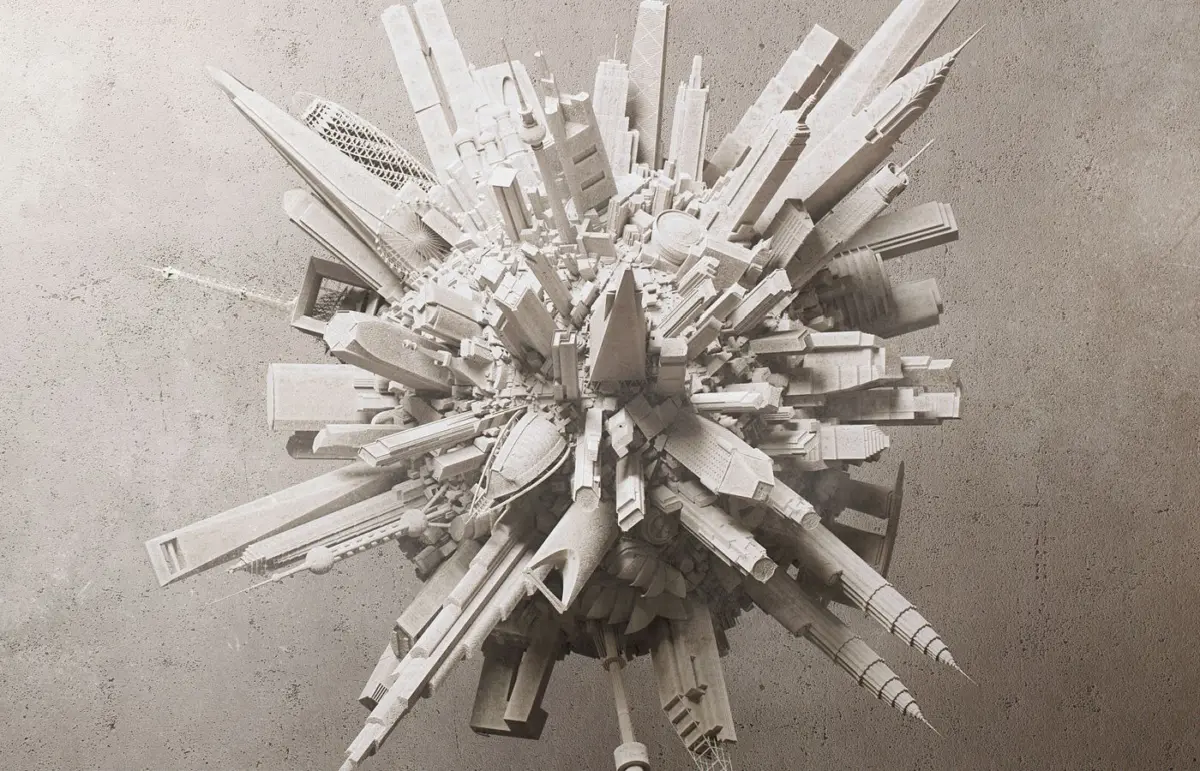
Cities used to grow by sheer accident. For most of human history, a settlement’s location usually made pragmatic sense—often established on a defensible hill, an island, near extractable resources, or at the confluence of major transport routes. But what happened next was almost entirely ad hoc. People who worked in the local fort, mines, port, or warehouses needed places to eat, sleep, and worship. Essential infrastructure threaded through the daily hustle and bustle—water networks, sewage systems, roads, trolleys, gas lines, and electricity—in vast networks of improvisation. While planned exceptions existed, such as Alexandria, Roman colonial towns, specific districts in major Chinese cities, or Baron Haussmann’s sweeping redesign of Paris, urban expansion was largely defined by happenstance, luck, and the layering of new structures directly on top of the old.

At least, that is the way things worked for centuries. Around the second decade of the 20th century, however, everything changed. Cities started to happen on purpose. Beginning with New York City’s landmark zoning laws in 1916, urban development began to occur by commission rather than omission. Laws and regulations dictated the shape of the architectural envelope, and functional decisions increasingly determined aesthetic outcomes—though not always for the best.

Fast-forward to the present day: roughly a century after human beings first began putting concerted thought toward designing cities as cohesive wholes, urban planning is entering a golden era. High-tech materials, sensor networks, new scientific insights, and better data are empowering architects, designers, and urban planners to work smarter and with unprecedented precision. Consequently, global cities are becoming more environmentally sound, more vibrant, and more visually striking. This evolution comes none too soon, as a majority of the human population now lives in urban centers rather than rural areas.

In this year’s design issue, we explore the stories behind some of the world’s most ambitious urban projects, ranging from the intricate details of a new streetlight to a sacred city in flux, from masterful museums to infrastructure specifically engineered for bicycles and the complex algorithms that run it all. The cities of tomorrow may still self-assemble haltingly, but when done right, the process is no longer accidental. A city should no longer simply happen on its own; every block, every building, and every brick represents innumerable deliberate decisions. Decide well, and cities become a form of magic.

Los Angeles Embraces Connected LEDs, Elite Airport Lounges, and Drought-Resistant Landscapes
Los Angeles is currently retrofitting 4,500 miles of orange-yellow sodium-vapor streetlights with a moonlight-hued matrix of energy-efficient light-emitting diodes. While roads will appear noticeably brighter, they will also become deeply connected. Every single lamp links wirelessly to the Bureau of Street Lighting, transmitting real-time operational data back to headquarters to indicate whether the light is functioning normally, turned off, or broken. Looking ahead, city officials envision lights that dynamically change in response to their immediate environment—perhaps blinking to signal the approach of an emergency vehicle or brightening to aid pedestrians leaving a stadium after a major sporting event. While other cities worldwide deploy LEDs primarily to save money or add splashes of color, LA aims to build a comprehensive network that communicates the status of the entire urban landscape.

Meanwhile, Los Angeles International Airport is undergoing an $8 billion overhaul to modernize everything from passenger concessions to moving walkways, following a year that saw over 70 million travelers navigate its terminals. Delta Air Lines contributed $229 million to completely rework Terminal 5, introducing the exclusive Delta One lounge—a private, high-end sanctuary catering to celebrities and affluent fliers that hints at a more organized, less dehumanizing future for air travel. Travelers are greeted curbside by an attendant who verifies their identity in a velvet-rope style before directing them to a private lounge. When boarding time arrives, Delta escorts passengers up a private elevator and through a dedicated corridor straight to the front of the line at priority security. Returning travelers can even opt for VIP Select service, receiving a chaperone directly to the tarmac where a hybrid Porsche whisks them across the airfield and out to Century Boulevard.

To combat California’s severe drought, landscape architects across LA are also ditching thirsty turf and imported flora in favor of native, drought-resistant plants. This emerging aesthetic—dubbed "California Dry"—relies on creative textures and shapes, replacing traditional lawns with decomposed granite, mulch, rocky pathways, and architectural succulents like foxtail agave and echeveria, softened by native perennial plants that add color and visual depth.

Art is also taking to the streets in unconventional ways. Hopscotch, a mobile opera set across 24 limousines and SUVs driving through downtown Los Angeles, places audiences knee-to-knee with performers. Over its multi-week run, the vehicles follow three distinct routes that trace a narrative of searching for a lost love, while actors and dancers equipped with wireless microphones perform on sidewalks and passing cars, seamlessly blending high art with the everyday choreography of city life.

Shanghai’s Spiral Museum Bridges Past and Present
While Shanghai has spent recent years thrusting forests of towering skyscrapers skyward, its new Shanghai Natural History Museum takes the opposite approach. Located in a park near the Pudong financial district, the building spirals downward into the earth like an archaeological excavation of the city’s pre-urban roots. A central courtyard, inspired by the traditional water gardens of Suzhou, honors the reverence ancient Chinese culture placed on natural beauty, while a honeycombed glass wall reminiscent of plant cell structures floods the interior with natural light.

Architect Ralph Johnson of Perkins+Will drew inspiration from the nautilus shell for the building’s geometry, a design choice that also serves a vital crowd-control function. Because Chinese museums frequently experience heavy attendance, the descending architectural ramps naturally steer crowds through a chronological tour of life on Earth. Along the way, visitors encounter roughly 11,000 specimens, including a towering Mamenchisaurus skeleton and fauna native to Shanghai’s vanishing wetlands. Modern green climate and water systems, including the courtyard pool that assists in cooling the building, ensure that the museum honors the city’s exuberant futurism while anchoring its inhabitants in natural history.

Medellín’s Cable Cars and Library-Parks Unify a Fractured City
Nestled high in an Andean valley, the Colombian city of Medellín faced severe urban divides during the 1990s, when drug gangs and guerrilla fighters controlled the narrow, steep streets of the hillside comunas where many of the city’s poorest residents lived. As violence subsided, residents confronted a major logistical barrier: severe geographic isolation made commuting to economic opportunities exceptionally difficult.

To knit the fractured city together, then-mayor Luis Pérez proposed an innovative transit solution: cable cars. Rather than navigating perilous, winding hillsides, residents could board a gondola and soar directly to a formal metro station. The first Metrocable line debuted in 2004, instantly providing underserved populations with reliable access to downtown jobs and education. As citizens from all socioeconomic backgrounds began utilizing the cable cars, crime plummeted in connected neighborhoods, and public investment flourished.

Former urban projects director Alejandro Echeverri expanded upon this momentum by introducing architectural investments to low-income neighborhoods, most notably through a network of five striking "library-parks" surrounded by public greenery. By pairing dignified public transit, beautiful architecture, and community-driven street-level improvements such as new trees and upgraded schools, Medellín fundamentally transformed its urban fabric. Grassroots efforts have further empowered residents, with community activists like artist Daniel Felipe Quiceno—known as Perrograff—leading neighborhood walking tours of vibrant murals that honor local history and memorialize victims of past violence, cementing a culture of collaborative urban renewal.

Eindhoven’s Hovenring Lifts Cyclists Above Traffic
Eindhoven transitioned from a quiet provincial town into a vibrant European technology and research hub after the Philips family began manufacturing lightbulbs there in 1891. As thousands of workers began commuting from sprawling suburbs, the city’s busy intersections became increasingly hazardous for cyclists. To address this, Eindhoven commissioned design firm ipv Delft to build the Hovenring, an $8 million suspended cycling roundabout completed in 2012.

Rather than treating bicycle infrastructure as an afterthought, the 1,000-ton steel deck is suspended by 24 steel cables from a towering central pylon and illuminated by dramatic LED light panels that pay homage to the city’s lighting heritage. By lowering the roadway beneath the intersection, engineers maintained gentle, effortless approach ramps, creating a dedicated aerial transit space that safely elevates thousands of daily commuters above heavy automotive traffic.

Saudi Arabia Prepares for Millions of Pilgrims in Mecca
Every year, the population of Saudi Arabia swells by three million people during the hajj, the sacred Islamic pilgrimage to Mecca. To manage these immense surges safely, the Saudi government has continually enlisted world-class architects to upgrade infrastructure while honoring religious traditions. At King Abdulaziz International Airport, the 2.8-million-square-foot Hajj Terminal features massive Teflon-coated fiberglass roofs inspired by traditional Bedouin tents. Natural ventilation keeps the open-air waiting areas comfortable even when exterior temperatures reach extreme highs.

To manage the massive accumulation of waste generated during the gathering, a pneumatic waste management system moves up to 600 tons of trash daily through a network of underground tubes at speeds of 40 miles per hour. Meanwhile, expansion efforts at the Masjid al-Haram—the Great Mosque surrounding the Kaaba—have introduced multi-level platforms designed by Gensler to double pedestrian capacity without compromising the emotional and spiritual experience of the pilgrims. Additional interventions include the massive, fire-resistant tent city in the Mina Valley, complete with dedicated medical facilities, and the multi-level Jamarat Bridge, engineered with dedicated exit ramps to streamline the ritual stoning of the pillars and prevent dangerous crowd bottlenecks.

Nairobi Organizes Its Matatu Network Through Digital Mapping
Transportation in Nairobi relies heavily on matatus, a fleet of privately run, vibrant minibuses known for their loud music and disco balls. While cheap and plentiful, the ad hoc nature of the network historically meant that schedules changed unpredictably, making route planning a risky guessing game for commuters.

A research collective known as Digital Matatus resolved this issue by deploying local university students with smartphones to track routes and stops using GPS technology. Publishing a clear, subway-style map of over 100 routes—and successfully integrating Nairobi’s informal transit system directly into Google Maps—the project transformed urban mobility. The digital mapping provided much-needed predictability and safety for daily commuters, particularly women traveling after dark, while establishing a powerful framework for integrating informal transit networks in cities across the globe.

San Francisco Coworking Spaces Redefine the Modern Workplace
As remote work and startup culture reshape modern employment, coworking spaces have evolved far beyond basic open-floor plans and shared desks. Companies like WeWork now operate full-service professional environments in cities like San Francisco, offering bright private rooms, carefully designed communal areas, and robust networking opportunities. By prioritizing natural light, architectural character, and operational convenience—such as handling maintenance, cleaning, and high-speed internet—these collaborative hubs offer independent professionals and growing startups the flexibility to scale without the rigid long-term lease commitments of traditional corporate real estate.

Dubai’s Turbine Interchange Solves Highway Congestion
Emirates Road in Dubai once featured a notoriously congested roundabout that forced motorists traveling at high speeds to come to a complete stop before merging. In 2006, city officials resolved to eliminate the bottleneck by replacing the outdated junction with a turbine interchange—a modern configuration originally devised in the United Kingdom during the 1960s.

Unlike traditional cloverleaf interchanges or multi-tiered stacked stacks that require up to six elevated levels, the turbine interchange utilizes a two-tier design that significantly reduces construction materials and costs. The configuration allows motorists approaching from four directions to execute any turning movement without slowing down or weaving through cross-traffic. Although turbine interchanges require a substantial amount of land—spanning nearly a third of a mile wide with 11 bridges totaling 1.5 miles—sprawling Dubai had ample space for the project. Completed in 2008 at a cost of $111 million, the Arabian Ranches Interchange successfully streamlined traffic flow, demonstrating how bold infrastructure design can harmonize high-speed transit with aesthetic simplicity.