In modern software development and user interface design, few operational tasks generate as much ongoing friction as naming. The choice of labels for design tokens, CSS classes, UI components, code variables, and platform features shapes not only how systems are built, but also how teams communicate. When product terminology is vague or inconsistent, digital teams suffer from reduced maintainability, fragmented workflows, and inflated cognitive load. Conversely, overly rigid or overly specific naming structures restrict flexibility, preventing scalable reuse across growing product ecosystems.
The challenge lies in establishing a shared language that bridges the gap between disparate organizational disciplines. Designers, frontend engineers, product managers, and end-users frequently speak different "dialects" when describing the exact same interface element. This misalignment often leads to duplicate work, miscommunication during handoffs, and UI components that fail to achieve widespread adoption. To solve these systemic inefficiencies, industry practitioners have developed structured taxonomies, open-source directories, and dedicated naming methodologies aimed at unifying digital product terminology.
Expanding Code Vocabulary Beyond Generic Syntax
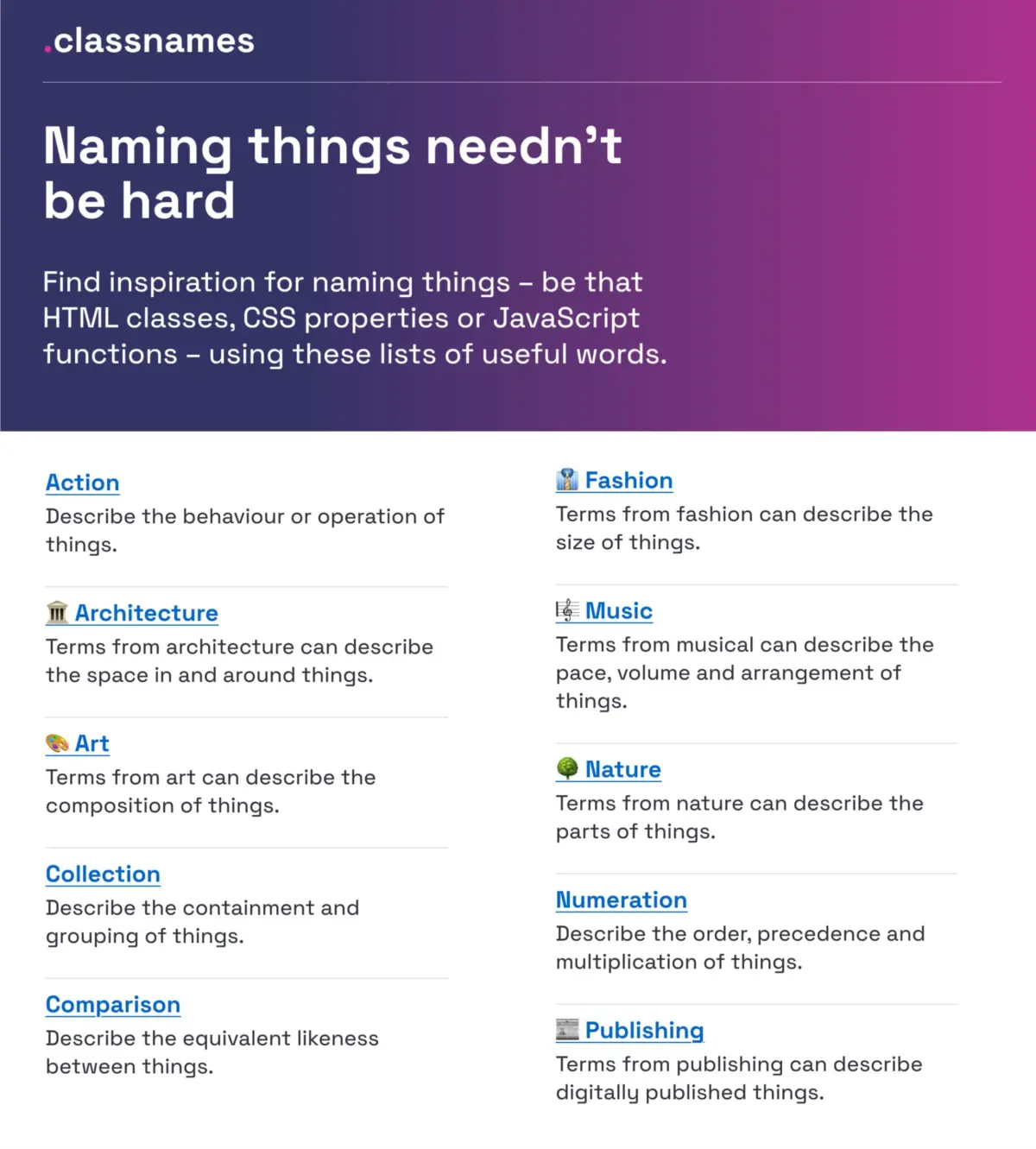
When developers construct HTML classes, CSS custom properties, or JavaScript utility functions, they often fall back on repetitive, highly generic descriptors. Labels like wrapper, container, inner, or box obscure the structural purpose of elements and lead to ambiguous codebases that are difficult to debug or maintain. To help developers break out of uninspired naming habits, software designer Paul Robert Lloyd created Classnames, an curated linguistic resource designed to stimulate thematic thinking in code architecture.

Rather than offering rigid technical templates, Classnames categorizes words into thematic groupings that inspire precise structural and conceptual thinking. The platform organizes terminology around behavior, likeness, sequential order, structural association, and spatial grouping. Beyond standard engineering terms, the resource incorporates curated word collections borrowed from diverse non-technical domains, including architecture, art, literature, theater, music, fashion, nature, and print publishing.
By drawing on established concepts from domain-driven architecture and classical design disciplines, developers can select class names that express intent more clearly. Using nuanced descriptors derived from natural or spatial systems allows teams to establish readable, self-documenting codebases that remain legible across long product lifecycles.
Resolving the Color Paradox: From Raw Values to Semantic Nomenclature
Establishing consistent naming conventions for color palettes represents another common hurdle in product design. Abstract hexadecimal values and RGB triples communicate precise visual data to render engines, but they convey zero contextual meaning to human team members. Assigning informal names like light-blue or brand-red-2 quickly creates maintenance bottlenecks when brand palettes evolve or dark modes are introduced.

To catalog and standardise the vast landscape of color terminology, developer David Aerne maintains an extensive open-source color repository containing more than 30,000 unique color names. Sourced from historical references, scientific data, and thousands of community contributions, the database pairs distinct visual shades with recognizable, human-friendly titles.
Aerne’s ecosystem includes tools like Color Parrot, an automated reference tool that assigns definitive names to arbitrary color values submitted by users, alongside interactive color pickers and search interfaces. By pairing precise hex codes with standardized visual nomenclature, teams can reduce ambiguity when constructing base color palettes. These tools provide a foundation for converting raw visual values into predictable primitive tokens before they are assigned broader semantic roles in a design system.
Structural Discipline in Design Files: Guidelines for Layers and Groups
Systemic naming issues often begin long before code is written, originating in design tools where canvas layers, frames, and component groups are created. Unstructured Figma or Sketch files—crowded with default names like Frame 402 or Rectangle Copy 12—introduce unnecessary friction during design reviews and developer handoffs.

Design system specialist Javier Cuello has outlined a comprehensive set of best practices designed to bring scalable order to digital design assets. According to Cuello, an effective layer or component name must possess a logical structure, remain concise yet meaningful, be universally understood across disciplines, and refrain from hardcoding temporary visual attributes.
Cuello’s framework emphasizes that layer names should describe an element’s functional role or structural identity rather than its current cosmetic appearance. For instance, labeling a layer based on its visual color or pixel dimensions creates immediate inaccuracies the moment the design updates. By adopting strict naming conventions for component variations, group hierarchies, and layout dimensions, design teams can build scalable UI libraries that mirror the structural integrity of production code.
Enterprise Design Token Architecture: Lessons from Intuit
For large enterprise organizations managing multi-brand product lines, naming conventions must scale beyond individual design files or single applications. Intuit—the parent company behind products such as QuickBooks, TurboTax, Mailchimp, and Mint—faced the challenge of establishing a unified design token taxonomy capable of supporting disparate brand identities while maintaining system-wide cohesion.

Design systems architect Nate Baldwin documented the evolution of Intuit’s token taxonomy, detailing how the team overhauled their legacy structures to create an extensible foundation. The initiative required addressing key vulnerabilities in older naming schemes, establishing rigorous criteria for token hierarchy, and decoupling primitive brand values from semantic usage contexts.
Intuit’s taxonomy organizes design tokens into clear tier structures, moving from basic primitive values to semantic application tokens and component-specific variables. Under this multi-tiered model, a primitive color value is mapped to a functional role—such as an interactive state or background surface—before being applied to individual UI controls. This systematic abstraction allows sub-brands within the Intuit portfolio to apply distinct visual skins without breaking the underlying structural logic or code implementation.
Interface Component Libraries and Common Architectural Patterns
When deciding what to name a newly designed user interface element, product teams often reinvent the wheel, selecting custom terms that disconnect their applications from industry norms. Looking to how established design systems define similar UI patterns offers a practical path toward intuitive nomenclature.

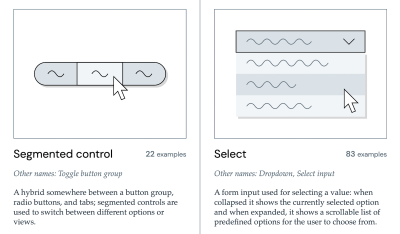
To streamline this research, developer Iain Bean created The Component Gallery, an expansive online directory that aggregates real-world interface patterns from dozens of leading design systems. Indexing more than 50 standard UI component types—ranging from simple accordions and badges to complex navigation menus and visually hidden utility wrappers—the platform serves as a dictionary for web UI patterns.
The Component Gallery displays the primary names used across different enterprise design systems while explicitly listing secondary aliases and alternative titles. By analyzing how industry design systems name similar structural patterns, teams can choose component titles that align with standard developer expectations and established web accessibility patterns. Visual utilities like Name That UI further complement this effort by providing visual reference guides for identifying standard software patterns.
Bridging the Gap in Feature Adoption: Aligning Product Names with User Vernacular
Naming challenges extend beyond backend systems and design components directly into the customer-facing user interface. A common cause of low feature adoption in digital products is poor discoverability, often driven by internal team jargon that fails to resonate with end users.
UX practitioner Erin Gannon has detailed how feature naming directly influences product adoption cycles. Before a user can regularly integrate a new feature into their daily workflow, they must first discover it, comprehend its function, attempt to use it, and successfully master it. When features are given abstract, branded, or overly engineering-centric names, users struggle to grasp their utility.
Gannon’s research demonstrates that user-centric feature names are rooted in problem-solving and task outcomes, directly signaling the feature’s underlying value or "job-to-be-done." Rather than forcing internal enterprise nomenclature onto the interface, product teams are advised to conduct user testing, asking participants to describe functionality in their own words. Adopting the exact language used by target audiences removes cognitive barriers, making new tools immediately legible and naturally discoverable.
Multi-Brand Variable Taxonomies: The Vodafone Framework
Managing multi-brand, multi-themed design systems requires robust structural orchestration. The design system team at Vodafone UK developed a public Variables Taxonomy Map to articulate the precise architecture governing their complex multi-brand software ecosystem.

Built upon design system foundational research pioneered by Nathan Curtis, Vodafone’s taxonomy breaks down the complete anatomy of design tokens and CSS variables into interconnected collections. The taxonomy map illustrates four distinct collection tiers required to sustain the platform:
- Brand Primitives: The foundational, uncontextualized raw values representing core brand colors, typography scales, and spacing units.
- Semantic Tokens: Functional abstractions that assign systemic roles to primitives, defining contextual usage like warning states, primary surfaces, or interactive text.
- Component Variables: Specific properties bounded directly to individual UI components, such as button padding or card borders.
- Page Layout Variables: Structural design decisions mapped directly to high-level page templates and application viewports.
This hierarchical chaining ensures that every design variable carries built-in contextual metadata. By inspecting the structured name of a variable, developers and designers can immediately determine its structural tier, its intended usage context, and its legacy fallback paths.
Interactive Frameworks for Token Builders and Inventories
To simplify the process of establishing custom token taxonomies, design system strategist Romina Kavcic developed the Design Token Naming Guide + Builder. The interactive resource assists product teams in designing custom naming structures by configuring combinations of components, categories, functional roles, and interaction states.

Complementing the builder tool, Kavcic’s Design Token Names Inventory provides a structured spreadsheet framework based on a clear four-level taxonomy model. This organizational system gives design operations teams a unified overview of their entire token inventory, allowing them to introduce new visual themes, dark mode variants, and platform-specific overrides without breaking structural naming rules. By filtering tokens by role, component, or state, teams can audit their systems for duplicate entries or naming conflicts before pushing code updates to production environments.
Strategic Naming for Digital Products and Ecosystem Services
At the macro level, naming digital products, standalone micro-services, or corporate sub-brands requires a blend of linguistic strategy, brand positioning, and legal verification. To aggregate resources for broad brand naming initiatives, the open-source directory Onym organizes naming tools, frameworks, and reference materials into a centralized knowledge base.
Onym categorizes tools suited for systematic brainstorming, brand vetting, linguistic etymology, naming sprints, and trademark searches. It also compiles historical case studies, industry guidebooks, and cautionary examples highlighting brand naming failures. Utilizing structured ideation frameworks allows organizations to select brand and service names that remain memorable, legally defensible, and adaptable as corporate software portfolios evolve.

Harmonizing Cross-Functional Dialects for Long-Term System Health
Ultimately, the goal of any naming strategy is to reduce friction and build a clear, unambiguous operational language shared by designers, engineers, product leaders, and end users. When digital product adoption suffers or developer handoffs result in frequent miscommunications, the root cause can often be traced back to mismatched terminology across functional silos.
Addressing naming technical debt requires continuous monitoring. Teams that proactively track terminology conflicts, align component libraries with web standards, and ground product feature labels in authentic user language build more scalable and resilient software systems. Establishing thoughtful naming conventions is an essential investment that streamlines internal collaboration and delivers more intuitive user experiences.