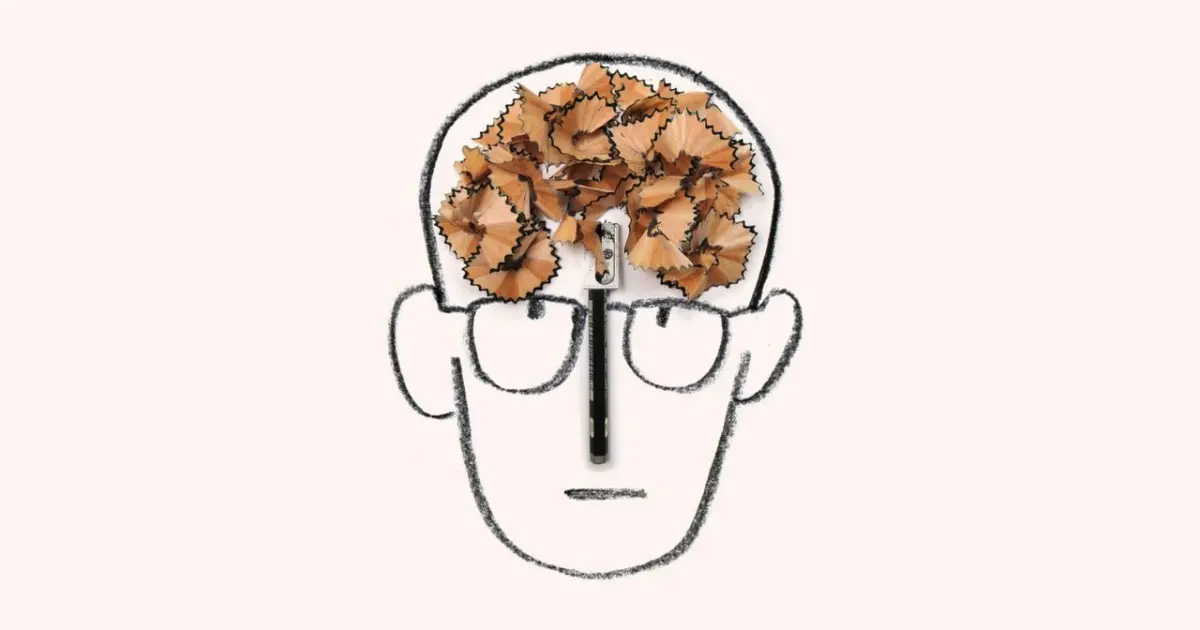
For years, renowned illustrator and artist Christoph Niemann dedicated his weekends to a deceptively simple yet brilliant visual experiment. Sitting down with a blank piece of paper and a random, everyday object from around his house, Niemann never knew what he was going to draw. The only rule was that his final illustration had to incorporate whatever ordinary item happened to be resting in front of him. Through this playful weekly ritual, ordinary spare change transformed into towering scoops of melting ice cream, ordinary bananas morphed into the muscular legs of a galloping horse, and everyday highlighters suddenly crackled with the glowing energy of science-fiction light sabers.

Over the years, Niemann devised hundreds of these clever visual puns, pushing the boundaries of perspective and imagination. Now, he has collected these whimsical experiments—alongside a broader retrospective of work spanning his illustrious career—in his new monograph, Sunday Sketching. Published by Abrams, the book functions simultaneously as a comprehensive showcase of Niemann’s diverse illustration portfolio and as a deeply reflective meditation on the realities of the modern creative process.

Throughout the pages of Sunday Sketching, Niemann relies on his signature style of minimalist drawings and a charming, self-deprecating breed of humor to tackle notoriously tricky subjects that most artists prefer to keep hidden. He addresses the heavy burdens of professional insecurity, the uncomfortable relationship between art and money, and the terrifying necessity of changing course in a career even when things appear to be going remarkably well. The book serves as a timely, grounded reminder that even the brightest and most successful creative minds in the industry face constant, grueling challenges when trying to produce consistently great work in a rapidly shifting media landscape.

The Fine Line Between Good and Great Work
In his book, Niemann candidly addresses the romanticized myth of the tortured artistic genius, arguing that traditional craft and rigid daily routine are far less glamorous, but infinitely more effective tools for professional survival. Relying on sheer discipline, he notes, is an excellent strategy for keeping oneself from going entirely insane in an unpredictable profession.

According to Niemann, even in the complete absence of innate talent or fleeting moments of divine inspiration, an artist can—through sheer, repetitive practice—become so fundamentally proficient at their craft that they can reliably and consistently deliver very good work. However, crossing the chasm from "very good" to "great" is an entirely different challenge altogether.

While achieving true greatness certainly demands an exceptional baseline of skill and mastered craft, Niemann points out that it ultimately requires a mysterious X-factor that simply cannot be controlled or engineered. Once an artist truly accepts this humbling reality, he writes, daily professional life actually becomes a great deal easier. For clients commissioning commercial art, Niemann offers a practical piece of advice: all that anyone can reasonably ask from an artist is very good work, because true, generational greatness is inherently unplannable.

The Dangers of Blind Specialization and Industry Disruption
This intense dedication to mastering a specific craft, however, carries a quiet, hidden danger. By pouring all of one’s energy into perfecting a particular skill set, an artist runs the risk of becoming dangerously blindsided by shifting cultural tides. Niemann compares this phenomenon to a dedicated chef who spends night after night tirelessly perfecting the ultimate hamburger, completely unaware that the entire culinary world has suddenly transitioned to a vegetarian diet.

This professional vulnerability is compounded by the staggering structural shifts currently reshaping the media and publishing industries. Many of the prominent magazines and print publications that, just a few short years ago, employed scores of dedicated art directors and fed entire armies of freelance illustrators have completely vanished from newsstands, while others have been downsized to a mere fraction of their former operations.

While industry observers often frame this upheaval as a natural evolution of modern commerce, Niemann emphasizes that the sheer speed and swiftness with which these tectonic shifts have destroyed legacy businesses and radiant careers remain genuinely terrifying. Furthermore, this ongoing revolution is far from over and is widely expected to continue at an ever-accelerating pace. For working illustrators navigating this volatile terrain, adapting requires a careful balance of financial pragmatism and artistic resilience.

Building a Financial Safety Zone
Right now, Niemann admits he finds himself blissfully busy with commissions and projects, yet he remains acutely aware that the proverbial party can come to an abrupt halt at any moment. The only reliable way to ensure that his work remains genuinely in demand is to focus relentlessly on executing high-quality creations. However, maintaining that level of focus is difficult under the best of circumstances, and it becomes virtually impossible when an artist is simultaneously consumed by acute financial anxiety.

Allowing considerations about tight budgets and looming monetary pressures to creep into the studio while working is, in Niemann’s view, absolute creative poison. Throughout his career, he has steadfastly avoided working with rigid time sheets or hourly tracking. Dreaming up compelling, original ideas is fundamentally inefficient; whether a conceptual breakthrough requires five hours of sketching or fifty hours of refinement has virtually no bearing on the final quality of the artistic outcome. Yet, completely ignoring financial realities is simply not a viable option for a working professional either.

To grant himself the mental breathing room required to think creatively, Niemann found that he had to deliberately construct a financial safety zone. He regularly calculates exactly how much money he needs to cover his baseline expenses each month, noting that these figures remain surprisingly consistent over time. As a matter of strict policy, he attempts to maintain at least six months’ worth of living expenses safely stashed away in a bank account.

If a catastrophic professional or personal crisis strikes, this cash buffer provides him with a crucial cushion of several months to figure out his next move. While achieving and maintaining this financial cushion is far from easy, Niemann has found that it yields profound repercussions on the overall quality of his daily work. Having this security affords him two critical luxuries: the ability to routinely turn down commercial assignments that prove to be a poor fit, and the empowering knowledge that he can afford to walk away from any job entirely—a drastic step he has taken only a couple of times throughout his entire professional career.

To keep his anxiety in check, Niemann dedicates time once a month to inspect his accounts, evaluating whether he is financially secure to keep pushing forward or if he needs to reevaluate his trajectory. Life remains fundamentally unpredictable, and he confesses that he is not always able to flawlessly maintain this conservative system. Worrying about money is inherently stressful, and because that fear and desperation inevitably bleed into an artist’s output, Niemann views financial prudence not as a glamorous trait, but as an uncool yet utterly crucial pillar of his artistic practice.

Navigating the Echo Chamber of Social Media
Beyond financial logistics, Niemann frequently grapples with the more complex and elusive questions surrounding the long-term creative direction of his career. While he must remain kind, gentle, and forgiving toward his own fragile ego during the messy initial stages of creation, he also recognizes the necessity of periodically stepping back to evaluate his entire body of work through the unsparing lens of an outsider.

He routinely asks himself difficult questions: Is his work merely devolving into shallow pandering aimed at pleasing a crowd? Is he actually taking genuine creative risks? Is he maintaining a meaningful connection with the broader cultural conversation happening outside his studio walls, or is he simply quick to blame his audience whenever a piece happens to fall flat?

Judging one’s own creative output is notoriously difficult, and remaining fully aware of what one is doing right can prove even harder. A decade ago, Niemann could only hash out these heavy existential questions with a tight-knit circle of trusted friends and industry colleagues. While those peer relationships remain vital when tackling specific creative roadblocks, those colleagues can never look at his work with the utterly fresh, unbiased eyes of an absolute stranger.

The advent of social media, however, fundamentally transformed this dynamic. Today, Niemann can take any piece of work—whether it is a polished, finished illustration or a rough, spontaneous experiment—and instantly gauge how real-world readers and viewers react to it. With the tap of a button, he can get a relatively swift pulse on whether the public deems an idea valuable or entirely forgettable.

At the same time, Niemann harbors no illusions about the psychological trap embedded within digital validation. Anyone who claims they are entirely immune to the dopamine hit of a post receiving a flood of "likes," or who insists they feel zero insecurity when a piece of content bombs entirely, is simply not telling the truth. Having built a career that long predates the rise of Facebook, Twitter, and Instagram, Niemann remembers what it felt like to create art in relative isolation with barely any immediate reaction from an audience. Consequently, he views social media as a fascinating, and perhaps indispensable, modern tool.

Yet, he issues a sharp warning about the underlying architecture of these digital platforms. Social media algorithms are brilliantly and ruthlessly designed to exploit human vanity and deep-seated insecurity, making it dangerously tempting for creators to unconsciously equate algorithmic metrics like likes and favorites with true artistic quality. Online approval, even when it swells into viral success, is ultimately far too superficial and fleeting to serve as a genuine metric of creative value. While Niemann admits he is naturally thrilled when a piece generates a massive public response, he reminds himself that internet cat videos and hollow listicles achieve the exact same viral scale—ultimately leaving viewers feeling emotionally bloated and intellectually empty. In an overwhelming ocean of rapid, frictionless digital reactions, creators must actively remind themselves that profound art is frequently slow, strange, and quietly nagging.

Striking the Balance Against Fads and Stagnation
As digital platforms continue to proliferate—moving fluidly from Twitter and Instagram to newer formats like Snapchat and Vine—Niemann frequently faces a wearisome dilemma. At what point does an artist throw up their hands, scream for the frantic pace to stop, and declare that they are deliberately ignoring all emerging technological fads just to focus purely on making art? He deeply admires historical artists who possessed the bold determination to ignore short-lived cultural trends and pursue their visionary paths with unwavering focus.

Conversely, Niemann is equally haunted by cautionary tales of creators who stubbornly refused to adapt at all. He vividly recalls being a student in the late 1990s, engaging in heated debates with peers who adamantly insisted that professional designers would never truly need to operate computers, convincing themselves that the whole digital revolution was merely an overhyped fad that would quickly blow over.

Ultimately, Niemann recognizes that leaning too hard into the identity of a rebellious maverick can easily become a convenient excuse. Just because a commercial client rejects a sketch, or a piece of art fails to generate traction on social media, it does not automatically mean the creation is an unappreciated masterpiece ahead of its time.

Sometimes, as Niemann candidly concludes, a bad drawing is simply just bad.

Sunday Sketching by Christoph Niemann is published by Abrams and is available now through major booksellers.