Walk down any street in New York City today, and your likeness will be captured on camera dozens of times before you even reach your destination. You will pass security cameras affixed to building facades, peer out toward lenses mounted on traffic lights, and descend into subway platforms where more than 4,000 closed-circuit television cameras track your every move. There are security gadgets planted discreetly in elevators and lobbies, humming quietly in coffee shops and convenience stores, all of which keep a watchful, unblinking eye on the urban populace.
Multiply this local phenomenon across the entire nation, and the scale becomes staggering. An estimated 62 million security cameras monitor the United States alone, meaning that at any given moment, you are probably being watched, recorded, and cataloged without even knowing it. It functions almost like a modern, dystopian version of Hansel and Gretel, where everywhere you go in the contemporary public square, you leave a trail of digital breadcrumbs in your wake—pixels, data points, and video frames that trace your path.
For the most part, we rarely see or consciously think about these cameras as we go about our daily routines. They have faded into the visual background of modern life, accepted as an inevitable byproduct of urban security and commerce. However, a compelling exhibition at New York City’s Park Avenue Armory attempts to shatter that complacency by putting the surveillance state overtly on display.
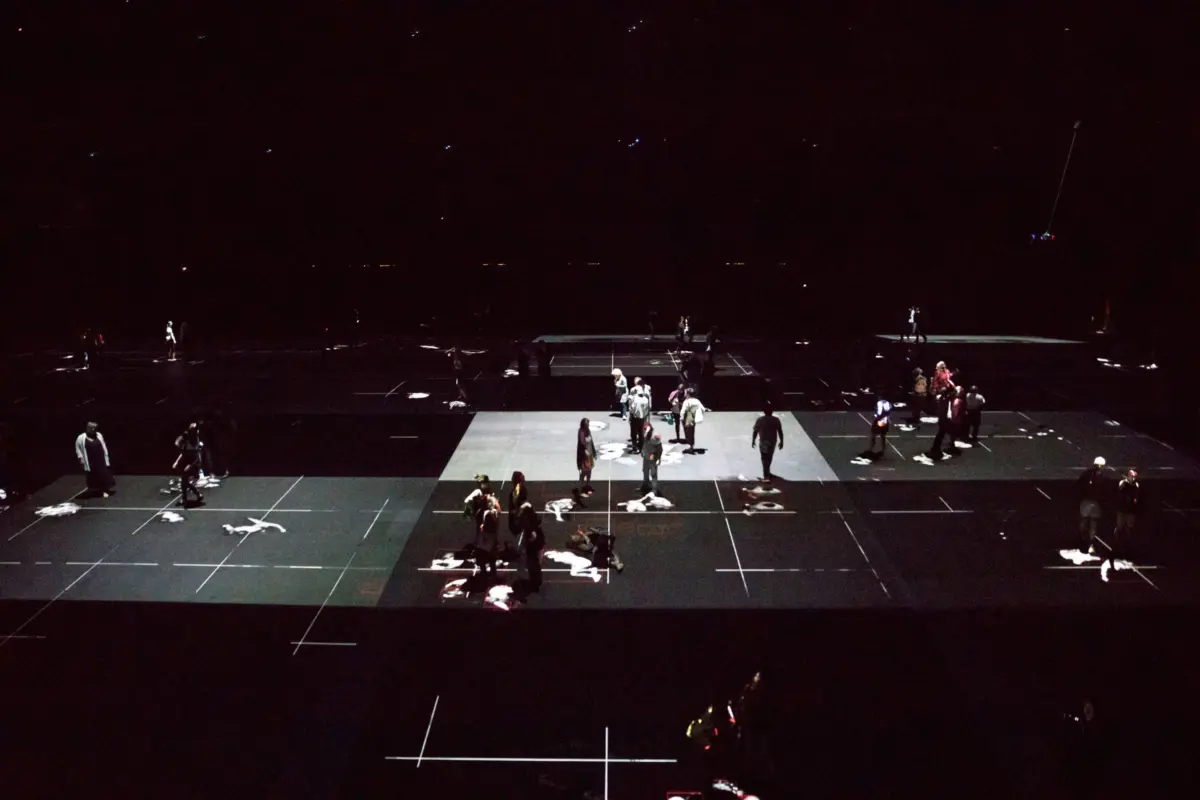
For an ambitious collaborative project titled Hansel and Gretel, artist Ai WeiWei and Swiss architects Jacques Herzog and Pierre de Meuron transformed the Armory’s cavernous drill hall into an immersive, interactive surveillance park. Rather than hiding the machinery of observation, the creators brought it out into the open. A series of 56 tiny computers, attached to high-tech infrared cameras and powerful projectors, hang precariously from the industrial rafters high above the floor. Meanwhile, a handful of tethered drones buzz ominously overhead, sweeping across the dark space, capturing real-time footage of the visitors below, and feeding that video directly back into a live public stream.
As visitors wander through the cavernous, darkened room, the overhead cameras instantly capture their likeness and cast ghostly, transient renderings directly onto the floor beneath their feet. A complex grid of projected red boxes and bright white lines frames each individual person in real time, serving as an unspoken, hard-hitting acknowledgement of technology’s modern ability to precisely pinpoint, track, and analyze your physical location down to the square foot.
“It’s the physicalization of surveillance,” says Herzog, who alongside de Meuron and Ai aimed to construct an environment that mimics an interactive surveillance state. The core concept behind the installation is straightforward yet profound: people should see firsthand, in a visceral and unavoidable way, the exact kind of sophisticated technology that tracks, monitors, and records them on a daily basis in the outside world.
Surveillance on Display
Watchdog technology has proven to be a remarkably rich area for contemporary artists to mine, largely because it occupies a strange dual space in modern society: it is simultaneously so pervasive that it dictates our movements and so invisible that we completely forget it is there.
When artists encounter this invisible architecture of control, the knee-jerk, traditional response is often to use it as a tool to elicit shock—employing a clever bait-and-switch technique that eventually reveals the delayed, unsettling truth that something has been watching you all along without your knowledge or consent.
With Hansel and Gretel, however, the artists deliberately sidestepped that familiar trope. Instead of relying on stealth or surprise, they made the technology an overt, undeniable component of the entire visitor experience. The absolute fact that you were being monitored was no secret from the moment you stepped into the drill hall, a design choice that paradoxically made it easy for visitors to work the technology directly in their own favor.
All around the vast hall, people paused for eerie, futuristic photo shoots, striking poses with their smartphones held high in the air as the cameras overhead snapped their pictures and instantly replicated them in glowing light on the ground below. Despite the pervasive darkness, the flashing lights, and the inherently ominous mood of the space itself, the environment felt surprisingly convivial. Rather than inducing genuine fear and deep paranoia among the attendees, the installation remarkably managed to turn the cold machinery of surveillance into an extension of everyday selfie culture.
“There seems to be an ambivalence [towards surveillance],” reflects Tom Eccles, the show’s curator, pondering the relaxed reaction of the crowds. “Maybe that’s the way the world has changed.”
After eventually exiting the main drill hall, visitors shuffle slowly toward another entrance within the sprawling Park Avenue Armory complex, where a polite usher greets them with cheerful hospitality.
“Hi there, could you put your toes on the line and look straight ahead for me?” the usher asks cordially.
Directly ahead stands another camera, this one engineered to capture a precise, straight-on headshot that, just minutes later, will be projected onto the massive digital frames that line the perimeter of the Armory’s walls. On the sleek tables positioned just below these frames, a row of iPads invites visitors to take yet another selfie. This newly captured image is immediately fed into advanced facial recognition software that rapidly searches a database for a matching image.
Within mere seconds, a familiar face pops up on the screen—the photo having been taken just moments prior in the hallway. The computer’s underlying matching software registers a rating of being 52% confident that it is indeed the visitor.
For some individuals traversing the exhibition, the startling immediacy of this automated recognition will inevitably feel jarring and uncomfortable. Yet, that initial creep factor and sense of digital exposure tends to subside remarkably fast when a simple commercial pop-up box emerges on the screen. For a fee of $10, visitors are informed, they can purchase a physical print of the photo they just generated, which is conveniently made available for purchase right inside the museum’s gift shop.