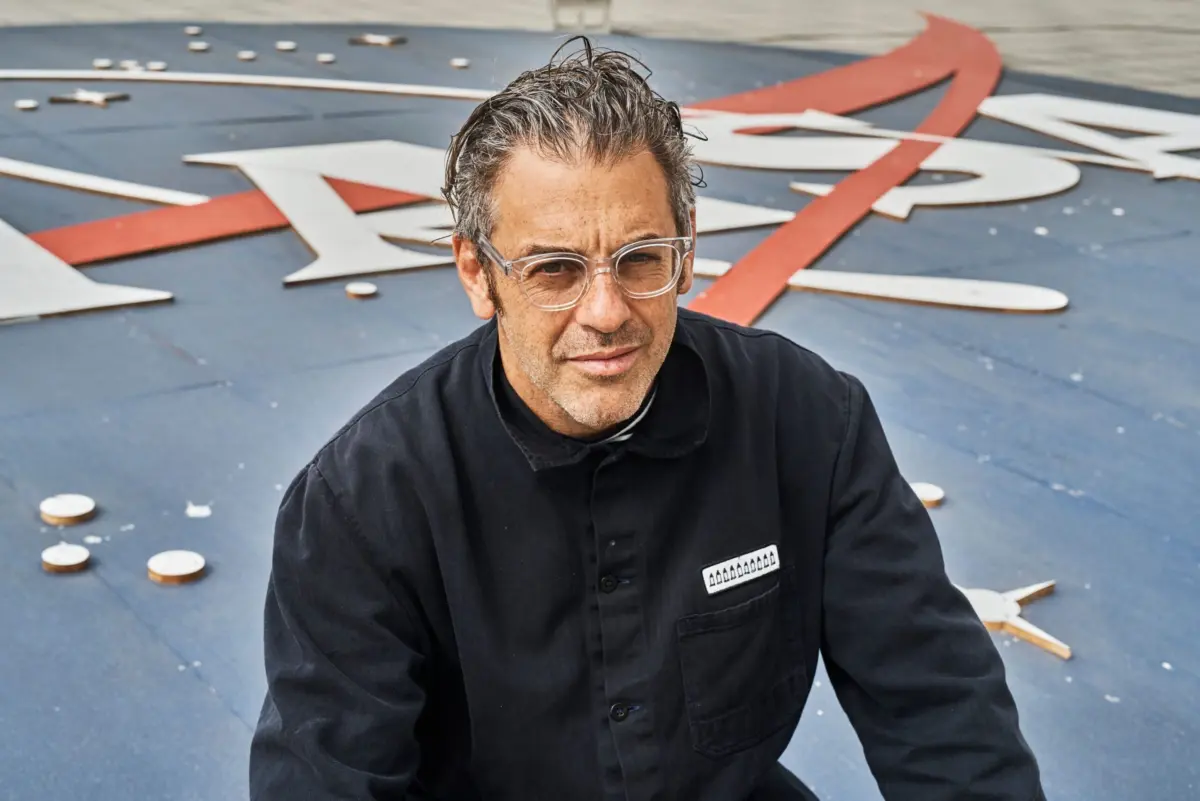
Deep in the labyrinth of a lower Manhattan workshop, every cabinet, shelf, workbench, and sorting system tells a story. The space is a warren of customized chaos, where even a lowly drill press has been heavily remade. Two machine lamps spider off its top, a specialized brush on a retracting cord sweeps away debris, and both a chuck key and a center punch cling magnetically to its face. These meticulous rituals, taken together, represent more than mere organization—they embody a philosophy of work that defines the studio of sculptor and bricoleur Tom Sachs.
Sachs defines a bricoleur as someone who cobbles together functional contraptions out of received or collected materials. A decade ago, the contemporary art world began taking notice of his provocative, rough-edged works, which have included a cardboard hand grenade housed in a mock Hermès box and a Glock pistol branded and detailed in the style of Tiffany. Today, Sachs and his dedicated twelve-person team mount large-scale exhibitions in major museums around the world, supported by a faithful following of art collectors.

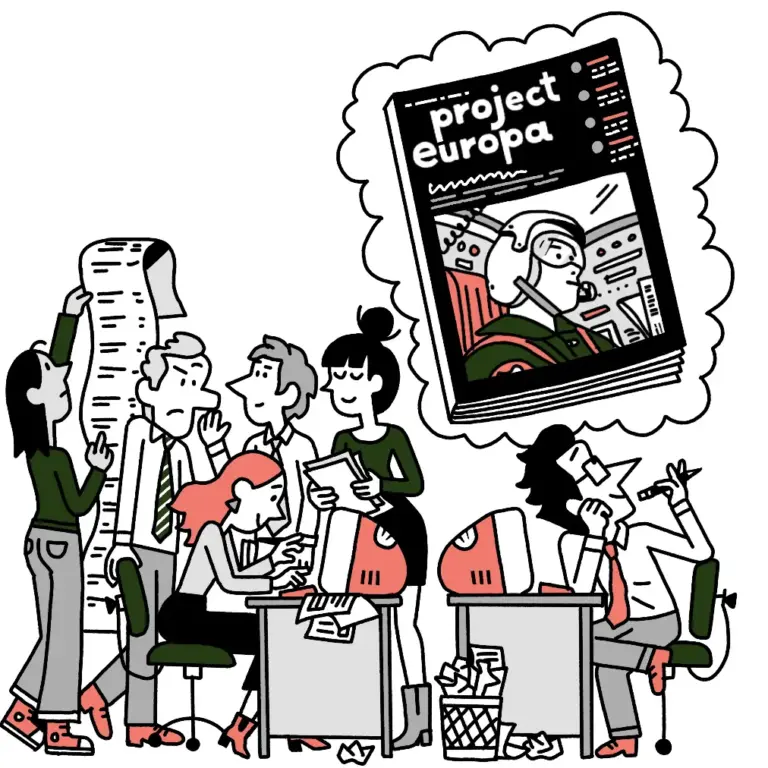
On a typical studio visit, the atmosphere buzzes with preparation for a major installation at San Francisco’s Yerba Buena Center for the Arts. The project centers on a simulated mission to Europa, the Jovian moon widely believed by scientists to harbor subsurface life, sending two "astronauts"—played by studio assistants—into a plywood mock-spaceship. It marks the third major undertaking in Sachs’s ongoing Space Program series. Amid the studio noise, assistant Sam Ratanarat works on stabilizing a utility cart that the astronauts will wheel out onto the simulated alien surface, carefully welding the titanium rods that hold the structure together.
Sachs inspects the work, praising Ratanarat’s initial weld as a stellar example of material bragging rights, though he is less enamored with their beat-up MIG welder. Meanwhile, Sachs is busy developing gear for the edgier demands of the Europa mission. While past space projects utilized modified Spyderco folding knives engraved with NASA’s iconic 1970s logo, the narrative of Europa calls for something starker.

"Europa is a mission about imperialism," Sachs explains, noting the thematic shift toward planetary exploration and abduction. "So what’s the knife of colonialism? A machete!" True to form, he is milling his own version directly from a Japanese lawn-mower blade.
With multiple concurrent exhibitions in New York and the impending launch of the Europa landing in San Francisco, Sachs stands at the peak of a two-decade career. His cobbled-together, joyful contraptions have established him as arguably the most famous bricoleur working today.

Sachs’s path to this point was unconventional. Described as a peculiar child who bought his clothes at Goodwill and had them tailored, he struggled academically as a D-minus student, battled unpopularity, and was forced to repeat the ninth grade. Eventually, he gained admission to Bennington College, where a senior named Babs taught him how to weld and introduced him to the foundational works of Constantin Brancusi and Richard Serra. Though she eventually ended their relationship, the brief encounter fundamentally altered his trajectory. She introduced him to a more complex way of working—creating political and social objects that actively participate in the rituals of daily life.
That distinct artistic vision eventually caught the attention of fellow creators, including former MythBusters host and master maker Adam Savage. After seeing a video of Sachs’s replica Lunar Excursion Module on a simulated Mars mission, Savage forwarded the link to actor Tom Hanks, a noted space enthusiast who already knew Sachs personally. Hanks connected the two, sparking a lasting friendship built on shared obsessions.

Sachs and Savage discovered a profound affinity for one another. Both are obsessive organizers who construct meticulous replicas, and both share a distinct studio quirk: when they find themselves stuck creatively, they build infrastructure like stands, shelves, and benches. Sachs has even incorporated construction techniques borrowed from television science programming into his own workflow. Today, the two makers regularly cross coasts, using each other’s workshops when traveling, with their spouses jokingly describing their relationship status as "dating."
When Savage examines Sachs’s workshop, the tools are familiar, but the true resonance lies in the rituals—the deliberate methods by which Sachs transforms prosaic, everyday objects and materials into high art. Savage spends his own time building meticulous replicas of cinematic props like the Blade Runner pistol, space suits from Alien, or the mechanical glove from Hellboy. In doing so, he is essentially communicating with his ten-year-old self, creating physical artifacts that bridge the gap between beloved cinematic narratives and reality.

When Sachs replicates objects for a gallery, he is similarly speaking to his younger self, but with a different gesture: gifting that child an endless supply of art materials and granting permission to play without restriction. While Savage tells stories through objects by layering on a patina of age and wear to mimic realistic narratives, Sachs barks his narratives directly into the construction itself. The exposed edges of plywood, visible screwheads, greasy fingerprints, and accidental tool marks remain proudly intact. The viewer always knows the object is deliberately made by human hands, establishing that Sachs’s pieces are art because his manufacturing rituals ultimately tell stories about the artist himself.
This dedication to immersive narrative and material ritual extends directly into Sachs’s public-facing projects, most notably his elaborate tea ceremonies. At the Noguchi Museum in Long Island City, Sachs constructed a teahouse out of plywood and resin to host intimate gatherings for museum donors, stepping into the role of tea master.

While classical Japanese tea ceremonies require guests to shed non-essentials like keys, coats, and shoes before donning traditional tabi footwear, Sachs’s iteration puts a distinct spin on the tradition. Guests slip into sneakers modified into makeshift sandals, and their smartphones and wristwatches are promptly locked inside a Faraday cage to sever their connection to the modern world.
The ceremony blends earnestness with subversion. Sachs methodically whisks tea powder and pours water, but the performance features non-traditional elements: guests smoke from a homemade pipe, drink sake from vessels crafted out of stacked plywood circles coated in resin, and snack on Oreos and Ritz crackers with peanut butter.

Sachs compares the multifaceted appeal of the tea ceremony to his enduring obsession with the National Aeronautics and Space Administration. Just as people are drawn to astronomy for navigation, existential philosophy, or pure hardware appreciation, the tea ceremony attracts adherents for its Zen spirituality, its sensory engagement, or its distinct architectural tradition. For Sachs, the hardware and the physical environment matter immensely, but they remain fundamentally empty without the surrounding ritual.
That emphasis on ritual and potential failure is precisely why NASA’s missions serve as a compelling framework for Sachs’s art. The agency operates as a massive, highly ritualized failure-analysis organization, constantly studying structural, personal, and organizational missteps to prevent their recurrence. Sachs’s simulated space missions embrace that same vulnerability to failure on a grand theatrical scale.

For the Europa mission, the performance incorporates layers of intricate staging. Astronauts begin in a quarantine trailer, transfer via scissor lift to the landing module, and launch via a model rocket filmed with a miniature camera at authentic NASA angles. The rocket travels along a length of yarn toward a spinning globe, setting up the most perilous phase of the mission: the landing.
If the astronaut playing the classic Atari game Lunar Lander exhausts her fuel or crashes the module, a television screen displays an actor impersonating Richard Nixon reading the contingency speech prepared in the event that the Apollo astronauts perished, bringing the performance to an immediate halt.

Success, on the other hand, allows the astronauts to exit the lander in suits cooled by backpack-mounted ice-water tanks. Guided by mission control—with Savage stepping in to direct for at least one performance—they drill through an ice-covered koi pond that doubles as the Europan sea, capturing the hidden "aliens" living beneath the surface. Though Sachs has debated the logistics of which aquatic lifeforms to feature—partially motivated by a desire to avoid criticism from animal welfare organizations regarding the astronauts eventually consuming the specimens—the elaborate mechanics remain fully committed to the bit.
Engineers and roboticists at NASA have enthusiastically embraced these projects, frequently supplying reference materials and imagery. Dave Lavery, a roboticist at the agency, notes that beneath the roughly cut plywood edges and half-worn paint lies a meticulous attention to detail, with hardware choices that can be genuinely traced back to actual spaceflight engineering. The missions are playful, but they avoid the territory of mere parody.

Executing these complex productions requires immense effort using decidedly imperfect materials. The space suits are difficult to keep cool, the mechanical hatches and switches are prone to breaking, and assembling the entire installation demands weeks of intensive labor for just a few days of live performance. Yet that friction is central to Sachs’s artistic ethos. He values the overarching philosophical questions of space exploration primarily because they fuel his drive to build things with his own hands.
"I love getting my hands dirty. I only feel good if I have a cut somewhere," Sachs says. "If I have a little burn, it means that I’m probably doing something right."

That shared dedication to physical making recently culminated in a direct collaboration between Sachs and Savage: constructing replicas of the distinctive lunch box carried by character Heywood Floyd in Stanley Kubrick’s 2001: A Space Odyssey. Savage built his version by starting with foam core to establish proportions, cutting patterns from styrene and aluminum, casting the piece in fiberglass, machining custom hinges and locks, and insulating it with Mylar bubble wrap sourced from NASA. It stands as a precise replica of the fictional prop from the narrative.
Sachs built his own version using raw plywood, exposed screws, and resin, deliberately allowing the wood grain to bleed through the white paint. Both creators built two lunch boxes and traded them.

While Savage questions whether his own meticulously engineered props qualify strictly as fine art given their functional nature, Sachs insists that they do. Reflecting on the difficulty of parting with finished pieces, Sachs offers a definitive measure of artistic success. If you cobble together everyday materials into a humble bricolage, and letting it go genuinely hurts, you have successfully made art.