By Robbie Gonzalez
July 15, 2016
Back in March, Donald Trump made a menacing and widely publicized prediction about what would transpire should the Republican Party fail to grant him its presidential nomination at the upcoming Republican National Convention in Cleveland. "I think you’d have riots," Trump warned at the time, underscoring the high stakes of the political gathering. "I think you’d have riots. I’m representing a tremendous… many, many millions of people."

With tens of thousands of individuals carrying profoundly opposing political viewpoints descending upon downtown Cleveland, city officials have found themselves looking to the very physical fabric and architecture of the urban landscape to manage what is expected to be four volatile days of intense protests, counterprotests, and marches. Demonstrators representing organizations as wildly disparate and ideologically opposed as Bikers for Trump and Stand Together to Stop Trump are slated to gather in the exact same designated zones within the broader Event Zone. This sprawling 3.3-square-mile area operates essentially as a city-within-a-city, governed by unique security guidelines where items such as tennis balls, flashlights, and water guns are strictly prohibited. Curiously, however, due to the specific provisions of Ohio state law, the open carry of real, loaded firearms remains entirely permitted.
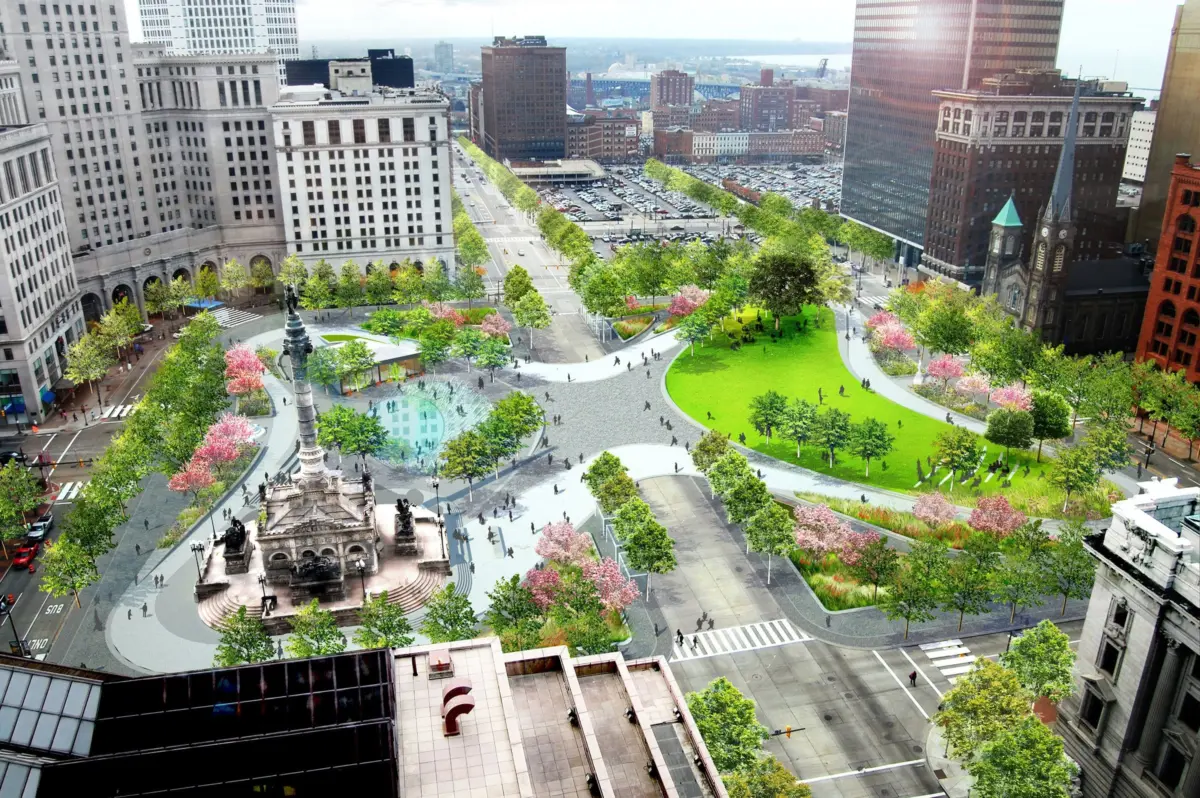
At the very center of this high-security staging ground—both metaphorically and almost literally—lies Cleveland’s newly redesigned and remodeled Public Square. Once a fractured layout divided by vehicular traffic, the park has been transformed into a unified plaza that now serves as the site of a city-sanctioned Speakers’ Platform. The result of a massive civic redesign spearheaded by renowned landscape architect James Corner, perhaps best known for his work on New York City’s iconic High Line, this immaculate new public plaza is about to be tested on the national stage. It must quickly fulfill its ultimate democratic purpose by serving as a sustained site of demonstration and public assembly.

The physical shape and spatial geometry of any public environment invariably inform how human beings navigate, inhabit, and use it. To better understand how the park’s contemporary layout might dictate the unfolding dynamics between passionate protestors, curious onlookers, and convention delegates, we spoke with Corner alongside a pair of prominent urban and crowd control experts. While it remains entirely unpredictable whether the demonstrations will maintain a peaceful character or descend into violence, Corner possesses distinct insights into how crowds will interact with his design. Similar perspectives come from Paul Wertheimer, a nationally recognized crowd control expert and the founder and head of the Los Angeles-based Crowd Management Strategies, as well as Greg Coleridge, the director of the Northeast Ohio American Friends Service Committee and an organizer with decades of deep-rooted protesting experience in Cleveland. Ultimately, their visions and expectations diverge in fascinating ways.
A Good Public Square Promotes People Flow
When evaluating the relationship between urban design and mass movement, the flow of people is paramount. Greg Coleridge notes that the old incarnation of Public Square served as a wildly popular and traditional staging area for public marches over the years. "In the past," Coleridge explains, "we would circle one or two of the four quadrants before going somewhere else." While he notes that the new Public Square will likely not alter the fundamental routes chosen by any major public marches, "one could easily envision the new square affecting how they form." The updated design makes it significantly easier for a large, unruly crowd to encircle the entire park, or alternatively, to walk directly through its interior core, allowing a march to gather momentum and attract substantially more attention before officially setting out.

To achieve this transformation, James Corner and his design team tackled the fundamental fragmentation of the older space. The traditional Public Square was broken up into four distinct quadrants by intersecting roadways. To mend this division, Corner’s team permanently closed one road, significantly reduced the width of the remaining avenue, and wrapped the entire park in a continuous "promenade ribbon." This architectural feature actively encourages visitors to walk completely around the perimeter—and directly through the heart—of the park.
"Those journeys, especially the diagonal ones, were not available before," Corner points out, emphasizing that these pathways represent an essential feature for modern parks where "the interaction of a diverse mix of people is allowed to really play out."

Visibility Is Good for Democracy
Beyond simple pedestrian movement, the visual openness of a public space plays a critical role in political demonstrations. Greg Coleridge points out that traditional circle- and square-shaped civic spaces historically lend themselves exceptionally well to public demonstrations. "Everyone can see each other and everyone has a sense of equality," he observes.
However, the newly engineered Public Square breaks away from traditional geometric norms, adopting a layout that Coleridge describes as an "hourglass." While it is true that the contemporary Public Square affords unique sightlines that the older design completely lacked—particularly along its long diagonals—large swaths of the park are now deliberately broken up by newly planted trees, dense gardens, and landscaping features that inevitably limit overall visibility.

James Corner counters that one of the greatest intrinsic joys of any well-designed public space is the simple, powerful act of human beings observing one another. Among Public Square’s most notable new features are its primary sight lines, which extend in sweeping, uninterrupted diagonals straight across the plaza.
"Seeing and being seen, and being juxtaposed with people who aren’t really like you, is important for fostering tolerance and diversity," Corner says. "It’s an extraordinarily social form of public life, that, in a sense, supports democracy."

He quickly adds that democracy in action takes many different forms across society. "Its most dominant form is protest and large assembly, and those are important," he acknowledges. "But I also think democracy plays out in everyday life."
Cleveland’s Official Speakers Platform Will Attract an Audience
To accommodate political expression during the convention, municipal authorities in Cleveland have erected an official speaking platform situated safely at the southern end of the park. From this designated spot, registered individuals will be permitted to deliver 30-minute speeches daily between the hours of 9:30 a.m. and 6:30 p.m. throughout the duration of the convention.

However, crowd management expert Paul Wertheimer warns that logistics must be carefully monitored. "Any sizeable crowd will extend up to, and beyond, the fountain in front of the speakers’ platform," Wertheimer cautions. He advises city authorities to ensure that the fountain is explicitly turned off during these events to guarantee that people have adequate physical room to gather. Given that the Public Square is relatively compact, he notes, "there’s a good chance they’ll need the space."
Unofficial Speakers Platforms Could Attract Audiences, Too
While the official stage will draw considerable attention, urban designers and crowd experts recognize that spontaneous expression is equally vital. "It’s important to support the unpredictable in public spaces," James Corner asserts. "I think the best spaces for free speech are the everyday spaces that are designed for generosity, openness, and flexibility."

To that end, the park features a central lawn whose edges slope inward, creating a subtle, intentional amphitheater effect at its core. "It’s really intended for picnics, sitting in the sun, looking on the city," Corner explains, "but it also lends itself to larger political gatherings and events."
At the same time, municipal rules introduce complexities. Cleveland officials have officially forbidden the use of traditional soapboxes and other makeshift, portable podiums. Yet, a recent revision to the city’s legal definition of a "speakers platform" indicates that individuals may legally utilize preexisting objects and natural topography to exercise their fundamental freedom of speech.

"If people want to stand on a curb, a bench, or at the top of a grassy hill, they can do it," Wertheimer notes.
Conversely, Greg Coleridge worries about the potential side effects of this design versatility. Because the park is filled with various architectural elements that could naturally serve as impromptu speaking platforms, Coleridge fears it could inadvertently fracture crowds rather than unite them under a single banner. "Instead of addressing one whole group, you might have three different groups, three different sections, for three different speeches," he says, warning that "it doesn’t lend itself to a single, big event."

Statues Are Rallying Points
Physical landmarks within civic spaces often take on profound symbolic importance during times of political unrest. Long before Public Square underwent its extensive modern redesign, a prominent bronze statue honoring Tom Johnson—an influential early 20th-century mayor of Cleveland—situated in the plaza’s northwest quadrant served as a popular, magnetic gathering point for various anti-corporate protests. Most notably, the space hosted an Occupy Cleveland encampment for many months.
"Johnson was a populist of a guy," Coleridge recalls. Today, that historically preserved statue has been relocated and centered on the north side of the newly unified square, positioned directly in front of what Coleridge describes as a much bigger, more visually attractive, and better-connected civic space.

Police Should Be Present, Not Overwhelming
Managing the delicate balance between public safety and civil liberties remains one of the primary logistical challenges facing local authorities during the convention. Paul Wertheimer emphasizes that while it is entirely necessary to have police officers and firefighters stationed nearby and ready to respond, an overwhelming or overly aggressive police presence can easily backfire, making a tense event feel unnecessarily confrontational.
"The parking lot located across the street from the Public Square is a logical assembly point for Cleveland’s police and fire departments," Wertheimer suggests, adding that "police inside the park should be dressed in non-confrontational uniforms—no Robocop gear." Establishing a dedicated, off-site staging area specifically for personnel, emergency vehicles, and heavy riot equipment can go a long way toward keeping baseline public tensions firmly in check.

Reflecting on local history, Coleridge notes that police forces within Public Square have historically played a helpful role during past protests. "They’ve stopped traffic, even when we didn’t have a permit to march in the street," he recalls.
However, he harbors legitimate concerns that law enforcement officers might prove significantly less obliging during the high-security environment of the RNC. "The new Public Square is meant to be a showcase, the crown jewel… I would imagine the police will be particularly vigilant about keeping order." The ultimate challenge for the police department, he concludes, will be finding a way to allow citizens—even deeply frustrated and angry ones—to fully express themselves without unnecessarily resorting to state-sponsored force or violence.

An Overflow Area Could Reduce Crowd Density
Should crowds swell beyond initial municipal projections, planners must have contingency plans ready to deploy. Paul Wertheimer points out that if authorities wind up drawing far more people to the plaza than anticipated, a clearly designated overflow area can help keep massive crowds safely contained without causing a stampede. The wide roads immediately surrounding the park could easily afford such a space.
"Authorities may decide to keep at least one side of the park closed off from overflow, or keep one of the surrounding lanes open, as an emergency lane for fire trucks, ambulances, police, and other official vehicles," Wertheimer advises.

A Street Makes the Space Versatile
While the redesign largely consolidated the square, Superior Avenue still runs directly through the park. Primarily functioning as a major municipal bus route on typical business days, the street can be entirely cordoned off and the buses rerouted on special occasions. James Corner notes that this built-in flexibility is a major asset for the urban design.
"You can imagine tents, festivals, carnivals being used on that space and allowing the two halves of the park to be more unified," Corner says.

Furthermore, because Public Square was never explicitly engineered to handle prolonged periods of massive public speaking engagements or continuous multi-day protests, Wertheimer emphasizes that city authorities must proactively step in to provide essential civic amenities. The center of the park, which remains easily accessible to pedestrians traversing the square as well as to emergency vehicles via Superior Avenue, offers an ideal location for the installation of temporary public toilets, drinking water stations, and medical first-aid tents to support the influx of convention-goers and demonstrators alike.