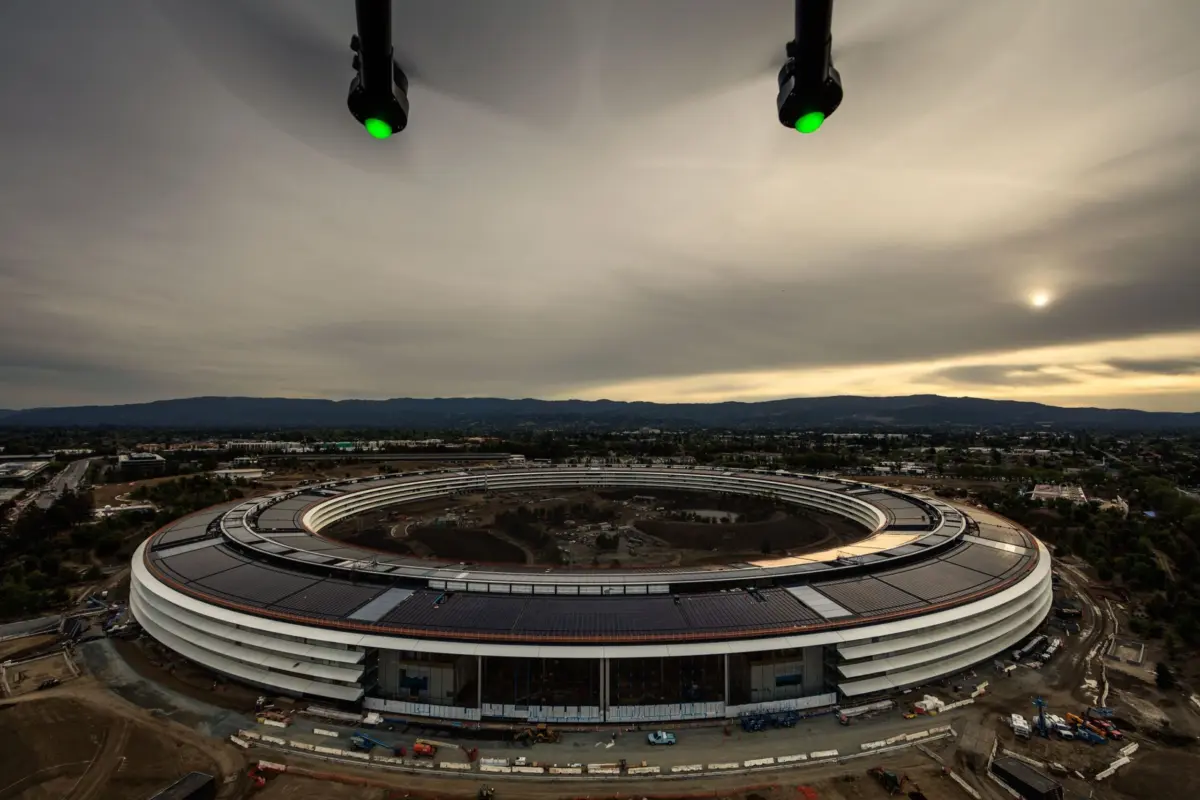
The new headquarters Apple is building in Cupertino has the absolute best door handles. They are precision-milled aluminum rails that attach to glass doors—sliding and swinging alike—with no visible bolts.
Everything in this building is engineered to be the best. The toroid glass of the roof curves scientifically to shed rainwater. And if it never rains again in California, an arborist carefully selected thousands of drought-tolerant new trees for the 175-acre site. Not every Apple employee will get to work in the new building, but 12,000 will. Of course, the campus only has 9,000 parking spaces, a constraint designed to encourage people to take an Apple shuttle to work. Once they arrive, the amenities are meant to keep them on-site: the fitness center features a climbing wall with pre-distressed stone, the concrete edges of the parking lot walls are softly rounded, and the fire suppression systems are borrowed from luxury yachts. Craftspeople even harvested the wood paneling at the exact time of year the late Steve Jobs demanded—mid-winter—so the sap content wouldn’t be ruinously high.
Whether you call it the Ring, the Death Star, or the Spaceship, something massive and otherworldly has alighted in Cupertino. No one could possibly question the elegance of its design and architecture. This building represents $5 billion and 2.8 million square feet of pure Steve Jobsian, Jony Ivesian, and Norman Fosterian genius.
Yet, to truly understand a building, one must look at what surrounds it—its site, as architects say. From that angle, Apple’s new headquarters is a retrograde, literally inward-looking building with a quiet contempt for the city where it lives and for cities in general. People rightly credit Apple for defining the look and feel of the future; its computers and phones often seem like science fiction. But by building a mega-headquarters straight out of the middle of the last century, Apple has exacerbated the already severe problems endemic to 21st-century suburbs like Cupertino, including transportation, housing, and shifting economics. Apple Park is an anachronism wrapped in glass, tucked neatly into a residential neighborhood.
The Architecture of Isolation
Apple Park is not the first high-end, corporate suburban headquarters. In fact, that used to be the industry norm. Looking back at the 1950s and 1960s, prominent examples include the Connecticut General Life Insurance headquarters in Hartford or John Deere’s headquarters in Moline, Illinois.
"They were stunningly beautiful, high modernist buildings by quality architects using cutting-edge technology to create buildings sheathed in glass with a seamless relationship between inside and outside, dependent on the automobile to move employees to the site," says Louise Mozingo, a landscape architect at UC Berkeley and author of Pastoral Capitalism: A History of Suburban Corporate Landscapes. "There was a kind of splendid isolation that was seen as productive, capturing the employees for an entire day and in the process reinforcing an insular corporate culture."
By moving out of downtown skyscrapers and building in the suburbs, major corporations were reflecting 1950s urban attitudes—cities were viewed as dirty, crowded, and unpleasantly diverse. The suburbs, conversely, offered exclusivity, aspiration, and architectural blank slates. Buildings there were easier to secure, and workers were less likely to wander out for lunch where they might hear about other, better job opportunities. It was, in essence, corporatized white flight.
Silicon Valley, however, never truly played by those traditional rules. While IBM built a couple of research sites modeled on its East Coast redoubts, Silicon Valley generally thrived on using interchangeable buildings for workplaces, Mozingo notes. A company might start in a garage, take over half a floor in a modest office park, expand to a full floor, then an entire building, and eventually move to a better office park after securing venture capital.
When an economic bust arrives or a new product fails, companies let leases lapse or sell off real estate. More than half of the land where Apple sited its new home used to belong to Hewlett-Packard, just as the Googleplex formerly belonged to Silicon Graphics. It is the natural circuit of life for tech real estate.
Except when a company builds a statement structure like the Spaceship, that circuit cannot be completed. If Apple were ever to go out of business, the question remains: what would happen to the building? The same fate that befell Union Carbide’s monolithic headquarters. That is why nobody builds these types of structures anymore. Successful buildings engage with their surroundings. Apple is not situated in some remote suburban arcadia; it occupies a real city, standing directly across the street from houses and retail, near two major freeway onramps.
Instead of engaging with that urban fabric, the Ring is mostly hidden behind artificial berms, much like Space Mountain at Disneyland. "They’re all these white elephants. Nobody knows what the hell to do with them. They’re iconic, high-end buildings, and who cares?" Mozingo says. "You have a $5 billion office building, incredibly idiosyncratic, impossible to repurpose for somebody else. Nobody’s going to move into Steve Jobs’ old building."
The Local Landscape and Housing Crisis
That future scenario is a problem for tomorrow’s Apple. Today’s Apple, however, must contend with how the campus fits into Cupertino and a crowded, congested, expensive Silicon Valley.
Between 2010 and 2015, the San Francisco Bay Area added 640,000 jobs, with more than a third of that growth concentrated in the tech sector. Yet the region failed to build nearly enough housing. With the exception of a brief spike during the boom years leading up to the 2008 recession, the number of new housing units built in San Francisco trended steadily downward, a pattern mirrored across other Bay Area cities. When supply fails to meet demand, costs skyrocket: the median price for a home in the Bay Area climbed to $800,000, and prices are even higher in Silicon Valley proper.
Conditions are slowly beginning to change in major urban centers. San Francisco has tens of thousands of units in its housing pipeline, and San Jose adds thousands every year. But the smaller towns along major thoroughfares like US-101 and I-280—the home turf of companies like Apple, Google, and Facebook—have been largely resistant. Cupertino, Mountain View, and Palo Alto host tens of thousands of tech workers and continue to add more, yet these municipalities have historically been reluctant to approve new residential housing or apartments.
How this dynamic became Apple’s responsibility is a complex question for local leaders. "Apple’s obviously very important to the city, and when they came in with that plan, we understood this wasn’t going to be just any development," says Aarti Shrivastava, Cupertino’s assistant city manager. "They had certain needs." A heightened sensitivity to corporate security was paramount, which ultimately meant zero public access and even the permanent closure of a major public road.
Early in the planning process, reports indicated that Apple was initially unwilling to participate in financial "community benefits." Cupertino’s city council seemed equally hesitant to push back against one of the city’s largest employers and taxpayers, even as the mayor at the time unsuccessfully proposed higher local business taxes.
Over time, however, Apple committed funds to help mitigate traffic and parking strains. "We had to bring them into our world. They don’t do urban design. They don’t do planning. We needed to talk to each other," Shrivastava explains.
When the site operated under Hewlett-Packard, it accommodated about 5,000 workers; the new Apple complex more than doubles that figure. While only 10 percent of those workers live in Cupertino, an Environmental Impact Report submitted by Apple indicated that local demand for Cupertino housing would increase by 284 percent. To address this, Apple agreed to pay a Housing Mitigation Fee based on overall square footage. Because the new campus only added about 800,000 square feet over the previous structures, the company agreed to double the usual fee. However, because the city had previously halved the fee structure, Apple ultimately paid the standard calculated rate, totaling roughly $5 million.
Simple math shows that with only 10 percent of Cupertino employees living locally, 90 percent must commute. Most reside in San Jose, located 10 miles east, or San Francisco, 45 miles north. The absence of a cohesive regional transportation network in the Bay Area heavily privileges personal automobiles, prompting companies like Google and Apple to field private corporate shuttle fleets.
Apple’s shuttles traverse the entire peninsula and extend into the East Bay, with the company committing to raise the proportion of employee commutes made in non-single-occupancy vehicles to 34 percent. According to the Environmental Impact Report, just 1.5 percent of commute trips to Apple’s existing facilities utilize public transit. Despite this, the company maintained that the existing public bus system was robust enough to handle the spillover—a circular piece of logic that assumes if public transit infrastructure is not built or expanded, demand will simply not materialize.
Apple did collaborate with Cupertino on several other fronts. Because part of the new campus subsumed planned public space, Apple contributed $8.2 million for Cupertino to construct a park elsewhere. The company also helped address severe local traffic concerns, contributing $250,000 for a feasibility study on improving a nearby intersection, and an additional $1 million for another. Recognizing that a deficit of on-site parking would inevitably push cars into surrounding residential streets, Apple provided $250,000 to Santa Clara and $500,000 to Sunnyvale in parking restitution. "We worked very hard with both cities to figure out what amount would be OK, and Apple was very open to that," Shrivastava says.
Additionally, Cupertino historically forgave all of Apple’s business-to-business sales tax, but under updated terms, the city will retain 65 percent of it. Apple also constructed a $5 million system to pipe recycled water from Sunnyvale to hydrate its massive new landscape, an infrastructure project that may eventually serve other large local developments like the Hamptons and the former Vallco Mall site.
Still, critics point out that against Apple’s staggering cash reserves of roughly $250 billion, these community contributions feel modest. Urban planners argue the company could have easily helped fund infrastructure projects like doubling the frequency of CalTrain commuter rail or constructing a dedicated transit center in Cupertino, which currently lacks one entirely.
"Apple could have done anything. Money was no object," says Allison Arieff, editorial director for the San Francisco Bay Area Planning and Urban Research Association (SPUR) and lead author of a report on corporate campuses. "They want to be innovative in everything, and they’re not innovative in this thing." Instead, Apple focused its efforts on roadway and highway improvements. "If the intractable problems of the region are housing and congestion, they’re giving the finger to all that," Arieff says.
Broader Economic Pressures
The systemic challenges facing the Bay Area, Los Angeles, and other urban regions are far more complex than a single corporate campus. Municipalities constantly balance the economic benefits of adding high-paying jobs against the mounting costs of required public services like schools and transit.
The situation is particularly acute in California due to Proposition 13, a 1978 ballot measure that drastically limits yearly property tax increases. While the law gutted basic public services like education, it also inadvertently transformed real estate into the primary vehicle for Californians to accrue and preserve personal wealth. Homeowners who purchased inexpensive properties in the Bay Area decades ago sit on massive windfalls, heavily disincentivizing them from supporting policies that might reduce property values, such as approving nearby apartment buildings.
Concurrently, California cities must figure out how to fund escalating pension obligations for retired municipal employees, which consume an ever-larger share of local budgets. Lacking the ability to tax legacy homes or easily build new ones, cities often view tech booms and commercial real estate projects as vital fiscal lifelines. "It’s a lot to ask a corporate campus to fix those problems," Arieff notes.
That reality does not mean corporations cannot try to be better neighbors. Other tech firms have adopted different models; the main building of cloud storage company Box sits directly across the street from the Redwood City CalTrain station, and the company opens its downtown parking lots to the public on weekends. "The architecture is neither here nor there, but it’s a billion times more effective than the Apple campus," Arieff says—representing a contemporary planning approach that avoids hiding behind rolling hills and distancing operations from public transit.
For multinational technology corporations, however, local engagement remains difficult. "Tech tends to be remarkably detached from local conditions, primarily because they’re selling globally," says Ed Glaeser, a Harvard economist who studies urban centers. "They’re not particularly tied to local suppliers or local customers." Consequently, these firms often possess fewer incentives to help solve local municipal problems than even local homeowners do.
"Even if they see the problem and the solution, there’s not a way to sell that. This is why there are government services," Arieff adds. "You can’t solve a problem like CalTrain frequency or the jobs-to-housing ratio with a market-based solution."
Urban design trends are shifting toward a more contemporary approach: commercial architecture that builds upward rather than outward. While Apple’s ring spreads 2.5 million square feet across 175 acres of engineered hills and trees reminiscent of Stanford University, San Francisco’s 60-story Salesforce Tower houses 1.5 million square feet on roughly an acre of land. It maintains a direct connection to a major regional transit hub—the Transbay Terminal—and cost a fraction of Apple’s campus.
Looking Ahead
Cupertino is frequently described by technology writers as "once-sleepy" or "nondescript." Yet local officials point to developments like Main Street Cupertino—a mixed-use area featuring restaurants, shops, multi-story residential housing, and a modest patch of green space functioning as a town square—as evidence of gradual evolution. Directly across the street, the former Vallco Mall, a massive fortress-like shopping center surrounded by an expansive parking lot, stands as Cupertino’s most hotly debated site for future redevelopment. Like many suburban Silicon Valley towns, Cupertino recognizes the necessity of change, even if that change unfolds slowly.
That transformation takes considerably longer when major local businesses remain reluctant partners. In the early 20th century, industrial capitalists recognized that publicly financed infrastructure enhanced their own economic growth. They partnered with governments to build transit lines, water systems, power grids, and schools. "In most parts of the US, you open a tap and drink the water and it won’t kill you. There was a moment when this was a goal of both government and capital," Mozingo says. Later, in the 1930s and 1940s, Bay Area businesses realized they needed a regional transit network and collaborated for decades with communities to establish BART.
Contemporary tech companies are taking tentative steps in similar directions. Google integrated nearly 10,000 apartments into the development package for its new headquarters in Mountain View’s North Bayshore area. Facebook’s Frank Gehry-designed headquarters was planned to be more open to the community, featuring a public farmers’ market, while Amazon’s urban Seattle campus integrates transparent terrarium domes directly into the downtown core.
What Apple could have built instead remains an open question—something taller, perhaps, with integrated mixed-use zoning surrounding it. Local zoning laws would likely have barred such a concept, but given unlimited resources, the world’s foremost designers and architects could have attempted something entirely new. Instead, the company produced a sprawling architectural marvel shaped like a navel, designed entirely to gaze inward.
Steven Levy wrote that the headquarters was Steve Jobs’ last great project, an ultimate physical expression of how he viewed his domain. Yet for all its circular perfection, Apple Park functions less like an open community hub and more like a modern pyramid—a monument tailored more to a vanished past than to the complexities of a changing future.