By Robbie Gonzalez

In March, Donald Trump made a menacing prediction about what would happen should the GOP not grant him its nomination at the Republican National Convention in Cleveland: “I think you’d have riots. I think you’d have riots. I’m representing a tremendous … many, many millions of people.”
With tens of thousands of people holding sharply opposing political viewpoints assembling in downtown Cleveland for the high-stakes political gathering, city officials have found themselves looking to the physical fabric of the city itself to manage four days of intense demonstrations and marches. Demonstrators from organizations as disparate and ideologically opposed as Bikers for Trump and Stand Together to Stop Trump are slated to gather in the exact same areas within the designated Event Zone. Spanning 3.3 square miles of a city-within-a-city, the security zone enforces strict rules where tennis balls, flashlights, and water guns are prohibited, yet—owing to Ohio state law—openly carried firearms remain completely legal.

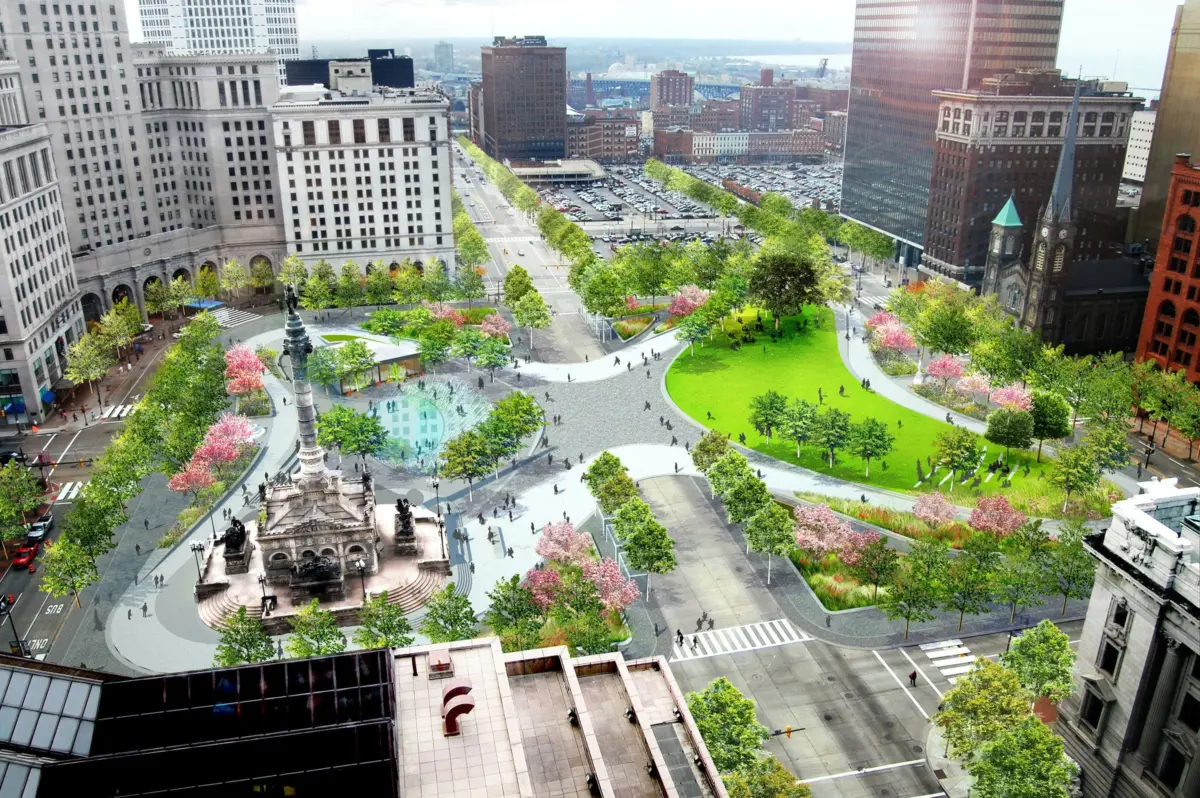
At the very center of it all—metaphorically and almost literally—is Cleveland’s newly redesigned and remodeled Public Square, a sweeping park featuring a city-sanctioned Speakers’ Platform. The ambitious urban project is the work of renowned landscape architect James Corner, who is perhaps most famous for his design of New York City’s beloved High Line. This immaculate new public plaza is about to face its ultimate test, serving its purpose as a democratic platform by becoming the primary site of sustained public demonstration and political expression.
The physical shape of a space inevitably informs how people move through and use it. To better understand what lies ahead, we spoke with Corner, along with a pair of urban and crowd-control experts, to explore how the park’s fresh design could influence the behavior of protesters, convention-goers, and law enforcement alike. While it remains entirely unpredictable whether the demonstrations will maintain a peaceful tenor or escalate into violence, Corner believes he has a strong grasp of how people will use his newly minted park. So does crowd control expert Paul Wertheimer, founder and head of the Los Angeles-based Crowd Management Strategies. And so does Greg Coleridge, director of the Northeast Ohio American Friends Service Committee and an organizer with decades of experience protesting in the streets of Cleveland. While their insights overlap in fascinating ways, their projections for the convention diverge significantly.

Three Perspectives on Public Square
A Good Public Square Promotes People Flow
The physical architecture of a gathering space dictates how crowds assemble and disperse, a dynamic that local activists and designers have analyzed closely ahead of the convention. Greg Coleridge recalls that the old Public Square served as a wildly popular staging area for public marches over the years. In the past, protesters would typically circle one or two of the four individual quadrants of the square before heading out toward their final destinations. While Coleridge notes that the new Public Square will likely not alter the established routes of major public marches, he acknowledges that one could easily envision the new square drastically affecting how those crowds initially form. The streamlined new design makes it far easier for a large, agitated crowd to fully encircle the park, or walk directly through its heart, allowing a march to attract vastly more attention and momentum before ever setting out on its route.
To transform the fragmented four quadrants of the old Public Square into a single, cohesive park, James Corner’s design team closed one heavily traveled road, reduced the width of the remaining avenue, and wrapped the entire park in a continuous "promenade ribbon." This architectural feature actively encourages visitors to walk completely around and straight through the heart of the park. Those journeys, particularly the diagonal paths crisscrossing the green space, were simply not available to pedestrians before the redesign, Corner notes. He adds that these pathways are an essential feature of modern urban parks in which the unpredictable interaction of a diverse and often conflicting mix of people is allowed to truly play out.

Visibility Is Good for Democracy
The geometry of public spaces has long been tied to the health of civic life, and the physical contours of Cleveland’s reimagined square are no exception. According to Greg Coleridge, traditional circle- and square-shaped civic spaces naturally lend themselves to effective public demonstration because everyone can see everyone else, fostering an immediate sense of equality among participants. However, the new Public Square is neither strictly circular nor rectilinear. Instead, Coleridge describes its unique footprint as an hourglass. While it is true that the new Public Square affords sweeping sightlines that the old layout simply did not provide—particularly along its long diagonals—large swaths of the park are separated by newly planted trees and dense gardens that inevitably limit overall visibility.
For James Corner, one of the great intrinsic joys of a well-designed public space is the simple, powerful act of people seeing one another face-to-face. Among Public Square’s most notable new features are its primary sightlines, which extend in long, unbroken diagonals across the plaza. Seeing and being seen, and being placed in direct visual juxtaposition with people who are fundamentally different from you, is vital for fostering tolerance and diversity, Corner argues. It represents an extraordinarily social form of public life that, in a very real sense, actively supports and sustains a healthy democracy. He is quick to add that democracy in action takes many different forms. While its most dominant and visible form during weeks like this is protest and large assembly—which are undeniably important—Corner believes that democracy also plays out quietly in everyday life.

Cleveland’s Official Speakers Platform Will Attract an Audience
To accommodate the influx of political expression during the convention, Cleveland city officials have erected an official speaking platform at the southern end of the park. From this designated stage, individuals will be permitted to deliver 30-minute speeches between 9:30 a.m. and 6:30 p.m. every single day of the convention. Crowd control expert Paul Wertheimer points out that any sizeable crowd gathering to listen to these speakers will naturally extend right up to, and well beyond, the decorative fountain located directly in front of the platform. To prevent bottlenecks and ensure that people can safely gather and disperse, Wertheimer suggests that authorities should strongly consider keeping the fountain turned off during peak hours. Given that Public Square is already relatively compact in size, he warns that there is a very good chance officials will desperately need every square foot of available space.
Unofficial Speakers Platforms Could Attract Audiences, Too
While the official platform will draw structured attention, the park’s natural topography invites spontaneous gatherings as well. James Corner emphasizes that it is vital to support the unpredictable nature of human behavior in public spaces. In his view, the absolute best spaces for free speech are everyday spaces that are thoughtfully designed for generosity, openness, and overall flexibility. The edges of the park’s central lawn gently slope inward, creating a mild amphitheater effect right at its core. While this feature is primarily intended for casual activities like enjoying a picnic, sitting in the sun, or looking out over the city skyline, Corner acknowledges that it also naturally lends itself to larger political gatherings and impromptu events.

City authorities have formally forbidden the use of traditional soapboxes and other makeshift podiums within the zone, but a recent administrative revision to the city’s official definition of a “speakers platform” indicates that individuals can legally use preexisting architectural objects and local topography to exercise their freedom of speech. If people want to stand on a concrete curb, a park bench, or at the top of a grassy hill to address a crowd, they are legally permitted to do so, Wertheimer notes.
However, local organizer Greg Coleridge worries about the potential complications of this decentralized approach. The park is brimming with design elements that could easily serve as impromptu speaking platforms, which he fears could end up dividing crowds rather than uniting them under a single message. Instead of addressing one large, cohesive group of listeners, a speaker might find themselves competing with two or three different groups gathered in separate sections of the park for entirely different speeches, potentially diluting the impact and undermining the potential for a single, massive historic event.

Statues Are Rallying Points
Physical monuments within civic plazas often serve as powerful magnets for political demonstrations. Long before Public Square underwent its multi-million-dollar redesign, a prominent bronze statue of early 20th-century Cleveland Mayor Tom Johnson, located in the plaza’s northwest quadrant, served as a wildly popular gathering point for a variety of anti-corporate protests, including months of continuous Occupy Cleveland encampments. Coleridge remembers Johnson as a true populist figure of a man. Today, that preserved statue has been moved to a centered position on the north side of the square, sitting directly in front of what Coleridge describes as a much bigger, more visually attractive, and better-connected public space.
Police Should Be Present, Not Overwhelming
Managing the delicate balance between public safety and civil liberties is one of the greatest challenges facing local law enforcement during high-profile national conventions. Paul Wertheimer emphasizes that while it is critically important to have police officers and firefighters stationed close at hand and ready to respond, an excessively heavy police presence can inadvertently make a peaceful event feel confrontational and hostile. A large municipal parking lot located directly across the street from Public Square serves as a logical staging and assembly point for Cleveland’s police and fire departments, Wertheimer suggests, adding that officers deployed directly inside the park should be dressed in non-confrontational uniforms rather than heavy tactical gear. Maintaining an off-site staging area for personnel, heavy vehicles, and specialized riot equipment can go a long way toward keeping simmering public tensions in check.

Reflecting on past local history, Coleridge notes that police officers stationed in Public Square have historically been quite helpful during times of protest, often going so far as to proactively stop street traffic for demonstrators even when specific permits to march in the street were lacking. However, he worries that law enforcement will be significantly less obliging and far more rigid during the high-stakes environment of the RNC. Because the newly redesigned Public Square is intended to serve as a major civic showcase and the crown jewel of the downtown area, Coleridge imagines that the police will be particularly vigilant about maintaining absolute order. The ultimate challenge for law enforcement, he concludes, will be finding a way to allow thousands of people—including deeply frustrated and angry citizens—to fully express themselves without the situation boiling over into violence.
An Overflow Area Could Reduce Crowd Density
Should the daily crowds swell beyond initial municipal projections, having a concrete contingency plan will be essential for public safety. Paul Wertheimer points out that if authorities wind up drawing far more people to the square than anticipated, a designated overflow area can help keep massive crowds safely contained without causing dangerous crushes. The wide streets and avenues surrounding the park could easily afford such a space if managed correctly. Authorities may ultimately decide to keep at least one side of the park entirely closed off from pedestrian overflow, or keep one of the surrounding traffic lanes permanently open as a dedicated emergency corridor for fire trucks, ambulances, police cruisers, and other official vehicles, Wertheimer advises.

The multi-lane thoroughfare of Superior Avenue, which bisects the park, offers its own unique tactical flexibility. While the street primarily functions as a heavily used bus transit route during normal business hours, those buses can be easily rerouted on special occasions, and the street’s path through the heart of the park can be quickly cordoned off. James Corner notes that one can easily imagine temporary tents, community festivals, and civic carnivals utilizing that central space, effectively allowing the two distinct halves of the park to be temporarily unified into a single grand plaza.
Furthermore, because Public Square was not originally engineered to serve as a permanent site for prolonged, massive public speaking engagements or continuous multi-day protests, Wertheimer points out that city authorities will likely need to bring in supplemental infrastructure and public amenities to sustain the crowds. The open center of the park, which remains easily accessible to everyday pedestrians on the square as well as to emergency medical and security vehicles via Superior Avenue, serves as an ideal location for deploying temporary public restrooms, clean drinking water stations, and mobile first-aid posts.

As the convention kicks off, the eyes of the nation will remain fixed not only on the speeches delivered inside the arena, but on the concrete and grass of Cleveland’s Public Square—where the physical design of the city will quietly shape the democratic expression of a divided nation.