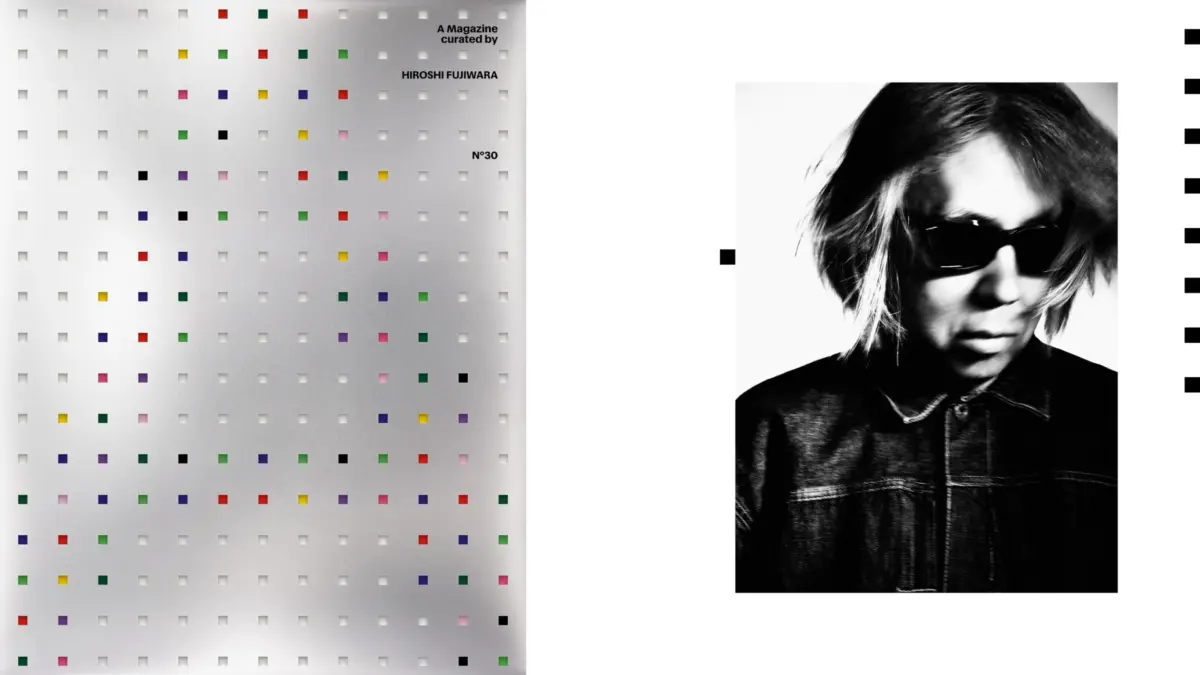
For decades, Hiroshi Fujiwara has operated as one of the most influential yet elusive forces in contemporary global culture. Widely celebrated as the undisputed "Godfather of Streetwear," the Japanese multihyphenate—whose multifaceted career spans music production, DJing, design, and the visionary Fragment Design project—has long preferred to let his creations speak for themselves. He is a man who deals in subtle shifts in taste, cultural cross-pollination, and an unerring instinct for what is next. Yet, in a rare departure from his usual discretion, Fujiwara has opened up his inner world for the milestone 30th edition of A Magazine Curated By.
Under the guiding ethos that "memory is better than a photo," Fujiwara has taken the helm as guest editor for the prestigious publication, producing a sprawling, multi-layered 184-page volume housed within a striking laser-cut metallic silver dust jacket. Rather than assembling a predictable, retrospective victory lap of his own legendary apparel designs, sneaker collaborations, and commercial projects, Fujiwara has chosen a more personal and idiosyncratic path. Instead, he has brought together a diverse, broad creative cast whose works and pursuits reflect his own wide-ranging intellectual curiosities—moving fluidly from Tokyo street life, music, and contemporary art to history, the nuances of the cinematic suspense genre, and deeply human real-world stories.
The project launches officially on Friday with an exclusive celebratory event hosted at the historic Hôtel de Crillon in Paris, coinciding strategically with the vibrant Art Basel Paris period. The timing aligns with the global convergence of art, fashion, and design, offering a fitting backdrop for a publication that challenges conventional definitions of what a fashion designer can and should be today.
A Lifetime of Sampling and Instinctive Curation
Speaking about the editorial process, Fujiwara explained to WWD that his overarching goal was simply to share fragments of his personal intellectual landscape. He wanted to offer a tangible map of his inspirations.
"I wanted to share some of the things that I find interesting, or things that I’ve found interesting over the years," Fujiwara told WWD. "Maybe by putting them together, people can understand a little more about where some of my ideas come from, which is something I normally don’t like to share."
For an individual whose career has been defined by enigmatic mystique, this peek behind the curtain is a significant event. Fujiwara noted that instinct plays a massive, undeniable role in what ultimately catches his eye. Whether he is producing records, designing high-profile apparel collections, or conceptualizing limited-edition consumer products, his process relies on an immediate emotional and aesthetic connection.
"I know right away when I like something or feel drawn to it," he reflected. "Then, once I become interested in something, I tend to go quite deep into it."

This relentless curiosity—a drive to understand the deep-seated origins of an idea and the individual human beings behind it—serves as the engine driving his creative discoveries. When asked how curating a magazine compares to his other multi-disciplinary endeavors, Fujiwara admitted that the editorial process felt "actually quite similar" to his daily creative routine.
"When I design clothes or products, or make music, I’m always sampling things in some way—things I’ve seen before, things I like or things that have stayed in my memory," he said. "With A Magazine, I was able to go deeper into the things I’m personally interested in."
Redefining the Modern Creative Role
Blake Abbie, the editor-in-chief of A Magazine Curated By, views Fujiwara’s guest editorship as a watershed moment for the publication, which has spent nearly three decades chronicling the minds of the world’s most visionary creators. Abbie describes Fujiwara as "one of the most impactful voices in contemporary fashion—and yet one of the most enigmatic."
According to Abbie, looking past traditional boundaries of what constitutes a fashion designer has never been more crucial, especially as the role itself has undergone radical transformations across the lifespan of the magazine’s 30 editions.
"Now a designer must combine all disciplines, like Hiroshi has done over his whole career," Abbie added, emphasizing that Fujiwara’s cross-disciplinary trajectory anticipated the current state of modern creative direction by decades.
Within the pages of the 30th edition, this multidisciplinary approach manifests in a rich tapestry of visual essays, deep conversations, and conceptual art projects. Among its contents is a candid photographic inventory of Fujiwara’s personal possessions, offering readers an intimate glimpse inside his private home environment. This is complemented by a series of photo-documentary pieces capturing specific locations around Tokyo that hold deep personal and nostalgic meaning for him.
The magazine also features thought-provoking portfolios and conversations involving prominent contemporary artists such as Ana Scripariu-Ochiai, Keita Morimoto, and Ai Weiwei. In another forward-looking section, Fujiwara collaborates with the VVS Tools design and development studio to present a conceptual catalogue of products that have never actually existed in the physical world.

The publication balances high-concept design with pressing global realities. In a poignant editorial pairing, journalists Plestia Alaqad and Noor Tagouri engage in a candid conversation regarding independent reporting, the inherent limitations and biases of established mainstream media, and the heavy ethical responsibilities borne by individuals documenting historical stories from directly within their own communities.
Blending Local Nostalgia, Music, and Global Culture
True to Fujiwara’s knack for cultural juxtapositions, the magazine infuses everyday life with high design and subversive playfulness. In one inventive spread, photographer Hugo Yu and food stylist Pearl Jones team up to reimagine signature dishes from some of Fujiwara’s favorite restaurants scattered around the globe, transforming them into stylized, prepackaged konbini—the ubiquitous Japanese convenience store—meals.
Music, a lifelong passion and foundational pillar of Fujiwara’s creative identity, naturally takes center stage in the issue as well. To mark the momentous 10th anniversary of Big Crown Records, the acclaimed independent New York-based label founded by Danny Akalepse and Leon Michels, the magazine features an extensive conversation with the label’s visionary founders.
Further bridging the gap between music and design, the issue includes two exclusive remixes produced by Fujiwara himself. He reimagined the track "What’s on Your Mind" by Indonesian soul and funk outfit Thee Marloes, one of Big Crown Records’ rising roster artists.
Highlighting the physical collectible nature of the release, a strictly limited run of 300 copies of the magazine will include an exclusive 45-rpm Big Crown Records vinyl record containing these very remixes. Furthermore, these special collector’s editions will feature an embedded NFC chip, allowing readers to experience the visionary, non-existent product creations of VVS Tools in fully realized three dimensions.
As A Magazine Curated By celebrates its 30th milestone issue under the distinctive creative lens of Hiroshi Fujiwara, the project serves as a testament to the enduring power of personal memory, unbridled curiosity, and cross-disciplinary mastery. The issue officially launches on Friday during the heart of Art Basel Paris with an exclusive gathering at the Hôtel de Crillon, bringing together the global tastemakers, artists, and creators who continue to orbit Fujiwara’s ever-expanding cultural universe.