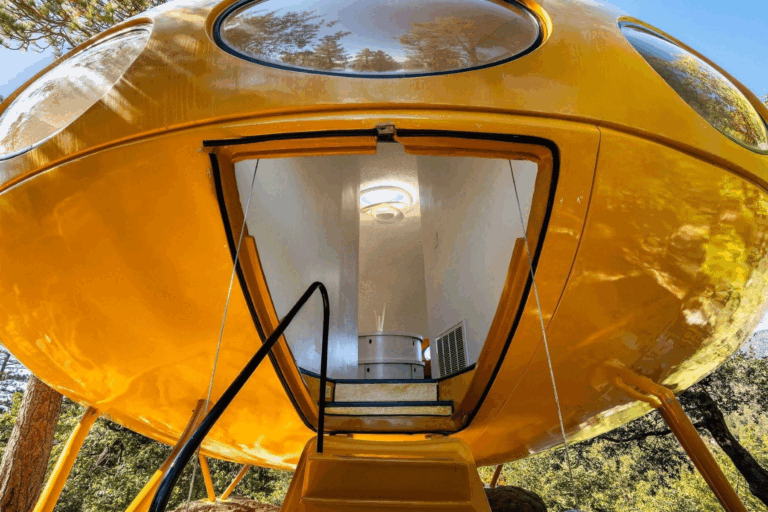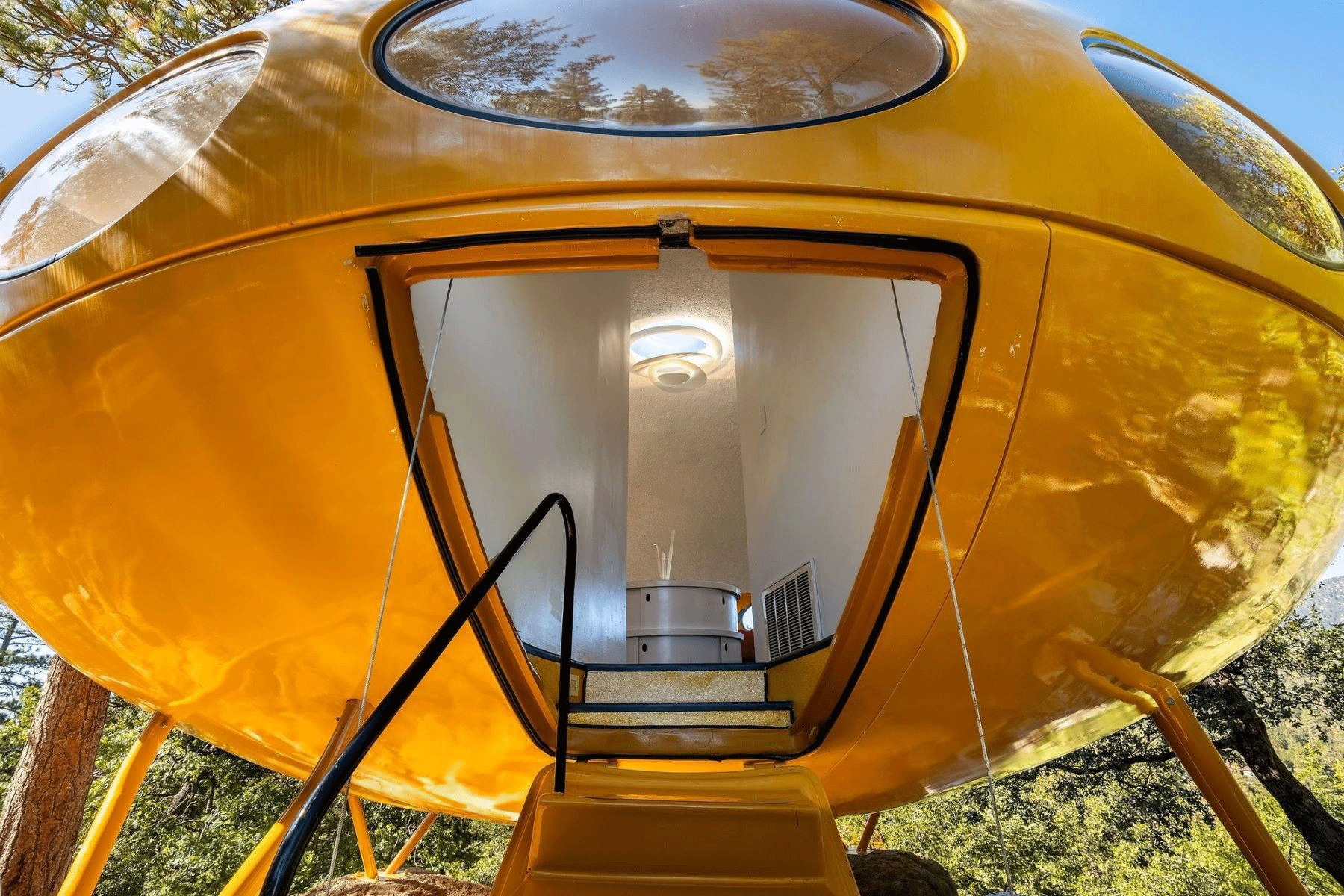
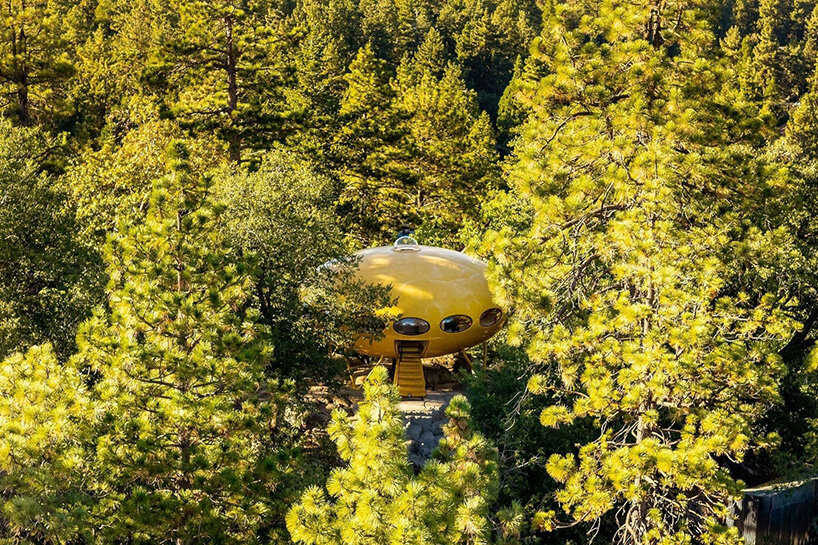
A remarkably preserved, UFO-shaped Futuro house nestled among the pine trees and granite boulders of Idyllwild, California, has officially been listed for sale with an asking price of $1.495 million. Designed by the visionary Finnish architect Matti Suuronen at the height of the Space Age, the striking prefabricated dwelling stands as a physical manifestation of a 1960s utopian ideal: a future where lightweight materials and modular prefabrication would liberate humans from traditional foundations, allowing homes to be effortlessly dropped into the most remote and rugged landscapes.
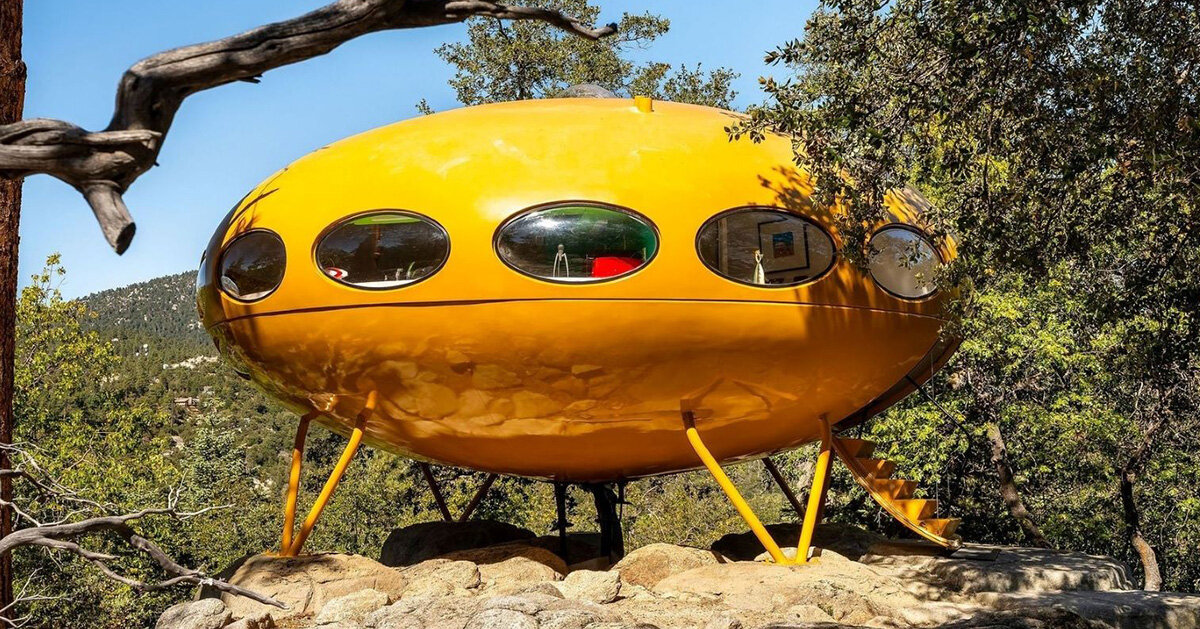
Today, with fewer than 100 Futuros ever manufactured worldwide, this particular property—known as the Donaldson Futuro—offers a rare and exceptionally intact surviving example of a radical architectural experiment. Listed through Desert Sotheby’s International Realty, the home carries a rich pedigree, currently owned by historic preservationist and former Obama administration appointee Milford Wayne Donaldson and his wife, Laurie Donaldson. Because of its meticulous restoration and unique cultural footprint, the structure is proudly listed on the National Register of Historic Places, transforming what was once a whimsical pop-culture curiosity into a treasured artifact of mid-century design history.
Conceived to Go Anywhere
When Matti Suuronen originally developed the Futuro concept in the late 1960s, he envisioned a portable ski cabin that could easily adapt to shifting terrain without the need for heavy machinery or permanent, invasive ground construction. The resulting structure was a marvel of mid-century industrial design. Measuring approximately 8 meters in diameter and 4 meters in height, the elliptical flying saucer-like dwelling encompasses roughly 73.7 square meters of interior living space. Despite its generous footprint, the entire structure weighs a mere 5,398 kilograms, resting lightly on a 0.23-hectare plot within the picturesque San Jacinto Mountains.
The brilliance of Suuronen’s engineering lay in its modularity. The entire house was constructed from prefabricated components designed to be bolted together rapidly on-site. Originally, the futuristic dwelling required just four simple concrete piers to anchor its angled supports, drastically minimizing its environmental footprint and eliminating the need for extensive excavation or conventional foundation work. The shell itself is fabricated from durable, fiberglass-reinforced polyester plastic lined with polyurethane insulation, a composition chosen to ensure that the interior could be heated quickly and efficiently, even when installed in freezing, alpine environments. Access to the interior is granted via an aircraft-style fold-down staircase leading straight up into the glowing yellow hull, where a ring of circular, porthole-style windows floods the compact living spaces with natural light and panoramic views of the surrounding forest.
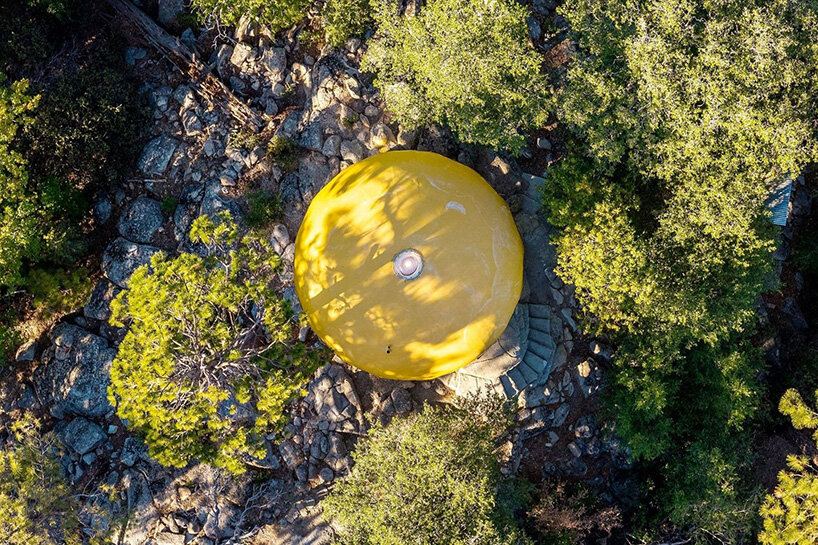
The Rise and Fall of a Space Age Dream
The Futuro house was born out of a specific socio-cultural moment characterized by boundless technological optimism. The mid-to-late 1960s were dominated by the space race, rapid advancements in synthetic materials, and a cultural willingness to rethink every aspect of modern life, from transportation to domestic architecture. Designers like Suuronen looked toward plastics and mass-manufacturing techniques to propose an alternative to the traditional site-built home. The premise was deceptively simple: a house could be manufactured in a factory, transported via helicopter or truck, bolted together in a matter of days, and just as easily disassembled and moved if the owner decided to relocate.
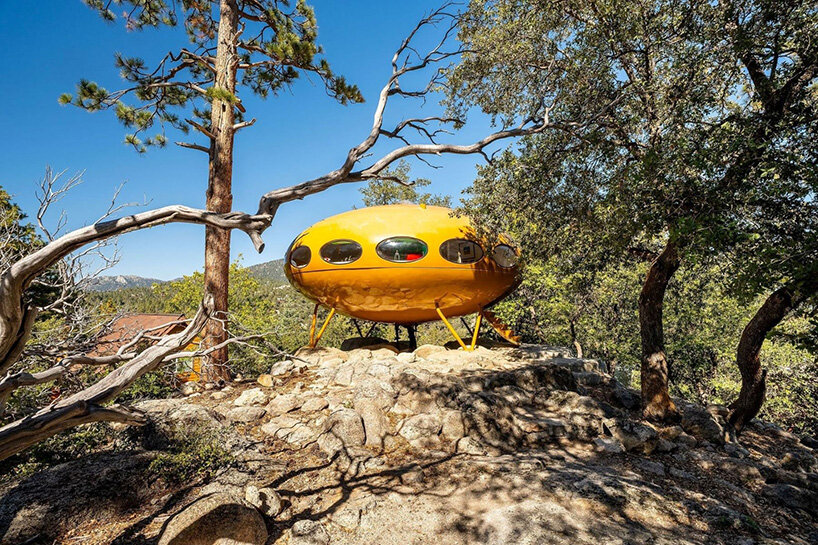
Yet, despite capturing the public imagination and media attention around the globe, the Futuro struggled to transition from a radical prototype to a viable commercial product. The very features that made it revolutionary—its unmistakable UFO silhouette and unconventional plastic construction—quickly became liabilities when faced with municipal realities. Many local communities balked at the unorthodox aesthetics, leading to fierce resistance from zoning boards and neighborhood associations. Furthermore, securing conventional mortgages for a plastic flying saucer proved nearly impossible for prospective buyers, severely dampening market demand.
The final blow to the Futuro’s economic model came with the global oil crisis of 1973. As the cost of petroleum skyrocketed, the price of producing synthetic materials like fiberglass-reinforced polyester surged alongside it, completely undermining the affordability and economic premise of plastic-based architecture. Consequently, production ground to a halt. According to historical records, fewer than 100 units were ever built before the project was shelved. What was initially conceived as a mass-produced, democratized retreat for the masses instead devolved into a rare, obscure architectural footnote.
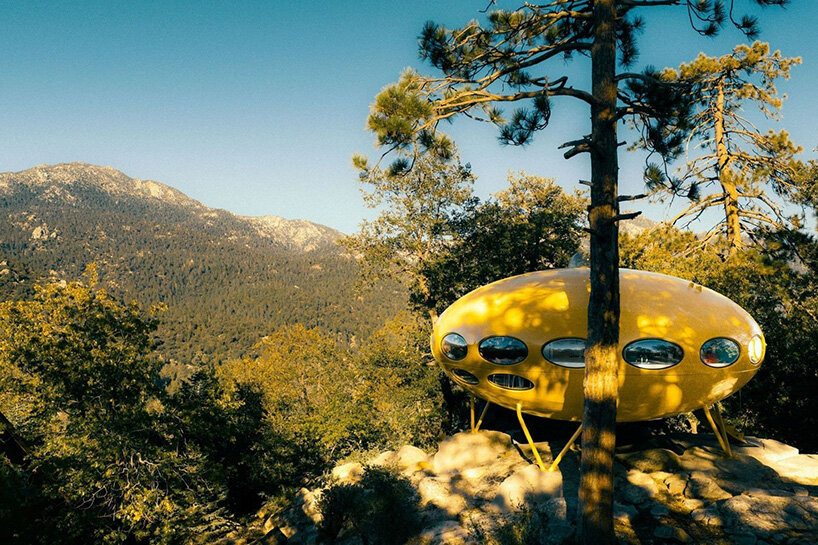
A Collector’s Artifact of a Forgotten Future
Decades after its commercial failure, the surviving examples of Suuronen’s Futuro have undergone a dramatic re-evaluation. Properties that once struggled against zoning laws and public skepticism are now revered as holy grails of modernist preservation. The Idyllwild property currently on the market embodies this evolution perfectly. Through the dedicated stewardship of Milford Wayne Donaldson and Laurie Donaldson, the Donaldson Futuro has been restored to exacting standards, ensuring that its original 1969 design integrity, materials, and workmanship remain entirely uncompromised.
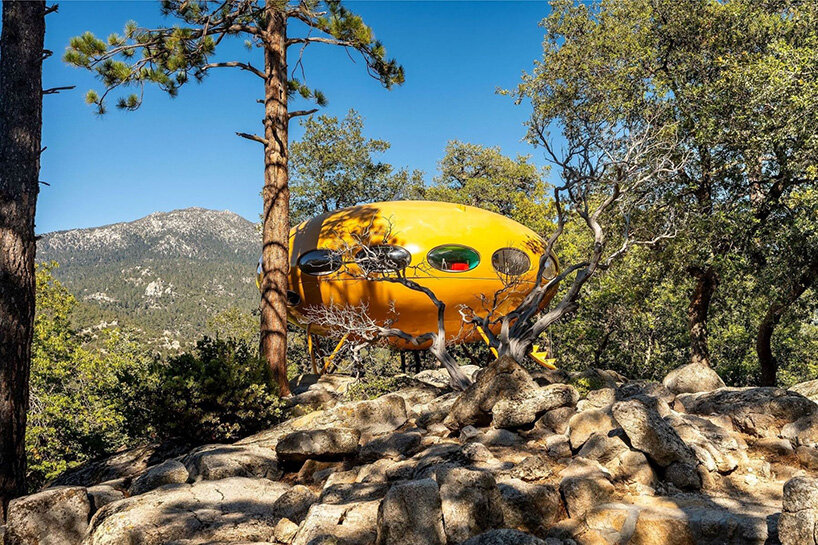
This commitment to historical preservation is what earned the home its prestigious spot on the National Register of Historic Places, cementing its status not just as a quirky novelty, but as a serious work of avant-garde architecture. The listing highlights a fascinating paradox at the very core of the Futuro’s legacy. Conceived as a mass-produced, highly mobile dwelling designed to colonize remote landscapes with minimal disruption, it now exists as a stationary, highly protected museum-piece artifact, valued precisely for its extreme scarcity and historical weight.
Priced at $1.495 million, the Donaldson Futuro is less of a conventional suburban home and more of a collector’s estate for architecture enthusiasts. It stands among the towering pine trees of the San Jacinto Mountains as a vivid reminder of a time when designers looked up at the stars and genuinely believed the future of domestic life would take flight.