If you happened to enjoy watching the chaotic trailer for “Other Mommy” during virtually every multiplex outing this past summer, you will certainly receive an extended, uninterrupted dose of its frantic energy during the actual feature film. The experience begins right down to an opening title card that appears letter-by-letter, heavily intercut with a barrage of choppy, disorienting action sequences. Directed by Rob Savage and adapted from the chilling horror novel “Incidents Around the House,” the finished cinematic product ultimately emerges as among the most limp and ineffectual works to grace the silver screen this year, misfiring aggressively in every possible direction, including and especially its wildly uneven tone.
At various points throughout its runtime, the film plays as though a horror-comedy in the distinct vein of Sam Raimi had been frantically recut at the eleventh hour to resemble a straightforward, humorless scarefest. It bears the unmistakable scars of missing narrative chunks, leaving gaps in the storytelling that feel as though they had been ripped out by hand. The narrative saga begins abruptly with what genuinely feels like the second act of a larger story and stubbornly continues in a relentless, exhausting state of high-pitch climax from beginning to end. It relies heavily on an endless litany of numbing jump scares that grow remarkably stale within the first twenty minutes, largely because they all unfold according to the exact same predictable blueprint.
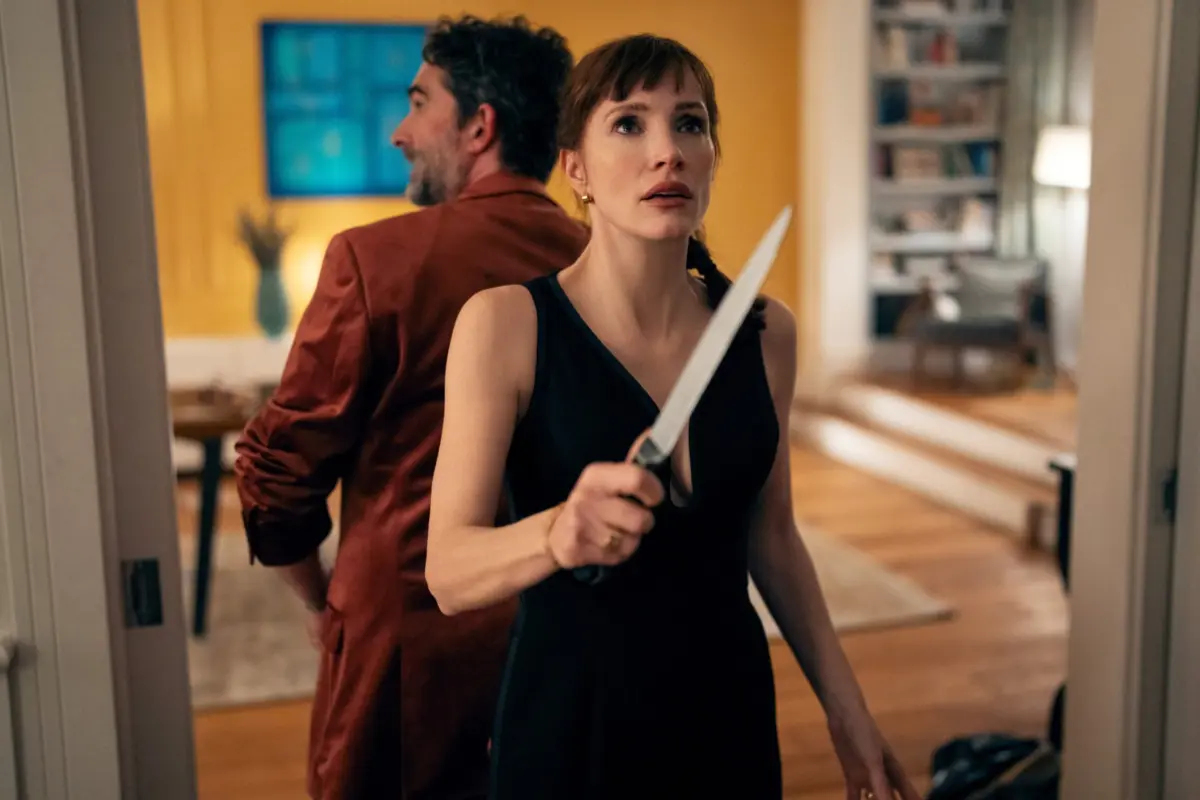
More often than not, the camera mechanically tracks around an unsuspecting character in a wide circle, revealing from directly behind them the film’s eponymous antagonist: the Other Mommy, played by Jessica Chastain wearing a grin that reads as far more goofy than genuinely unsettling. This demonic entity ultimately poses surprisingly little actual threat to the household, yet the movie treats every minor ghostly appearance as an apocalyptic event. The sheer effort exerted by the filmmakers in trying to make this exact gag work a hundred different ways would almost be considered endearing or adorable if it weren’t so consistently grating on the audience’s nerves.
When the story officially opens, young adolescent protagonist Bela, skillfully portrayed by Arabella Olivia Clark, is already intimately familiar with the sinister creature hiding out in her bedroom. The entity takes the unsettling form of her mother, Ursula, also played by Chastain. It is not long before her unsuspecting father, Russell, played by Jay Duplass, catches a fleeting glimpse of the monstrous imposter as well. The creature casually taunts them in the family kitchen one morning, leading to an entirely straight-faced narrative premise where every single member of the family readily and immediately accepts that there is a malicious, exact copy of Ursula lurking somewhere inside their domestic space.
Bizarrely, this copy spends time contorting her physical body into the shape of a swastika for reasons that are never given any real explanation or narrative justification. In the vast majority of conventional horror movies, when characters encounter the impossible, they feature skeptical naysayers and doubting family members specifically for the purpose of building dramatic tension, suspense, and narrative intrigue. “Other Mommy,” however, displays almost zero interest in utilizing these traditional mechanics of suspense building, choosing instead to dive headfirst into absurdity without establishing any grounding reality first.
Despite gazing directly at the ghostly presence in full view, Bela’s parents never seem all that genuinely spooked or emotionally traumatized by the ordeal. This lack of reaction persists even during a sequence where the young girl is physically tossed around the living room like a helpless rag doll during an anniversary gathering hosted at their suburban home. Throughout the narrative, no human character seems to behave like a real, psychologically grounded person. Meanwhile, the Other Mommy functions merely as an impish rogue loosely comparable to Pennywise the Clown, minus any of the genuine terror or child-eating stakes associated with Stephen King’s famous creation.
Instead, the picture operates as a succession of bizarre psychological pranks involving indoor ball pits, suddenly wonky household gravity, and a CGI-rendered version of Jessica Chastain that alternately melts away like the classic Batman villain Clayface and flails around wildly like an inflatable tube man stationed outside a secondhand automobile dealership. All the while, there is seldom any consistent sense of physical scale, spatial geography, or proximity to help put any of these chaotic supernatural set pieces into a proper visual perspective for the viewer.
To be fair, if an audience member squints hard enough, they can spot the bare bones of a compelling story and a thematic undercurrent. Early on, Bela harbors lingering suspicions that her mother might be having an extra-marital affair. Therefore, the concept that Ursula is somehow not who she appears to be initially makes for a worthwhile, emotionally resonant entry point into a broader tale exploring the psychological horror of an eerie, dead-eyed copy—at least in theory.
In actual cinematic practice, however, this mischievous supernatural presence constantly ping-pongs wildly between maternal domestic lies and the wholesale, unmotivated impersonation of other everyday people. While this chaotic shifting may or may not be entirely in keeping with the narrative structure of the original source novel, very little of the movie’s condensed, 94-minute runtime feels guided by any cohesive visual, thematic, or emotional idea. The production all but abandons the “Mommy” half of its thematic premise long before the credits finally roll, leaving the audience stranded in a narrative wasteland.
Adding to the overall sense of disorientation, each of the three principal cast members appears to belong to an entirely different movie altogether. Jessica Chastain goes completely for broke with unbridled melodrama as she juggles the dual roles of both the real and the fake Mommies. Meanwhile, young Arabella Olivia Clark, although asked to play a character significantly younger and much more naive than her own actual chronological age, maintains a surprisingly captivating and naturalistic presence on screen. She holds her ground admirably until she eventually appears to visibly tire of the repetitive, dead-end premise—and frankly, it is difficult to blame her for checking out mentally.
Jay Duplass, rounding out the core trio with his trademark “aw, shucks” demeanor, reads less like a panicked father facing a demonic invasion and much more like a broad, improvisational caricature plucked straight out of a late-night comedy sketch. The entire enterprise is hopelessly all over the place tonally. This fractured feeling is not helped by the fact that individual scenes frequently appear to begin and end entirely at random, devoid of any natural narrative flow or rhythmic editing—a clear byproduct of a film that has evidently been cut down within an inch of its life in the editing suite.
In the most basic sense of cinematic grammar, a film in which supernatural scares and dread are supposed to arise courtesy of negative space ought to at least feature thoughtful, deliberate framing. Instead, the endless series of startles arrive with the exact same flat weight and monotonous energy as the cheap narrative fake-outs that precede them. Dramatic tension dissipates instantly no matter who or what jumps out suddenly from darkened hallways, as the movie constantly veers erratically between tangible physical dangers and purely imaginary sequences.
Throughout these segments, Chastain’s ethereal, spiritual entity occupies young Bela’s attention less like a terrifying demonic threat and more like an annoying, persistent daydream that refuses to fade. Ultimately, that is precisely what “Other Mommy” becomes to its paying audience as well: a persistent annoyance to be handwaved away rather than a genuine source of cinematic tension or thematic meaning to be confronted at any stage of the viewing experience. Audiences might as well keep their arms and legs dangling outside the ride; judging by how things progress, this picture is simply not going anywhere of consequence.