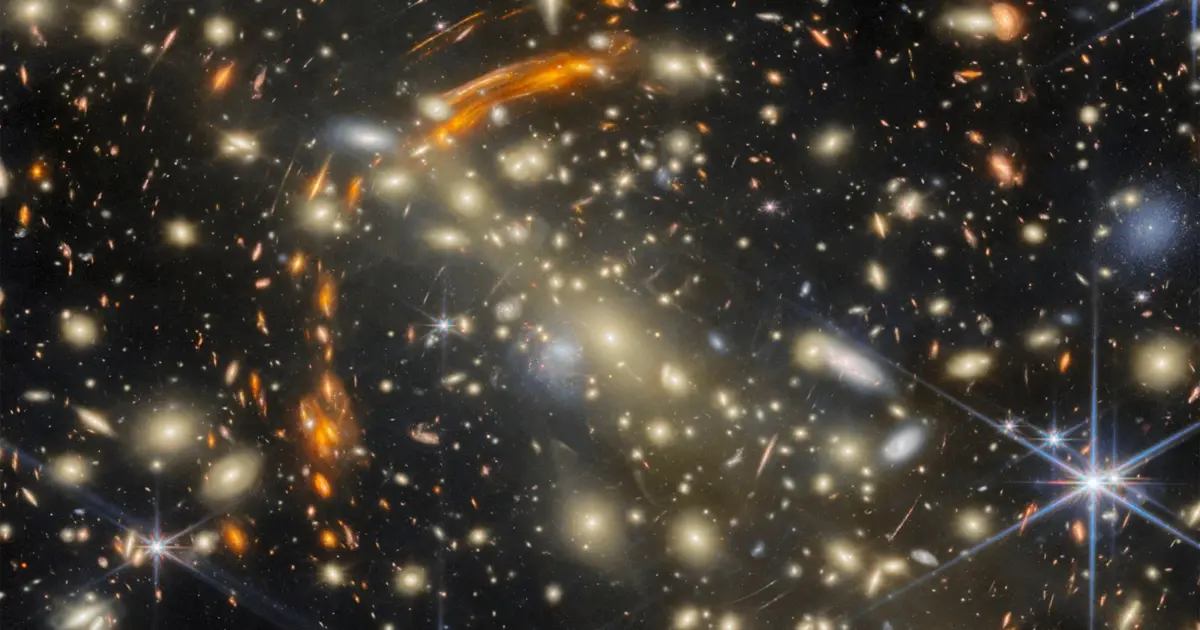
The National Aeronautics and Space Administration (NASA), the European Space Agency (ESA), and the Canadian Space Agency (CSA) have released the latest Picture of the Month captured by the James Webb Space Telescope (JWST). The new photograph stands as one of the most stunning, clear, and powerful examples of gravitational lensing ever recorded by humanity, showcasing a dense, complex field of galaxies whose light has been profoundly bent, multiplied, and amplified by the colossal mass of a foreground galaxy cluster.
Described by ESA Webb scientists as a "cosmic house of mirrors," the breathtaking image features the galaxy cluster known as MACS J0454.1-0300. Within this celestial tapestry, distant galaxies appear warped and multiplied, looking very much as though they have stepped into a galactic carnival. These heavily distorted galaxies sit at immense distances from Earth. While striking orange galaxies scattered on one side of the cluster are situated even farther away, MACS J0454.1-0300 itself lies roughly five billion light-years from Earth. Because of the vast distances involved, the ancient light captured in Webb’s photograph reveals these systems as they existed when the universe was only about eight billion years old, effectively turning the space telescope into a cosmic time machine.
Space telescopes like the JWST and its predecessor, the Hubble Space Telescope, rely on the phenomenon of gravitational lensing to peer deep into the far-distant universe. In fact, the very mechanism that warps the appearance of these galaxies in the photographic frame is what makes them visible to our instruments in the first place.
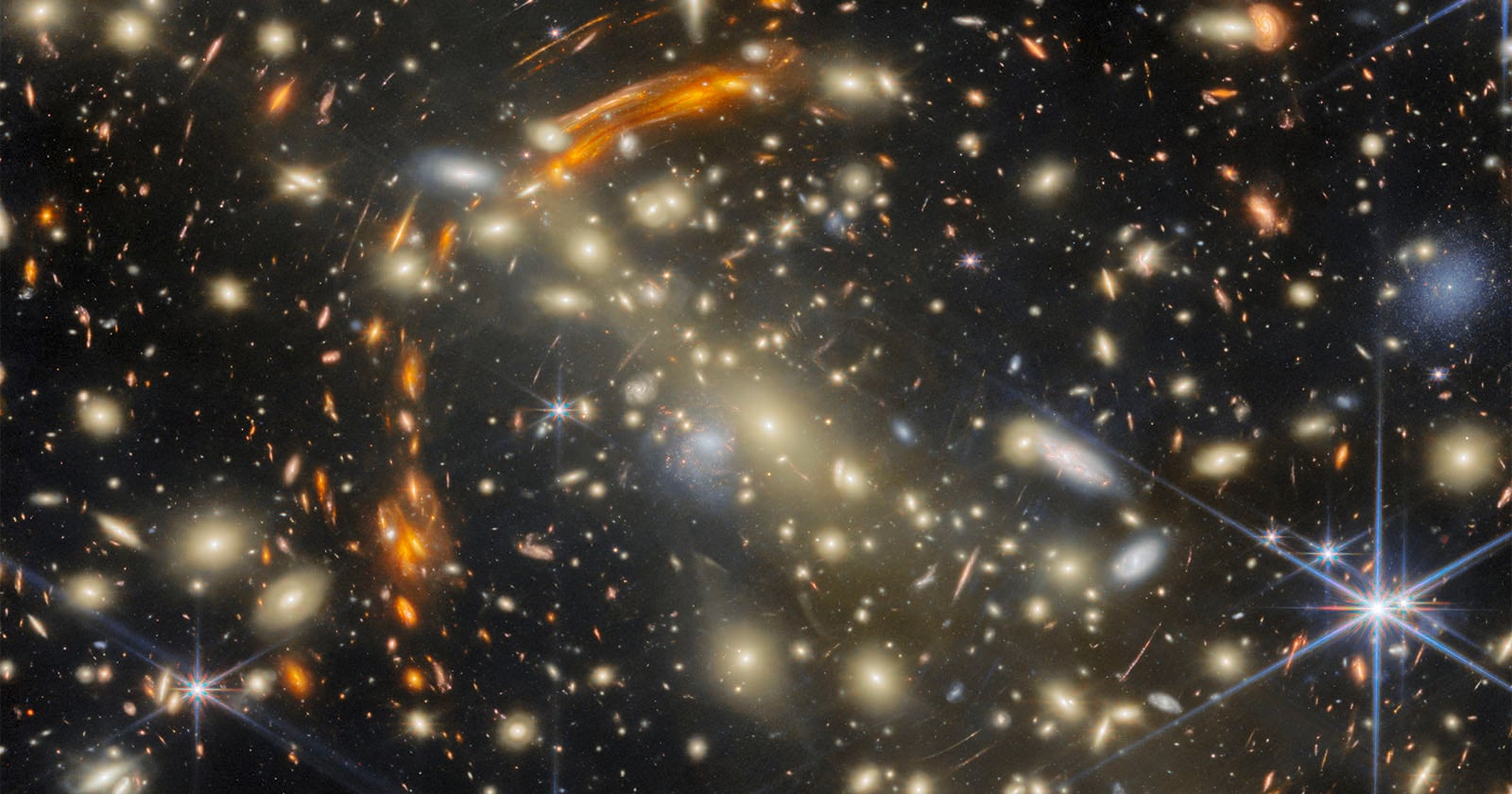
Gravitational lensing occurs naturally when a celestial body—such as a massive galaxy cluster—possesses so much mass that it literally bends the trajectory of light traveling from objects situated behind it relative to the observer on Earth. This phenomenon is a direct, observable consequence of Albert Einstein’s general theory of relativity, which revolutionized our understanding of physics by establishing that space and time are fused together into a unified continuum known as spacetime.
According to Einstein’s framework, massive objects cause the fabric of spacetime to curve, and what we perceive as gravity is fundamentally the geometric curvature of spacetime. As light propagates through the universe, the theory predicts that the path taken by photons will be curved and deflected by an object’s mass. Extremely massive celestial bodies, like galaxy clusters containing trillions of stars and vast reservoirs of dark matter, cause spacetime to curve so dramatically that they function precisely as lenses.
Crucially, these natural gravitational lenses do more than just bend light; they also act like colossal magnifying glasses. By concentrating and focusing light rays from background sources, gravitational lensing makes it possible for astronomers to photograph and study objects that would otherwise remain far too distant, faint, and obscured to ever witness directly. Scientists have learned to use this cosmic phenomenon to great advantage with modern observatories. Paired with Webb’s massive 6.5-meter primary mirror and its highly sensitive infrared instruments, researchers utilizing the JWST have consistently shattered previous records for identifying the most distant galaxies ever observed in the cosmos. Put another way, gravitational lensing has enabled humanity to peer farther back into the history and evolution of the universe than ever thought possible.
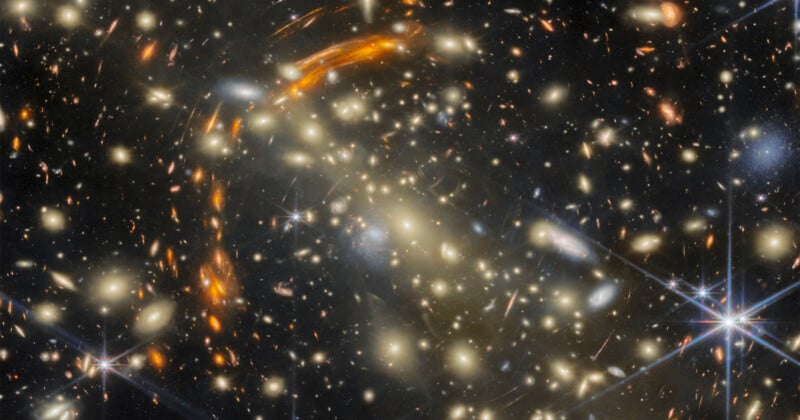
In Webb’s latest Picture of the Month, another rare and fascinating optical phenomenon associated with gravitational lensing is on full display. Under precise cosmological conditions, a single background galaxy can have its light bent around a foreground lens in such a way that multiple distinct images of the very same galaxy appear to the observer, creating double, triple, or even quadruple copies scattered across the frame.
According to ESA Webb, it is exceptionally rare to observe four or more distinct images of the exact same background galaxy. Producing this visual multiplication requires a highly specific alignment: the precise position of the background object and the exact mass distribution and shape of the massive foreground lens must line up in a very particular configuration. Because these requirements are exceptionally rigorous, this particular multi-image phenomenon is only observed in roughly ten to twenty percent of all known galaxy clusters.
This rare configuration is visibly duplicated twice within Webb’s new photograph of MACS J0454.1-0300. Astronomers note that this marks the first time such a double-occurrence has ever been documented within a single galaxy cluster. Furthermore, the compounding effects of this alignment mean that certain locations within the gravitationally lensed regions have been magnified by an astonishing factor of 300, revealing structural details of ancient galaxies that defy ordinary observation.
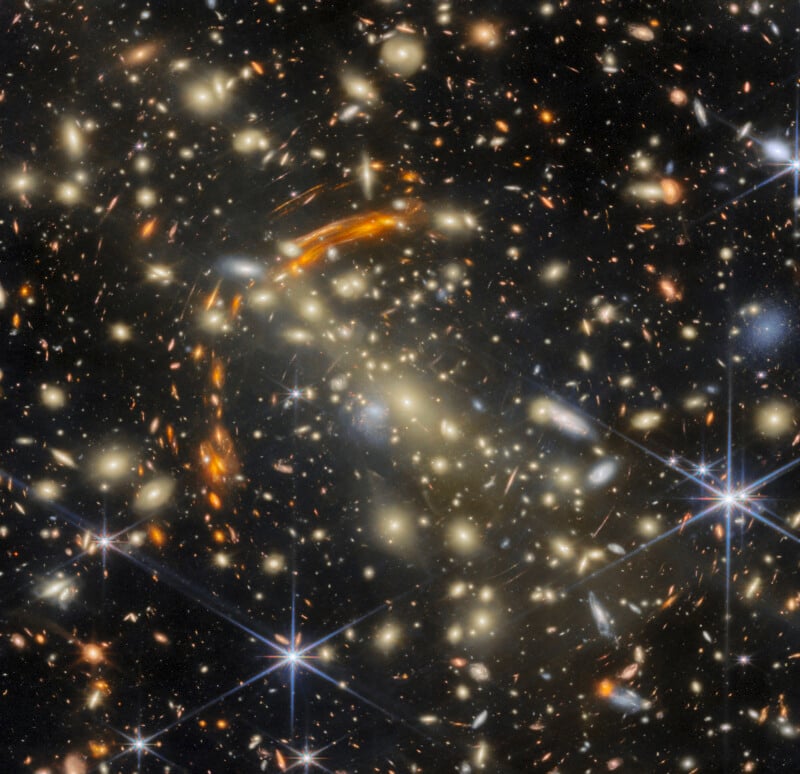
Despite its groundbreaking nature, the James Webb Space Telescope is not the first observatory to turn its gaze toward MACS J0454.1-0300. Twelve years prior to the release of Webb’s image, the Hubble Space Telescope captured the exact same patch of sky. Placing the two historic images side by side illustrates just how profoundly advanced Webb’s photographic and spectroscopic capabilities are, as the two space-based portraits could hardly look more different from one another.
The new Webb image reveals hundreds of galaxies that were completely missing from the earlier Hubble photograph. According to ESA Webb, those distant galaxies were present in the field of view all along, but the James Webb Space Telescope possesses vastly superior sensitivity to the much redder, longer-wavelength infrared light emitted by ancient, dust-obscured cosmic structures.