When Apple officially discontinued the Mac Pro earlier this year, it brought a rather quiet end to a brief, experimental chapter in the company’s hardware history: an era defined by stuffing high-performance Mac Studio internal components into a massive, cavernous Mac Pro housing. For many industry professionals, the departure of the tower raised questions about the future of Apple’s most performance-heavy desktop ecosystem. However, putting the newly released M5 Ultra Mac Studio through its paces reveals that the Mac Pro died in name only.
The final iteration of the Apple Silicon Mac Pro, which debuted in 2023, always faced a fundamental identity crisis. It relied on the exact same computer architecture and the same M2 Ultra chip found in the much smaller Mac Studio, offering only limited PCIe expansion slots inside an oversized chassis without any distinct performance advantage. Now, with the M5 Ultra Mac Studio occupying desk space and posting staggering performance metrics, it becomes clear that the Mac Pro was never truly abandoned. Instead, it was spiritually reborn within the Ultra series of the Mac Studio line.

The reviewed configuration of the Mac Studio with the M5 Ultra arrives at a steep price point of $12,300. While undoubtedly a massive investment for any desktop computer, this figure represents a noticeable shift when viewed through the historical lens of Apple’s professional desktop tier. The machine sits only slightly above the 2023 Mac Pro’s $11,800 launch price and the 2013 “trash can” Mac Pro at $10,000, while costing a fraction of the fully loaded 2019 Mac Pro’s infamous $52,600 price tag. More importantly, this generation delivers a massive performance leap that Apple’s previous tower configuration never experienced, all while sidestepping the extreme pricing tiers of past top-end desktops. For those who mourned the passing of the Mac Pro, reports of its death have been greatly exaggerated.

Design and Build Quality
The review unit furnished for testing represents the absolute pinnacle of current Apple desktop specifications. It houses an M5 Ultra chip featuring a 36-core CPU—split between 12 super cores and 24 performance cores—alongside an 80-core GPU, 256GB of unified memory, and 4TB of internal solid-state storage. A 512GB internal memory option is slated for release at a later date, though it was unavailable at the time of publication. While users can opt to spend an additional $6,000 to maximize internal storage to 16TB, the tested configuration easily qualifies as a fully loaded machine for professional workflows. At the time of publication, Apple manufactures no computer more powerful.

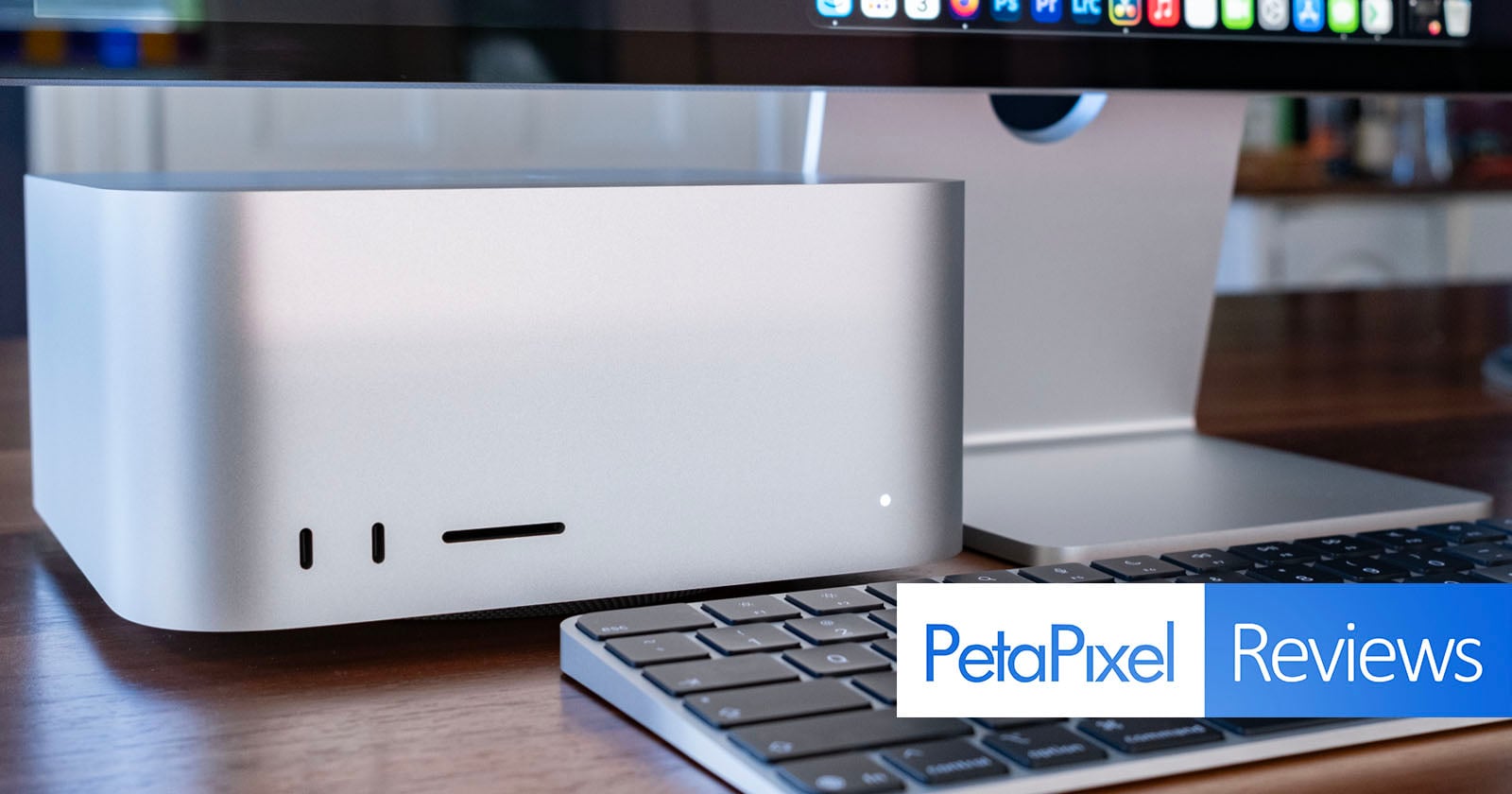
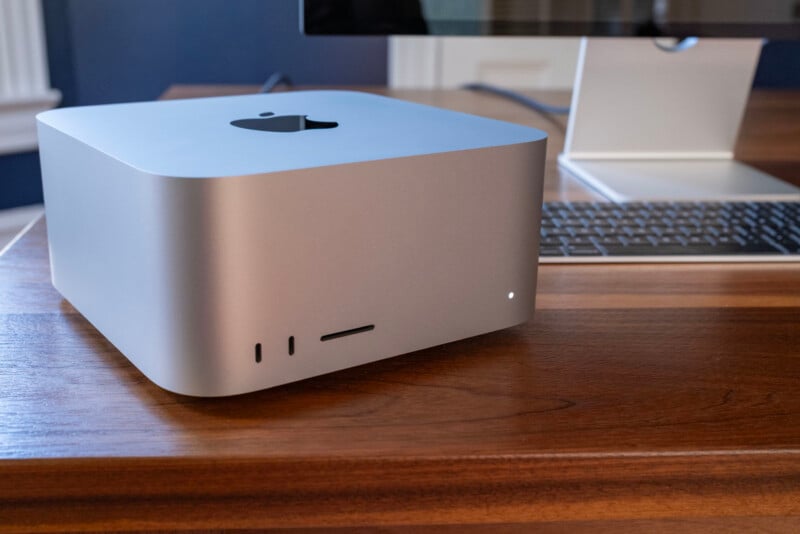
Examining the exterior reveals that the physical design remains identical to the M5 Max Mac Studio and the original Mac Studio introduced in 2023. It retains its familiar silver aluminum rectangular chassis, measuring 3.7 inches tall, 7.7 inches wide, and 7.7 inches deep while weighing approximately eight pounds. The substantial heft prevents the device from shifting around a desk when plugging in peripherals or reaching around to access the power button, yet it remains light enough to reposition when necessary. The thermal management system remains remarkably quiet, with the internal fan rarely making itself audible even under heavy computational loads.
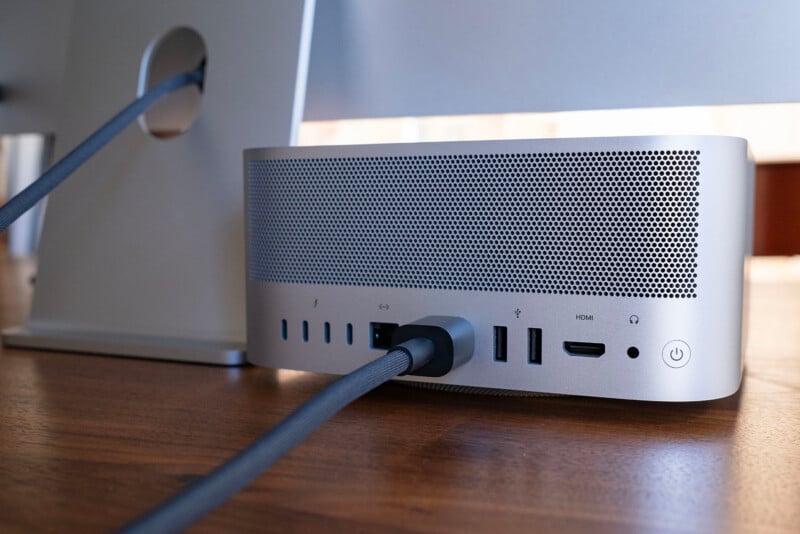
Connectivity options represent a key area of distinction for the Ultra series. The rear panel incorporates four Thunderbolt 5 ports, a 10Gb Ethernet port, two USB-A ports, an HDMI 2.1 port, a 3.5mm headphone jack, and the power button. The front panel features an SD card reader, a power indicator light, and two additional Thunderbolt 5 ports that support high-speed USB-C connectivity up to 80 Gb/s. This front-facing inclusion provides a substantial workflow advantage for video editors working with external SSD RAID arrays or handling external footage on location. Furthermore, the Ultra configuration expands display support significantly compared to the Max variants, driving up to eight separate 5K displays simultaneously, including four Apple Studio Display XDR monitors running at 5K resolution and 120Hz.
Performance Benchmarking: Adobe Photoshop
Evaluating the M5 Ultra chip within a desktop chassis highlights the unique position of the Ultra series, which appears exclusively in desktop form factors roughly once every couple of years. Puget Systems benchmarking tools provide a standardized metric for evaluating the hardware across essential creative applications, starting with Adobe Photoshop.
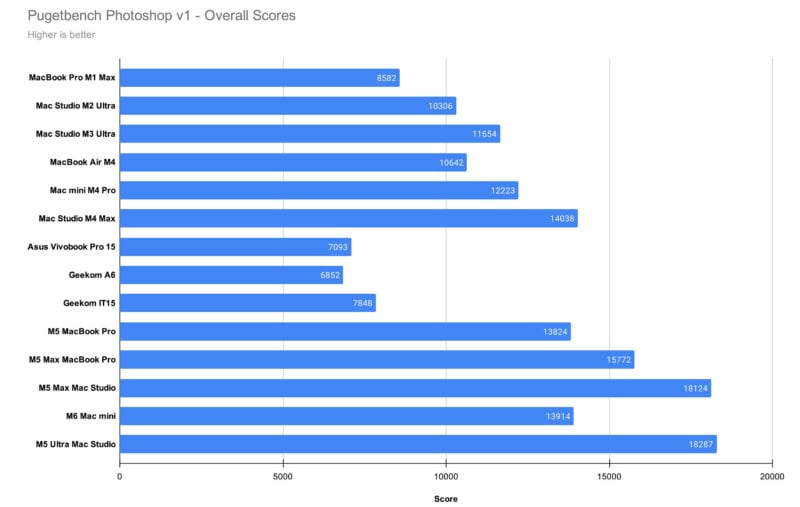
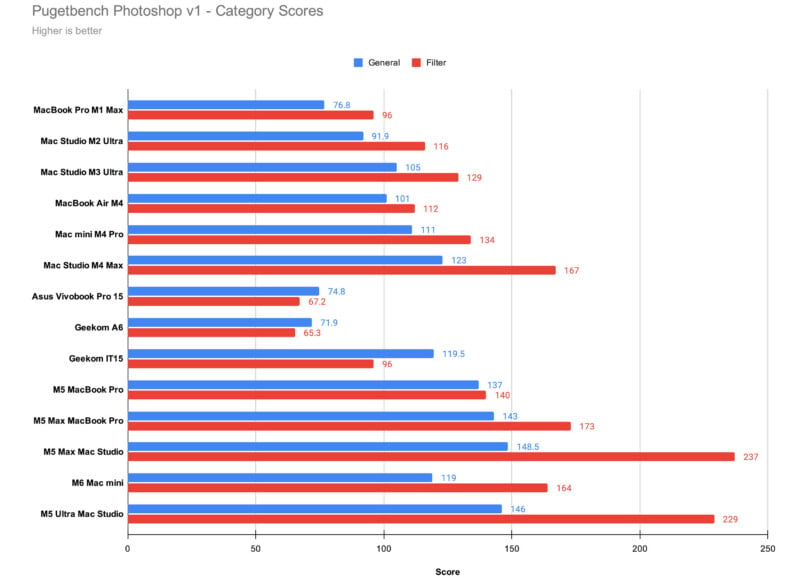
Photoshop remains primarily dependent on CPU performance rather than heavy GPU acceleration. Consequently, despite the massive hardware upgrade of the M5 Ultra over the M5 Max, performance gains in Photoshop are incremental rather than revolutionary. While the M5 Ultra stands as the most capable Photoshop machine tested, users working primarily within CPU-bound photo editing environments will notice minimal practical differences between the M5 Ultra and the M5 Max. Aside from older baseline M4 hardware or previous-generation M2 and M3 Ultra setups, recent Apple silicon systems process standard Photoshop tasks at comparable speeds.
Performance Benchmarking: Adobe Lightroom Classic
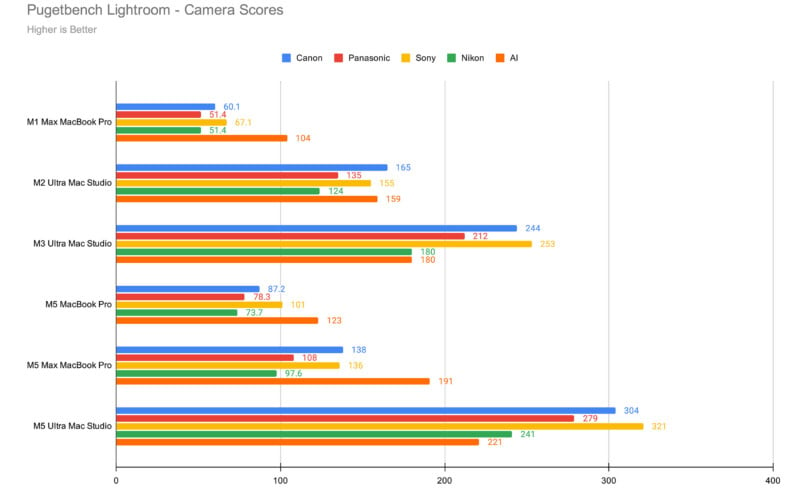
The narrative changes dramatically when shifting to Adobe Lightroom Classic, which benefits heavily from GPU acceleration. Puget Systems’ comprehensive benchmark imports 250 high-resolution RAW image files captured on flagship cameras like the Canon EOS R5 Mark II, Panasonic Lumix S1R II, Sony a1 II, and Nikon Z8, followed by Smart Preview generation, batch exporting, and rigorous AI-driven tasks including sky selection, subject masking, reflection removal, denoise, and super resolution.
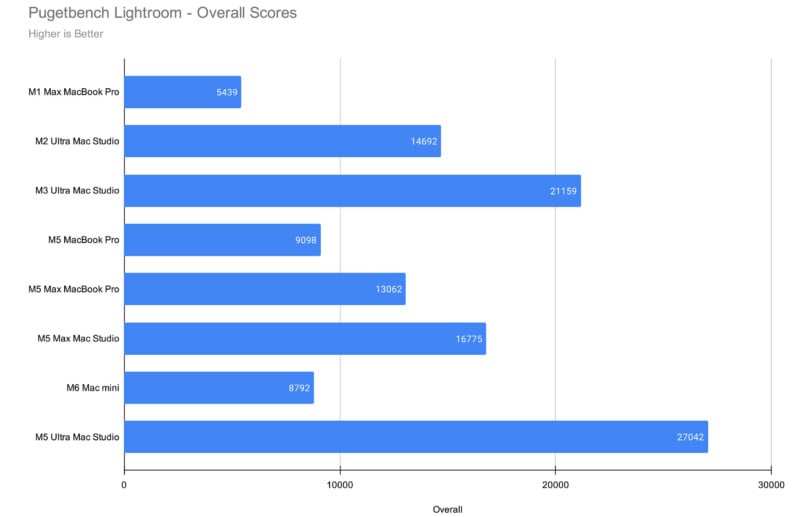
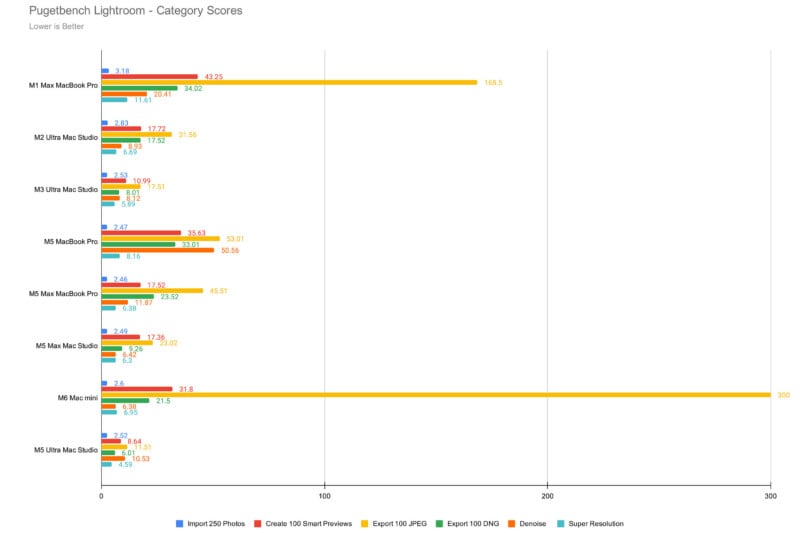
Powered by its substantial 80-core GPU, the M5 Ultra crushes every predecessor in the benchmark history, delivering nearly double the performance of the M2 Ultra and running roughly 22% faster than the M3 Ultra. When compared against non-Ultra architectures, the performance disparity widens even further, outpacing baseline processors significantly and operating nearly twice as fast as the M5 Max Mac Studio. Across almost every camera score category, the Ultra-series processor leapfrogs prior generations by a wide margin, establishing itself as the most powerful Lightroom workstation Apple has ever produced.
Performance Benchmarking: Adobe Premiere Pro and DaVinci Resolve
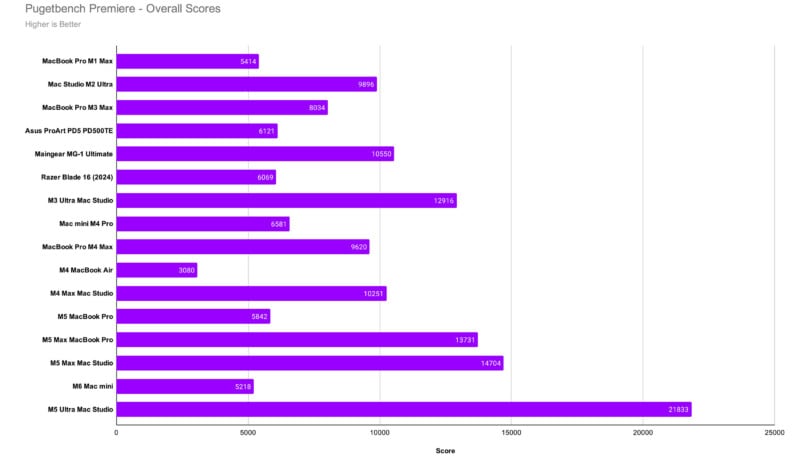
Video editing workflows represent the primary domain for a machine of this caliber, and the M5 Ultra delivers extraordinary results in both Adobe Premiere Pro and DaVinci Resolve. Driven by intense GPU utilization, Premiere Pro performance highlights the strength of the 80-core architecture, outperforming the M2 Ultra, high-end PC video editing configurations, and the M4 Max Mac Studio by a factor of two.
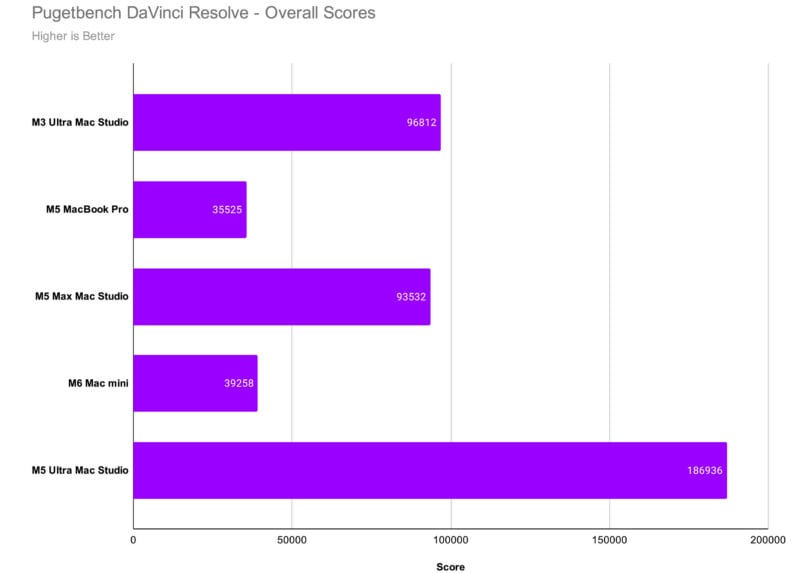
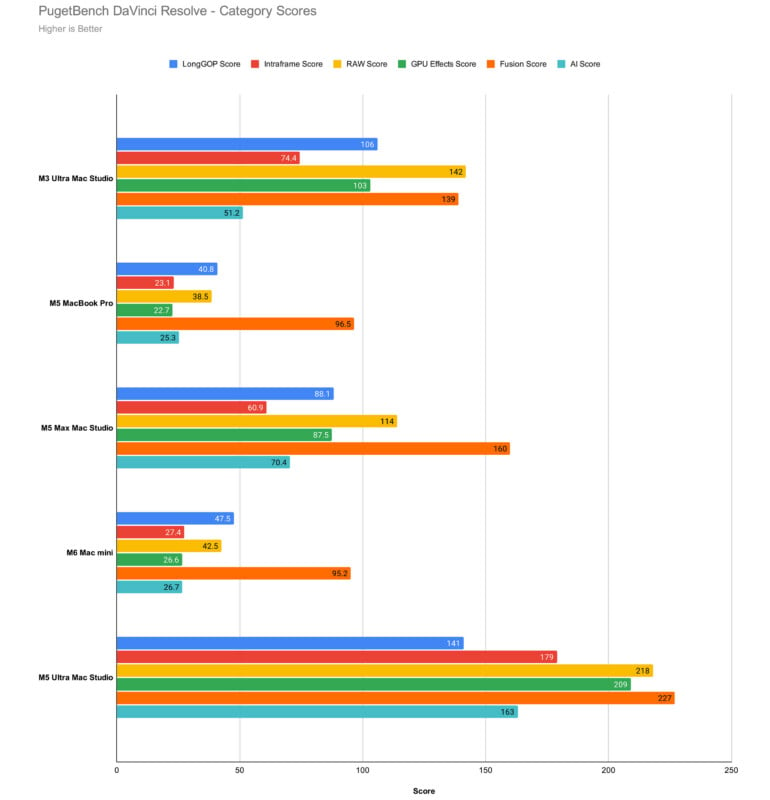
In DaVinci Resolve, the generational leap is equally profound. Despite limited historical backlog due to recent benchmark updates, the M5 Ultra doubles the performance scores of the previous top-tier M3 Ultra. Every measured category—including GPU effects, Fusion rendering, and AI processing tasks—demonstrates overwhelming gains, proving that single-generation architectural improvements can still shatter expectations.
Analyzing the Value and the Ultra Ecosystem
For photographers who do not engage in heavy video production, the Ultra series represents an unnecessary expenditure over an M5 Pro or M5 Max configuration. Many professionals continue to work comfortably on older M1-generation hardware, as import and export queue times rarely bottleneck the actual creative process.
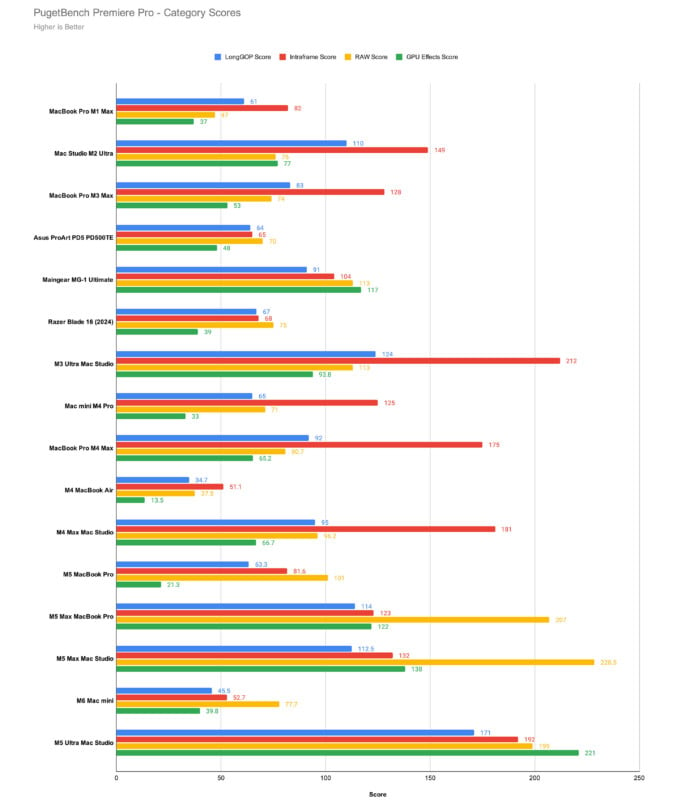
Conversely, modern high-resolution workflows involving 6K open-gate and RAW video formats continue to push older hardware to its absolute limits. For dedicated video editors handling demanding compressed codecs, the performance ceiling offered by the M5 Ultra provides essential headroom. The massive gap in capability between the M5 Ultra and standard consumer configurations reinforces the perspective that the Ultra designation has effectively assumed the mantle of the historical Pro tier.
Regarding expanded memory options, Apple’s upcoming 512GB configuration—priced at an additional $6,000—remains largely unnecessary for standard creative workflows. Core performance drivers like the GPU and memory bandwidth dictate application speed in Premiere Pro, DaVinci Resolve, and Lightroom Classic, leaving RAM expansion primarily beneficial for local artificial intelligence model training and large language model clusters rather than traditional media post-production.
For the vast majority of photo and video editors, the M5 Max Mac Studio remains the top overall recommendation. However, for the select percentage of professionals managing demanding billable workloads, the M5 Ultra Mac Studio delivers an unrivaled hardware experience. Tales of the professional desktop’s demise were greatly exaggerated; the Mac Pro lives on through the silicon prowess of the Mac Studio.