SAN FRANCISCO — Your favorite meal is now just a text or Slack message away, thanks to a sweeping suite of new artificial intelligence-powered features unveiled by DoorDash. As the landscape of on-demand delivery continues to evolve rapidly through technological innovation, the leading delivery platform is making significant strides to integrate its services directly into the daily communication channels where consumers and professionals already spend a substantial portion of their time.
During a high-profile media event held in San Francisco and livestreamed to audiences on Tuesday, DoorDash co-founder Andy Fang introduced the company’s latest advancements in AI integration. Among the headline announcements was the launch of the DoorDash Model Context Protocol (MCP) tailored specifically for corporate ordering. This sophisticated tool is designed to make it remarkably easier for businesses to put their office restaurant orders, team lunches, and supply restocks entirely on autopilot, fundamentally transforming how workplaces manage their catering and pantry needs.
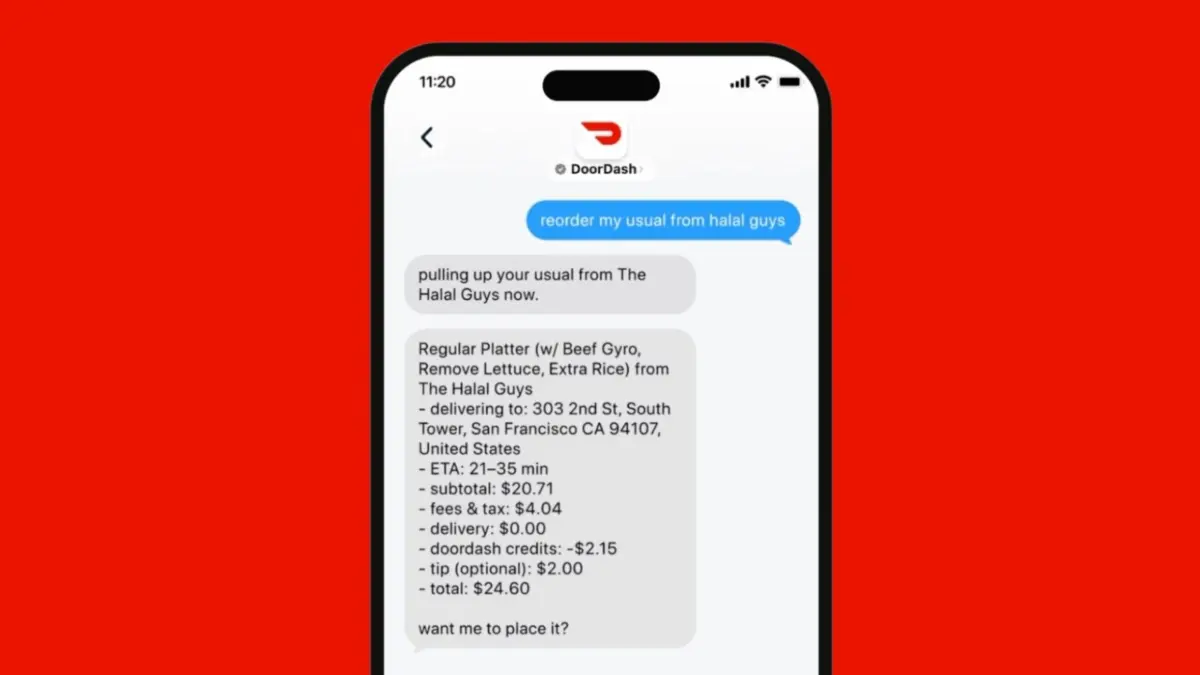
In addition to catering to the corporate sector, the delivery giant is also rolling out innovative features aimed at everyday consumers. The company has officially started piloting a new capability through Apple Messages that allows individuals to simply text DoorDash whatever they happen to be craving at the moment, or to effortlessly reorder their usual favorites with a few conversational keystrokes. Rather than navigating a traditional mobile application or browsing through menus, users can interact with the service as if they were messaging a friend, letting natural language processing handle the logistics of their food delivery experience.
This consumer-facing product is already making its way into the hands of real users, currently live with 20,000 consumers across the United States as part of its initial rollout phase. By bridging the gap between conversational messaging interfaces and logistics execution, DoorDash is positioning itself at the forefront of the next generation of commerce, where friction is reduced to the absolute minimum.
The introduction of the Model Context Protocol for corporate ordering represents a major leap forward for the company’s business-to-business strategy. Corporate administration, office management, and team provisioning often involve repetitive, time-consuming tasks such as coordinating weekly team lunches, ordering coffee and snacks for the breakroom, or organizing catering for client meetings. By leveraging advanced AI protocols, DoorDash aims to eliminate the administrative overhead associated with these tasks. Companies can now integrate the ordering system directly into platforms like Slack, allowing teams to coordinate meals collectively or automate recurring office restocks without requiring manual intervention from office managers every single time a delivery needs to be made.
This strategic push into workplace automation aligns with broader industry trends toward ambient computing and workflow integration. As modern enterprises increasingly rely on centralized messaging platforms like Slack for day-to-day operations, bringing logistical services like food delivery directly into those workspaces creates a seamless ecosystem. Employees no longer need to switch contexts, open a separate browser tab, or download a dedicated app to organize team meals; they can manage everything within the communication tools they already use to collaborate with their colleagues.
Simultaneously, the pilot program utilizing Apple Messages highlights DoorDash’s commitment to capturing consumer intent at the exact moment it arises. The integration allows users to communicate naturally, expressing broad desires or specific requests through standard text messaging. Whether a customer is typing out a craving for late-night pizza or asking the system to repeat their standard Friday lunch order from a local Thai restaurant, the AI-driven backend interprets the request, processes the transaction, and dispatches the order without requiring the user to tap through multiple screens within the traditional DoorDash application.
The initial rollout to 20,000 consumers in the United States serves as a critical testing ground for the technology. During the San Francisco media event, executives emphasized that gathering real-world feedback from these early adopters will be vital in refining the conversational AI’s accuracy, responsiveness, and ability to handle complex or nuanced food preferences. As consumer expectations for speed and convenience continue to rise, the ability to order food as simply as sending a text message could represent a significant competitive advantage in the crowded delivery market.
The unveiling of these features underscores a broader technological shift across the technology and delivery sectors, where artificial intelligence is increasingly being deployed not merely as a backend optimization tool, but as a primary front-facing user interface. By embedding its services into ubiquitous messaging platforms both in the office and on personal devices, DoorDash is effectively meeting its users wherever they are, redefining convenience for both individual consumers and corporate teams alike.