Known primarily for clever smartphone cases that transform modern handsets into the tactile equivalents of classic film cameras, Fotorgear is now setting its sights on dedicated hardware. The company’s upcoming project, the Fotorgear Campix, is a retro-styled digital camera that aims to blend vintage aesthetics with modern digital convenience. Featuring a distinctive waist-level electronic viewfinder, mechanical dials, and a classic black-and-silver finish, the Campix is shaping up to be an intriguing option for photography enthusiasts who yearn for the tactile charm of mid-century analog gear without the friction, expense, and development delays of actual film.
While Fotorgear has thus far kept official details under wraps through a series of early teasers and social media previews, the glimpses provided offer a clear picture of what the Campix aims to achieve. Rather than competing with high-end, professional mirrorless systems, the new device appears to position itself comfortably alongside the burgeoning market of budget-friendly, nostalgia-driven digital compacts. Devices such as the Camp Snap CS-Pro, the Rewindpix, and the Flashback One35 have demonstrated that consumers are increasingly eager for simple, distraction-free photographic tools that prioritize the physical experience of shooting over raw megapixels and complex menu systems.
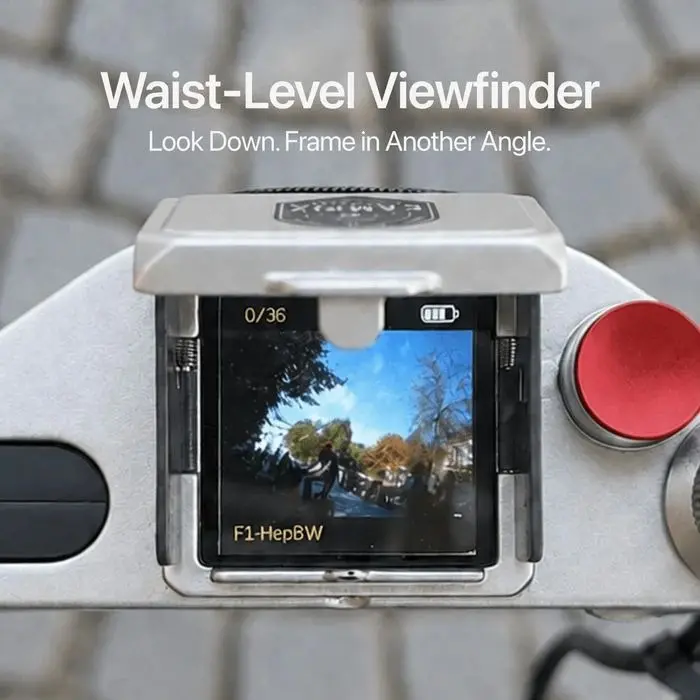
The standout feature of the Fotorgear Campix, and the one generating the most discussion among gear enthusiasts, is its waist-level viewfinder. For decades, the waist-level finder has been celebrated for offering a uniquely intimate and discreet way to compose images, allowing photographers to look down into the camera rather than holding it directly to their eye. While modern camera manufacturers have largely relegated this design element to the history books—though brands like Canon have occasionally teased similar concepts in experimental prototypes, and quirky toy cameras like the Chuzhao have adopted simplified versions—a true waist-level digital compact remains a rarity.
According to promotional teasers shared by Fotorgear on Instagram, flipping open the top hood of the Campix reveals a concealed electronic screen rather than an old-school optical mirror arrangement. This digital panel sits horizontally, mimicking the classic TLR (Twin-Lens Reflex) or medium-format experience while retaining the flexibility of a modern digital workflow. Adjacent to the viewfinder housing, a prominent pop-up module accommodates a built-in TTL Xenon flash, adding another layer of authentic retro utility to the top plate of the camera body.

Control layout is another area where the Campix leans heavily into its vintage inspiration. The top plate features mechanical-style dials, most notably a film wind dial and a dedicated film simulation dial. The latter allows users to cycle through six distinct built-in color profiles on the fly. Furthermore, Fotorgear intends to support a companion mobile application, enabling creators to "develop" their images digitally, upload custom presets, or import Look-Up Tables (LUTs) to fine-tune their preferred aesthetic look directly on their captured files.
In terms of optics, the Campix is designed with a fixed 26mm built-in lens, but Fotorgear has incorporated a modular twist. The camera will support swappable auxiliary lenses that mount directly over the primary 26mm glass, functioning similarly to the external clip-on conversion lenses commonly used on smartphones rather than the sensor-level interchangeability found on traditional mirrorless camera systems. This approach keeps the overall footprint compact while offering users some versatility in focal length and framing.
As anticipation builds for the official release, Fotorgear has announced that the Campix will launch via a Kickstarter crowdfunding campaign in the near future. To drum up early support and reward dedicated followers, the company has introduced a $5 deposit program—translated internationally to approximately £4, AU$7, or CA$7—which grants backers access to exclusive early-bird discounts and an extended one-year warranty once the crowdfunding platform goes live.
While final retail pricing has yet to be officially locked in, early estimates from Fotorgear suggest that the base camera model could retail around $209, with a comprehensive three-lens bundle climbing to roughly $509. However, backers participating in the upcoming Kickstarter campaign can expect substantial introductory discounts ranging from $100 to $150 off standard retail pricing. International pricing has not yet been formally detailed, but direct currency conversions place the base estimates around £158, AU$299, or CA$296 prior to any campaign-specific reductions.
With manufacturers continuing to explore alternative form factors—such as the waist-level screen layout seen on recent releases like the Instax Pal 2, alongside a growing market for screen-free digital compacts—the Fotorgear Campix arrives at a time when the photographic community is actively re-evaluating the role of simplicity and style in modern image-making. Whether the Campix can successfully bridge the gap between novelty toy cameras and functional everyday carry tools remains to be seen once review units reach the public, but its unique feature set ensures it will be one of the most closely watched releases of the season.