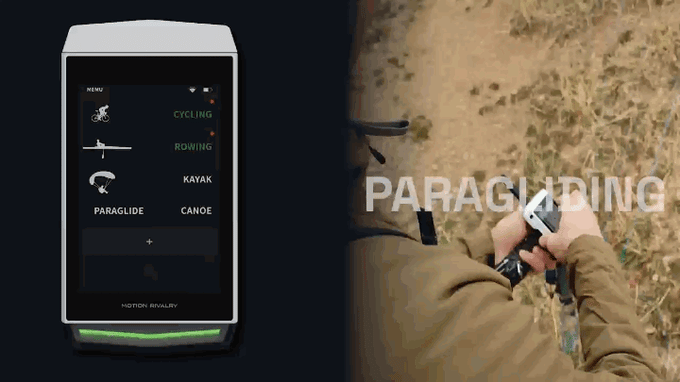
Athletes who have spent years juggling an expensive array of specialized gadgets—ranging from separate walkie-talkies and action cameras to dedicated wind meters—are finally looking at a much lighter hardware bill and a significantly less cluttered gear bag. Motion Rivalry has introduced a compelling solution with REACH, widely hailed as the world’s first modular multi-sport GPS computer. Rather than forcing athletes to stock a shelf with standalone devices for every distinct pursuit, REACH folds multiple hardware capabilities into a single, cohesive unit. By allowing users to simply snap on whichever accessory a specific training session calls for, the device adapts seamlessly across a diverse spectrum of activities, including cycling, rowing, kayaking, canoeing, and paragliding. It represents a paradigm shift in sports technology, offering hardware that is reconfigured rather than entirely replaced as an athlete’s training shifts from one discipline to the next.
The ingenious mechanism driving this versatility is a single, open-source connector seamlessly integrated into the top of the main unit. This standardized interface accepts various hardware modules in a matter of seconds, eliminating the frustrating need to fumble with tools, proprietary mounts, or complicated setups in the middle of preparation. Instead of purchasing an entirely new device every time an athlete picks up a new sport or changes their training focus, REACH treats its core body as a sturdy foundation designed to be continuously built upon. It functions less like a static, finished gadget and more like an evolving platform engineered to grow alongside whatever athletic discipline captures an individual’s attention throughout different seasons.
Currently making waves on Kickstarter, where it has already surpassed $122,000 in backing, the device is drawing substantial attention from outdoor enthusiasts and competitive athletes alike. Motion Rivalry’s innovative approach addresses a long-standing frustration in the sports tech market, where specialization often translates to excessive financial cost and hardware redundancy. By consolidating the fundamental electronics into a central hub, the system drastically cuts down on the sheer volume of gear athletes must carry, charge, and maintain.
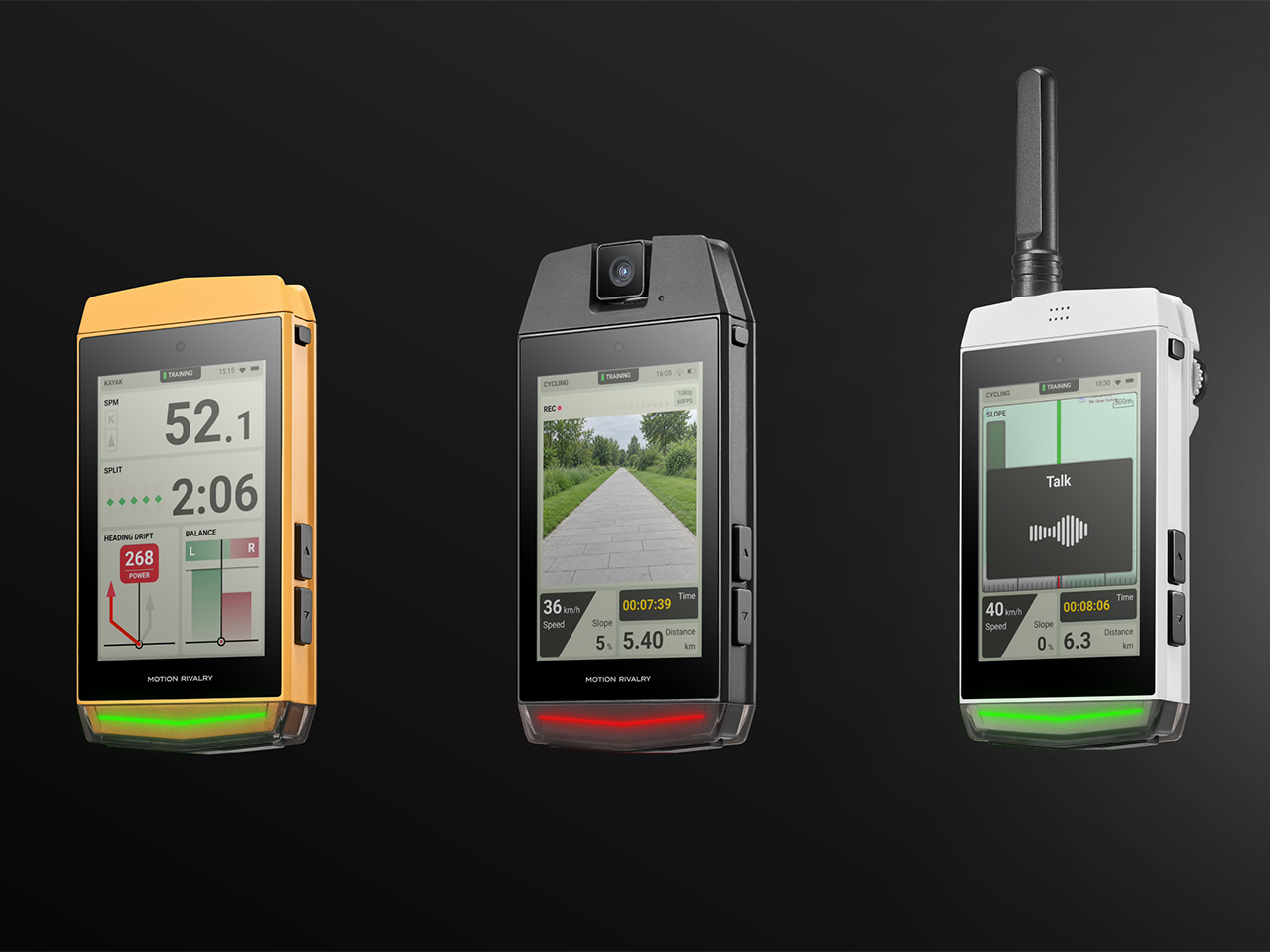
A closer look at the available ecosystem reveals how the modular design directly serves the practical demands of outdoor and endurance training. Two of the four initial modules are specifically engineered to enhance situational awareness and communication in the field. The Walkie-Talkie module bridges the communication gap between athletes and coaches, allowing a coach stationed on a riverbank or training course to stay in constant contact mid-session. Operating smoothly across a line-of-sight range of 0.6 to 1.2 miles, or roughly 1 to 2 kilometers, the module supports multiple channels to ensure clear lines of communication even in busy training environments.
Complementing the communication tool is an advanced Radar module designed to monitor the immediate surroundings. Utilizing 24GHz mmWave sensing technology, the radar is capable of detecting objects positioned between 16 and 98 feet away across a broad 100-degree field of view, providing an extra layer of safety and environmental awareness for athletes navigating shared spaces or dynamic courses.
The remaining two modules lean heavily into performance documentation and environmental data acquisition. The Camera module offers the ability to capture crisp 1080p video footage at 60 frames per second. Housed within a rotatable, splash-resistant enclosure that mounts directly onto the primary head unit slot, it effectively eliminates the need for bulky, separate action-camera brackets and redundant mounting hardware. Meanwhile, the Wind Meter module delivers precise, live wind speed readings down to 0.1 meters per second, alongside vital ambient data such as humidity and temperature metrics that carry immense importance for athletes operating in wind-dependent environments or airborne disciplines.
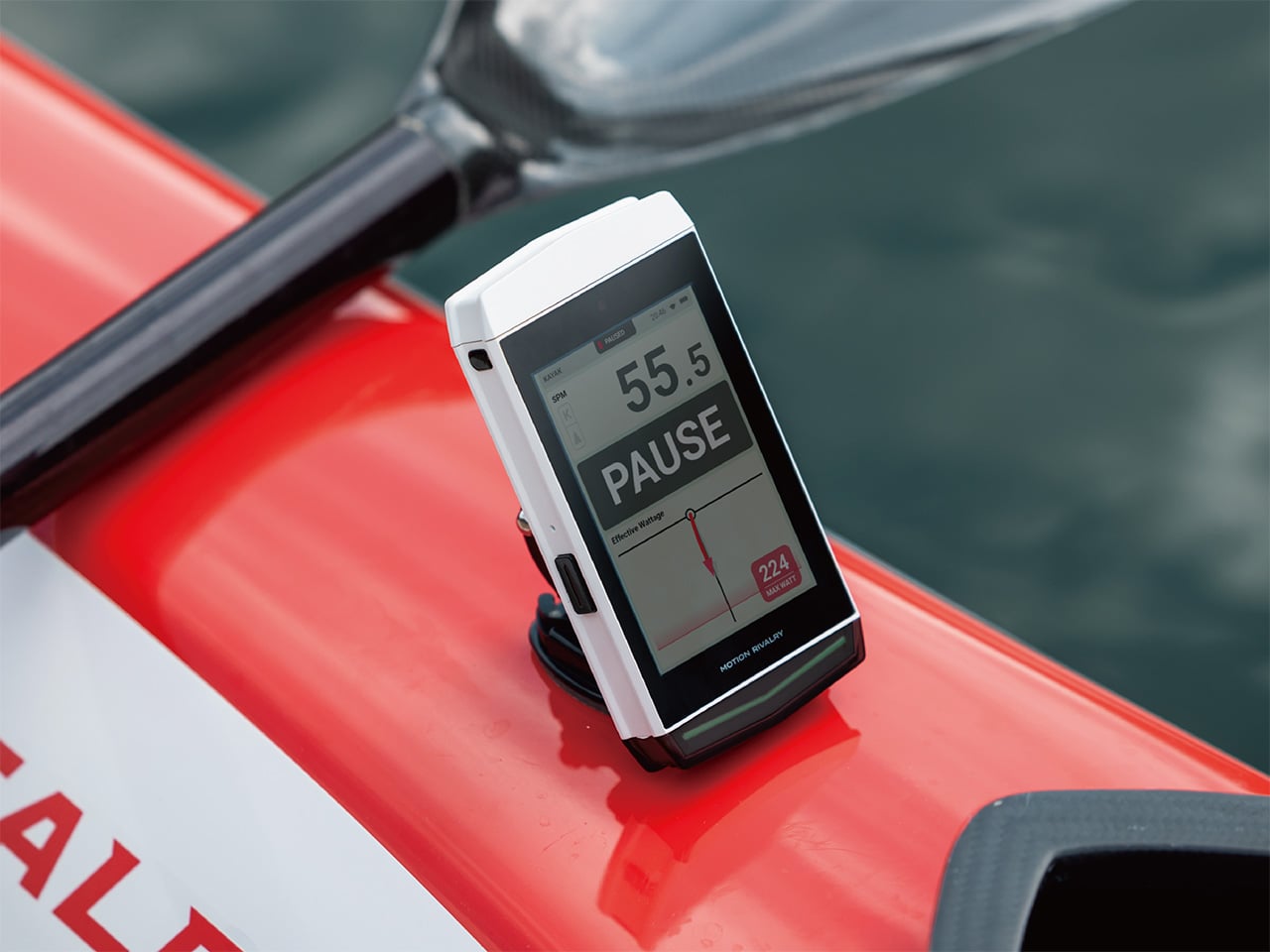
When taken out onto the water for rowing, kayaking, or canoeing, REACH puts its most sophisticated internal sensors to rigorous work. Water sports demand hyper-responsive data tracking, a challenge met by a 10Hz multi-constellation GNSS receiver. While standard sports GPS units typically operate at a frequency of 1 to 5Hz, REACH’s high-performance receiver locks onto position data ten times every second. This incredible sampling rate allows the device to capture sudden velocity changes within the span of a single stroke, rather than relying on generalized average splits calculated over the course of a lap.
This spatial precision is paired with a 200Hz 9-axis IMU, or inertial measurement unit, which tracks subtle heading drift and transforms a wandering watercraft line into concrete numerical data that a coach can immediately analyze and correct. The device intelligently synthesizes both data streams into a comprehensive Stroke Quality score. For coaches and teams hesitant to abandon historical metrics, a dedicated Legacy Mode ensures that the output remains directly comparable to existing, long-standing benchmarks used across the sport.
Transitioning from water to asphalt, the device adapts seamlessly to cycling without requiring the traditional constellation of external accessories. On a bicycle, REACH cleverly estimates both cadence and power output entirely on its own, bypassing the need for traditional external sensors mounted to the frame or crank arms. By tracking linear and angular acceleration directly from the pedaling motion, the onboard algorithms fuse and normalize those complex readings to amplify the distinct signal of the rider’s stroke while effectively filtering out ambient road noise.
The resulting cadence reading is remarkably stable and precise, capable of tracking elevation changes down to roughly 4 inches or 10 centimeters. The expansive 3.5-inch display lays out essential metrics—including speed, gradient, distance, and training stress score—in a clean, glanceable format optimized for split-second viewing mid-ride. Power estimation follows the exact same sophisticated sensor-fusion methodology, translating normalized motion signals into an accurate wattage figure without ever requiring a heavy crank sensor or specialized power pedals bolted to the bicycle. For cyclists, this means one less accessory to charge, pair, or worry about misplacing before heading out the door.
The same adaptable unit that measures stroke rates on a river in the morning can easily be strapped to a flight harness by the afternoon. In paragliding mode, REACH transforms into a specialized flight instrument, running a dedicated vario to monitor climb and sink rates with absolute precision. It layers terrain maps that are dynamically adjusted for local wind conditions and accurately predicts landing zones based on live wind speed and direction data. Every calculation and readout is purposely engineered to keep a pilot safely ahead of atmospheric conditions that can shift drastically by the minute.
Capturing a thermal updraft mid-flight is a thrilling experience, but marking its exact location for future reference is invaluable. With a single press of a button, REACH saves the precise coordinates to the onboard map, making the thermal accessible for subsequent passes, future flying days, or even sharing with other members of the local flying community who utilize the same site. Over time, as pilots fly the same mountain ridge repeatedly, transient guesswork transforms into a detailed, high-precision heat map built collaboratively by the aviators who have actually navigated the skies.
The utility of the Legacy Mode extends far beyond rowing, serving as a crucial bridge for established training programs. Coaches who have dedicated years to developing performance benchmarks around specific, traditional equipment are frequently resistant to new hardware that disrupts familiar data formats. By ensuring its readings can be matched to established reporting styles, REACH integrates smoothly into existing team infrastructures rather than forcing organizations to completely relearn how they measure athletic progress.
Data collected in the field is never trapped behind the device’s screen. A dedicated companion app, available for both iOS and Android platforms, pairs effortlessly over Bluetooth LE to handle comprehensive route planning, detailed post-session reviews, and Over-the-Air firmware updates once the athlete has returned to solid ground. Completed training sessions can be exported seamlessly in standard formats such as .FIT, .GPX, or .CSV, and can be synced directly to popular third-party platforms like Strava, ensuring that transitioning to the modular computer does not require abandoning established digital ecosystems. Furthermore, with an impressive 24GB of onboard storage capacity, athletes can store massive archives of training data spanning multiple sports without ever worrying about running out of space.
All of these advanced engineering features are housed within a remarkably lightweight shell tipping the scales at just 5.5 ounces, equivalent to 156 grams. The central 3.5-inch display is explicitly engineered for outdoor legibility, remaining clear and easy to read even under harsh, direct sunlight. An IPX7 water-resistance rating ensures the unit shrugs off heavy rain, water spray, and freezing cold environments, while a robust 2,900mAh internal battery delivers up to 26 hours of continuous operation on a single charge. Adding a final touch of thoughtful industrial design, a programmable RGB LED strip runs along the base of the device. This customizable indicator can be assigned to track stroke rates, split times, or heart rate zones, glowing a reassuring green when the athlete is performing in the zone and shifting colors when they drift outside their target parameters.