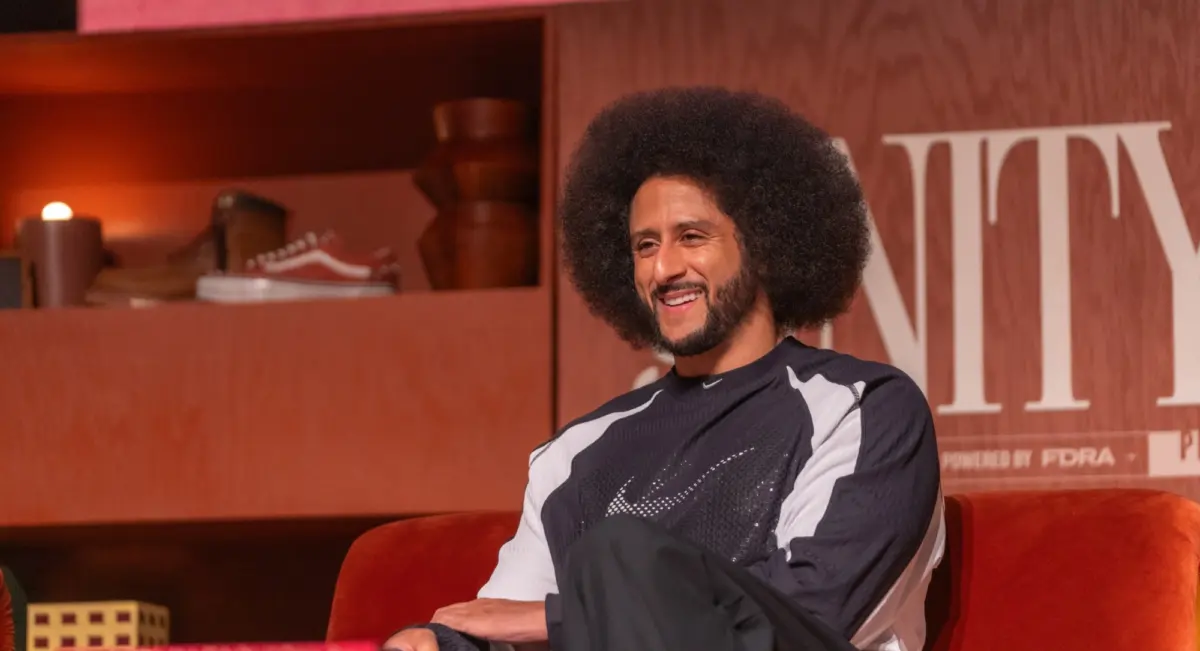
Ten years after former San Francisco 49ers quarterback Colin Kaepernick first took a knee to protest racial injustice and police brutality, the athlete-turned-activist is looking toward the future. While continuing his lifelong commitment to community-building and coalition work to spark meaningful systemic change, Kaepernick has also made it clear that he remains physically and mentally ready to return to the professional football field.
Kaepernick shared these insights during an appearance alongside sports journalist Jemele Hill at the 2026 Black Footwear Forum in Detroit earlier this month. The speaking engagement marked the first official stop on his nationwide book tour for his new release, “The Perilous Fight,” which hit shelves on September 15.
The conversation, held at a prominent forum centered on Black leadership, community development, and economic opportunity within the footwear and fashion industries, traversed several critical subjects. Kaepernick and Hill discussed his tumultuous NFL career, the peaceful protest that fundamentally altered its trajectory, and the vital collective action Kaepernick believes is still necessary to dismantle entrenched systems of oppression.
Addressing False Narratives and the Reality of His NFL Exit
During the panel discussion, Kaepernick addressed two persistent narratives surrounding his departure from the league that continue to frustrate him: the claims that he was simply a poor football player, and the accusations that his activism was driven by financial motives or personal gain.

Reflecting on these falsehoods, Kaepernick told the audience that the attack on his integrity hurts the most because it attempts to undermine the sincerity of his initial intentions. He emphasized that those claims are entirely detached from reality.
Kaepernick famously sat and later knelt during the 2016 NFL preseason and regular season while playing quarterback for the San Francisco 49ers. His actions came amid a wave of national outrage and public grief over the rampant, high-profile police killings of unarmed Black individuals across the United States. Following that 2016 season, Kaepernick became a free agent, but no NFL franchise offered him a contract. He subsequently alleged that team owners engaged in illegal collusion to blackball him from the league due to his outspoken political stance. In 2017, he filed a grievance against the NFL, a legal battle that ultimately concluded with a confidential financial settlement.
Even as his playing career came to an abrupt halt, Kaepernick’s cultural footprint expanded. Having originally signed an endorsement deal with Nike in 2011, he continued his partnership with the athletic apparel giant long after leaving the football field. In 2018, he starred in Nike’s iconic “Dream Crazy” advertising campaign, which featured the memorable slogan: “Believe in something. Even if it means sacrificing everything.”
The commercial proved to be fiercely polarizing, launching just ahead of the NFL season kickoff, yet it ultimately generated a surge in Nike’s stock value and earned an Emmy Award. The following year, Kaepernick collaborated with the company on a special release of the Air Force 1 sneaker, which completely sold out online in under two hours. Embracing that enduring relationship, Kaepernick wore a Nike Swoosh shirt while on stage at the Black Footwear Forum.

The Motivation Behind Pursuing a Return to Football
Although Kaepernick has not taken a snap in an official NFL game since January 1, 2017, he maintains a rigorous daily training regimen every single morning to ensure he remains primed and ready to step back onto the gridiron at a moment’s notice.
During the event, Jemele Hill pressed him on this apparent contradiction, asking, “You’ve pointed out the culture of obedience with the NFL, their racism, all these things, so why would you still play in the NFL knowing all of that? Why do you still think it’s important for you to fight to get back in?”
Kaepernick offered a two-part response. First, he asserted his fundamental belief that no individual should ever have their livelihood and career stripped away simply for standing up and fighting for basic human rights.
Second, he pointed to the chilling message the league intended to send to future generations. “I know the message that the NFL was trying to send,” Kaepernick explained. “They were trying to send very explicitly, ‘Hey, if you try to fight for Black folks, we’ll take your career from you.’ And that message has traveled.”

He recounted an encounter with a young participant at one of his organization’s Know Your Rights Camps in Las Vegas, who approached him with a heartbreaking dilemma. The youth asked whether he should choose to pursue his dream of playing professional football or fight for his community, asking which path Kaepernick believed he should select.
Kaepernick firmly believes that forcing young people or anyone else to make such a compromise should not be the reality of modern society. Challenging that precedent serves as a primary driving force behind his ongoing desire to re-enter the league. Furthermore, Kaepernick maintains that his pointed critiques of the NFL do not forfeit his right to compete.
“I worked my ass off to get to this place,” Kaepernick stated. “I put in the work and the hours, I want the same shot that everybody else gets. You say you’re a meritocracy, regardless of my critiques of you, I should have the right to go out and show you that I’m the best. And by denying that, you’re also telling on yourself in relation to what you actually value and what they’re actually looking for. They aren’t looking for the best players, they’re looking for obedient players who can put on a great show.”
Examining Co-optation, Corporate Alliances, and Collective Action
Kaepernick also opened up about behind-the-scenes maneuvers during the height of his activism. He revealed that amidst his ongoing collusion grievance, league representatives approached both him and former teammate Eric Reid—who knelt alongside him—with a proposal to become the public faces of a new NFL social justice initiative. Despite what he described as a multimillion-dollar offer, Kaepernick declined, stating that he refused to support or lend credibility to institutions pursuing agendas counter to the well-being of marginalized communities.

This corporate outreach followed a 2017 meeting between NFL players and team owners that brought together some of the most influential figures in professional sports. Kaepernick recalled comments made during that gathering, noting that New England Patriots owner Robert Kraft acknowledged the need to address the "elephant in the room," while Buffalo Bills owner Terry Pegula suggested the need for a "Black face to help us end the protest." According to Kaepernick, these discussions ultimately led to the formation of the Players Coalition and financial arrangements that prompted several participating players to halt their demonstrations.
Kaepernick stressed that the core mission of their movement was never about securing financial settlements or corporate checks, but rather about achieving genuine structural and institutional change. When those initiatives failed to deliver systemic transformation, he questioned the rationale behind prematurely ending the demonstration.
The conversation naturally touched upon subsequent developments, including the NFL’s multiyear partnership with Jay-Z’s Roc Nation, established in 2019 to oversee live entertainment and elevate social justice efforts. The business mogul and rapper has faced public scrutiny over the alliance, as well as more recent corporate partnerships, which he addressed in a freestyle rap at Yankee Stadium in July that referenced Kaepernick and the acceptance of NFL financial backing.
Kaepernick, however, rejected any equivalence between his own legal recourse and subsequent partnerships with the league. He distinguished his actions by emphasizing that his legal grievance followed a systematic blackballing by the NFL. In contrast, he viewed later corporate agreements as stepping into a void explicitly designed to pacify public dissent and redirect collective energy toward entertainment and halftime spectacles at the expense of community solidarity.

An Educational Awakening and the Evolution of a Movement
Reflecting on the roots of his activism, Kaepernick explained that his decision to protest was not born from a single isolated incident, but rather accumulated over a lifetime of experiences. The catalyst for his formal educational journey began when his now-wife, Nessa Diab, handed him a copy of “The Autobiography of Malcolm X.”
That reading list quickly expanded to include foundational texts by prominent intellectuals such as Frantz Fanon, James Baldwin, Steve Biko, and Marcus Garvey. Immersing himself in these works provided him with a profound comprehension of systemic oppression. Armed with this historical and structural knowledge, he watched a succession of fatal police shootings unfold across the country—witnessing the killings of Mario Woods in San Francisco, Alton Sterling in Baton Rouge, and Philando Castile in Minnesota.
Faced with this expanding awareness, Kaepernick felt he had reached a moral crossroads: he could either recognize the injustices occurring around him and remain passive, or he could act in alignment with his convictions. When asked to stand for the national anthem during the opening preseason game of 2016, he questioned why he should express reverence for a nation that routinely oppressed and denigrated marginalized populations, prompting his initial decision to sit.
The tactical shift from sitting alone to kneeling alongside teammates came after discussions with Eric Reid. Reid proposed kneeling as a respectful measure that would simultaneously honor military veterans while countering narratives of isolation, drawing focused attention back to the core issue of police brutality. Kaepernick also used the platform to clarify the historical record, disputing long-standing claims that former Green Bay Packers player and military veteran Nate Boyer was responsible for suggesting the kneel, reiterating that the concept originated with Reid.

Reflecting on the climate within the locker rooms at the time, Kaepernick noted that while the vast majority of fellow players expressed private support for his stance, few were willing to take public action themselves due to the immediate professional repercussions. He acknowledged the immense personal empathy he holds for athletes who hesitate to speak out, considering the extraordinary dedication required to reach the NFL and the generational wealth at stake.
Nevertheless, Kaepernick’s message at the Black Footwear Forum returned to the central theme of unity. As he continued his book tour and engaged with audiences on the importance of collective progress over individual advancement, his message remained clear: at a certain point, individuals must choose whether to prioritize self-preservation or stand together to effect lasting change.