President Donald Trump’s ambitious, AI-fueled vision for a heavily armed drone port atop the newly planned White House ballroom includes missile-bearing unmanned aerial vehicles and gun-toting troops, ostensibly designed to protect the 18-acre presidential complex and the nation’s capital. However, a few hundred feet away, a different kind of aerial security operation is already quietly underway.
Operated by the U.S. Secret Service rather than the military, a small drone port has become fully operational near the White House complex. Equipped with high-definition cameras and sophisticated sensors designed to spot potential threats from a bird’s-eye view, small unmanned aerial vehicles stand ready on alert inside four gray weatherproof boxes. These drones remain docked until deployed immediately at the direct command of security officers.
The federal agency is utilizing an operational framework commonly known as the “drone as first responder” model. This strategy involves launching speedy, unarmed drones from outdoor automated stations to act as mobile flying cameras during unfolding situations. Versions of this tactical model have already been adopted by hundreds of local law enforcement agencies across the United States, frequently powered by advanced artificial intelligence software that helps automated systems effortlessly dodge obstacles or track moving targets.
The existence of these surveillance drones positioned atop a Treasury Department building adjacent to the White House complex has not been previously reported. The operational reality on the ground could potentially undercut Trump’s legal arguments that the controversial ballroom construction project is strictly necessary to protect the executive mansion and the surrounding region from complex aerial attacks. The purported necessity of the specialized drone port has served as a central national security justification for the construction project—a rationale that Trump is now also citing to support the construction of a massive architectural arch outside the gates of Arlington National Cemetery.
Thus far, the actual Treasury building installation is markedly less imposing than the futuristic vision outlined by Trump. His concept features rows of aggressive attack drones—apparently modeled after the heavily armed hardware utilized in U.S. military airstrikes—which independent drone experts have described as practically outlandish for a domestic urban center.
“To be honest, if a drone was so close to the White House that it needed interdiction, it’s already gotten too far,” said Matt Sloane, co-founder of SkyfireAI, a firm that develops specialized software for drones deployed by public safety and emergency agencies.
According to Sloane, a far more realistic operational approach for the White House would mirror the understated setup the Secret Service has already quietly deployed next door. Under that model, a drone takes off, completes a designated perimeter sweep, and then automatically returns to its protective housing box.
The White House did not provide comments for this story. Meanwhile, the U.S. Secret Service declined to discuss the specific operational details of its aerial fleet, though agency representatives noted that the new docks are entirely separate from the proposed ballroom drone port championed by the president.
The details of Trump’s ballroom drone port remain murky
Security protocols for the sitting president and the sprawling White House complex traditionally fall under the purview of the U.S. Secret Service. The agency routinely works in close concert with the White House Military Office and various specialized military elements whenever heightened security measures are deemed necessary.
Trump has publicly stated that the integration of the grand drone port originated from a direct request by U.S. military officials. Speaking with reporters earlier in May, the president explained that the architectural plans for the ballroom structure were deliberately expanded to accommodate the military’s specifications. “They wanted more drone capacity,” Trump remarked at the time. Furthermore, on social media platforms, he boasted that the completed facility could ultimately end up housing what he described as the most sophisticated drone port anywhere in the world.
Despite these grand assertions, what Trump is ultimately aiming to construct, and the precise degree to which it will exceed the infrastructure already installed nearby, remains somewhat ambiguous. Beyond the conceptual AI-generated images that Trump filed as part of his legal appeal to the U.S. Supreme Court—seeking to lift lower court injunctions that had temporarily blocked the construction—the White House has not publicly disclosed what specific categories of drones will be housed there or outlined their exact tactical purposes.
In contrast, the surveillance drones actively utilized by the Secret Service are significantly smaller, representing only a fraction of the physical dimensions of the heavy attack drones depicted in Trump’s promotional AI-generated visuals. The U.S. Air Force notably procured similar compact drone models from manufacturer Skydio to safeguard military installations across the Middle East. The same commercial manufacturer also supplied surveillance drones to assist with security logistics during international soccer matches.
The Secret Service has steadily built out its comprehensive drone and counter-drone programs over the past several years. However, the pace of development and deployment has accelerated dramatically in the wake of the 20th-century-style security failure during the 2024 attempted assassination of Trump at a campaign rally in Butler, Pennsylvania. During that incident, the agency failed both to take timely action against a commercial drone utilized by the shooter to scout out the venue and to deploy one of its own aerial units to provide critical overwatch of the event.
In the weeks and months that followed that security breach, both tethered and untethered surveillance drones quickly became commonplace fixtures at political campaign rallies and large-scale public events hosted at the White House complex.
In an online informational video released by the agency to highlight the expanded deployment, the Secret Service explained that the Skydio drones are primarily deployed to deliver real-time situational awareness and continuous aerial overwatch during high-profile events.
“It allows you to see the threat before it becomes an issue, and to task assets accordingly,” explained Dustin Talbott of the Secret Service’s Aviation and Airspace Security Division during the agency video presentation. “We no longer wait for the threat to reveal itself. We find it first.”
Representatives for Skydio declined to provide official comments for this report.
Trump’s drone port vision would face logistical hurdles
President Trump has consistently prioritized establishing a much stronger and more robust drone presence surrounding the White House, responding directly to an observable increase in political violence and the rapid evolution of modern drone warfare across the globe.
Paul Eckloff, a former supervisor within the Secret Service’s elite presidential protection division, noted that ongoing conflicts such as the war in Ukraine have vividly highlighted the severe risks posed by small, off-the-shelf commercial drones capable of inflicting massive structural and human damage. Drones now represent one of the most significant and rapidly emerging threats that the executive protection apparatus must actively defend against, he explained.
During Trump’s first term in office, internal administration discussions regarding unmanned aerial vehicles frequently centered on tactical deployments in distant foreign conflict zones like Iraq and Syria, according to Javed Ali, who served on the National Security Council during that administration and currently teaches national security courses at the University of Michigan. Since that time, however, the primary concern has decisively shifted to matters of domestic security and urban protection, Ali noted.
Even so, implementing a busy, fully functional drone port directly on top of the White House roof would introduce a massive array of complex logistical hurdles.
“There’s a whole host of questions, like who is responsible for overseeing it, and how would there be any de-confliction with commercial airspace?” Ali pointed out.
The inherent complexities surrounding overlapping federal regulatory oversight were starkly demonstrated earlier this year when the U.S. military utilized a directed-energy laser to shoot down an unauthorized drone operating near El Paso, Texas, only to discover afterward that the aircraft actually belonged to Customs and Border Protection. That operational mishap prompted the Federal Aviation Administration to temporarily shut down surrounding civilian airspace.
Establishing a permanent drone hub at the White House would require careful navigation of the notoriously crowded, highly restricted, and complex airspace surrounding Washington, D.C., located just miles away from Reagan Washington National Airport and heavily utilized flight paths shared by various military and presidential transport aircraft.
Opponents say the White House is becoming a fortress
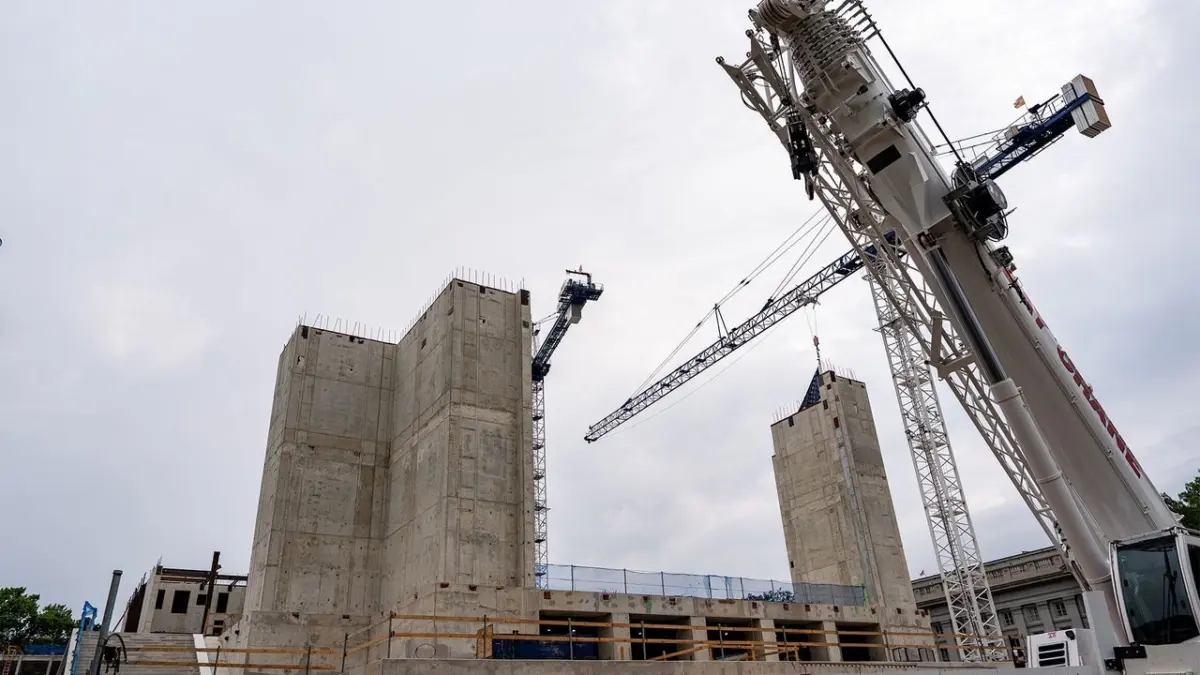
Trump first began publicly discussing the concept of an integrated White House drone port back in May, arriving just weeks after a federal judge issued an injunction halting the broader ballroom construction project while permitting work on underlying security components to move forward. Trump later referred to the evolving structure as a “military complex,” heavily leaning on its designated security function as a primary legal justification for its continuation.
The U.S. Supreme Court subsequently cleared the way in August for the administration to resume construction activities while the underlying legal challenges continue to wind their way through the judicial system.
Critics and political opponents argue that the president is pushing his physical fortification of the executive mansion far beyond acceptable limits, effectively transforming the historic estate into something resembling a fortified military compound. Edward Lengel, a former chief historian for the White House Historical Association, argued that Trump has systematically militarized the White House at a scale that stands sharply at odds with its historical legacy and cultural identity as “the people’s house.”
“It turns it into a big giant porcupine that has its spines pointing out against the people and against the world,” Lengel remarked.
Conversely, Trump has repeatedly maintained that the White House infrastructure was in a state of severe disrepair and neglect when he returned to office, arguing that decades of changing security landscapes had left the compound profoundly vulnerable to contemporary threats.
On various occasions, the president has expressed personal concern regarding his own physical safety and the escalating risks posed by hostile drones and other aerial hazards. While speaking during a Rose Garden dinner hosted for law enforcement officials in May, Trump briefly glanced upward from the lectern as a small bird flew overhead across the lawn.
“I thought that was a drone,” Trump remarked to the gathering, prompting immediate laughter from the assembled crowd. “They make them in all different sizes nowadays—they can be very destructive, as you’ve probably heard.”