Will your next pair of classic denim jeans or everyday cotton t-shirt be cultivated with the help of artificial intelligence and advanced soilless farming?
That futuristic vision is driving a new collaboration between Spanish hydroponic-farming innovator Magtech and the H&M Group’s Circular Innovation Lab. The two organizations have joined forces to test, refine, and ultimately scale soil-free cotton production, addressing some of the most persistent and resource-heavy environmental hurdles facing the global fashion industry.
For decades, traditional cotton farming has faced intense scrutiny over its immense resource footprint. Conventional cotton cultivation requires vast expanses of fertile arable land—space that could otherwise be utilized to grow food for a rapidly growing global population. Furthermore, traditional farming is notoriously thirsty, demanding millions of gallons of water, alongside heavy applications of synthetic fertilizers, chemical pesticides, and nutrient-rich soil additives.
Martin Ekenbark, who leads the Circular Innovation Lab at H&M Group, noted that the joint initiative with Magtech is designed to confront these systemic challenges directly. By shifting the cultivation process away from traditional agriculture, the project aims to dramatically reduce the textile sector’s reliance on dwindling water supplies, chemical crop treatments, and limited arable land.
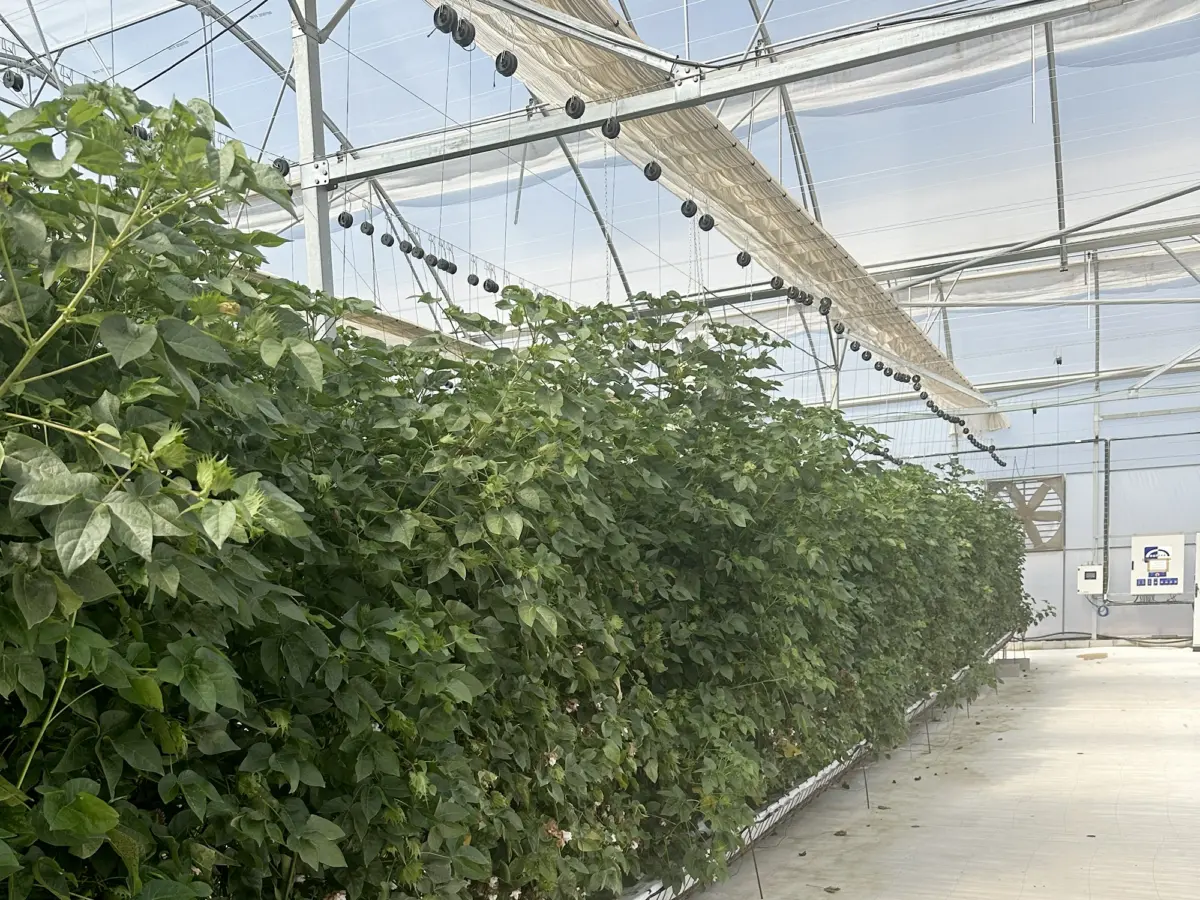
The core of the project explores how hydroponic growing methods—where crops are cultivated directly in water rather than earth—can be combined with artificial intelligence to optimize resource management. In a hydroponic cotton system, the plants are suspended so that their roots sit directly in circulating water, receiving a precisely controlled mixture of essential nutrients. To protect the crops from external elements, the plants are grown underneath protective net structures. Crucially, the water is continuously recovered, filtered, and reused, preventing the massive runoff waste typical of conventional farming.
One of the most promising aspects of this technology is its remarkable adaptability, which could fundamentally transform how and where textile supply chains are organized. Because the plants do not rely on traditional soil quality or large open fields, fashion brands could theoretically develop localized supply chains much closer to spinning mills or manufacturing hubs.
As Ekenbark pointed out, the systems can be established in unconventional urban or harsh environments. You can basically set this up in a car park, on a rooftop, or even in the desert, as long as there is adequate sunlight and a reasonable source of water.
While this partnership marks a major step forward, it is not the first time the fashion and sustainability sectors have looked toward soilless solutions. Previous experimental trials conducted by organizations like HKRITA and Materra have successfully explored soil-free and controlled-environment cotton growing. However, representatives from the H&M Foundation have noted that those earlier initiatives primarily demonstrated what was technically possible in a laboratory setting, rather than proving how hydroponic cotton could become a commercially viable and scalable alternative to costly conventional farming methods.
Transitioning from a controlled scientific experiment to a production-scale agricultural model introduces immense operational hurdles, particularly when monitoring thousands of individual plants over vast commercial areas.
David René Rodríguez, co-founder of Magtech, highlighted the sheer scale of managing a modern hydroponic farm and the logistical limits of human labor. He explained that a single hectare of their current system contains approximately 30,600 individual plants distributed across 52 massive growing channels, with each channel stretching about 98 meters long. Simply walking the length of those channels just once means covering more than five kilometers of ground. While a skilled agricultural technician can certainly inspect the crop, no single person can possibly observe every individual plant continuously or maintain the exact same frequency and consistency at larger commercial scales.
To overcome these operational bottlenecks, Magtech and the H&M Group’s Circular Innovation Lab are utilizing advanced, AI-driven monitoring systems to drastically improve farm efficiency and resource utilization. High-tech cameras integrated into the system continuously assess crop ripeness, monitor plant health, and detect potential pest infestations in their earliest stages. This early detection capability allows farm operators to apply pesticides in a highly targeted manner, treating only the specific plants that require intervention rather than blanketing an entire field with chemicals.
In addition to intelligent pest management, the project features a closed-loop water system that serves a critical environmental function. By containing and recycling the water and nutrient mixture, the system prevents excess agricultural nutrients from washing away into nearby rivers and natural water systems. In conventional cotton production, such agricultural runoff frequently contributes to severe ecological issues, including eutrophication—a process where excess nutrient pollution suffocates aquatic life by depleting oxygen levels in water bodies.
Despite the high-tech integration of artificial intelligence and closed-loop plumbing, the developers emphasize that the initiative is intended to complement, rather than completely replace, traditional agriculture.
Rodríguez stressed that they are not claiming zero environmental impact, nor are they attempting to entirely eradicate conventional cotton farming. Instead, the ultimate objective is to demonstrate, carefully quantify, and independently validate a viable, complementary method for growing the fiber—one that functions effectively in regions where freshwater is scarce, fertile land is severely limited, or where the textile manufacturing industry operates nearby.
Furthermore, Rodríguez noted that modern hydroponic facilities will still require a dedicated workforce of knowledgeable growers, agronomists, and technical operators. Importantly, existing agricultural farm workers can be successfully retrained to manage these advanced indoor and controlled-environment systems. Because the global cotton sector supports the livelihoods of millions of smallholder farmers and agricultural workers worldwide, any meaningful industrial transition must take social outcomes just as seriously as environmental and economic goals.
The initiative has already progressed past the theoretical stage and left the confines of the laboratory. The partners successfully cultivated and harvested an initial five-tonne batch of hydroponically grown cotton. After passing rigorous quality control checks, this innovative fiber was spun and turned into finished apparel garments in Spain. Building on the momentum of this initial milestone, the collaborative partners are already laying the groundwork to establish a second hydroponic growing site in India, marking another step in testing the global scalability of AI-driven, soil-free cotton production.