At first glance, the new Sony FE 400mm f/4.5 GM OSS and the FE 600mm f/6.3 GM OSS lenses appear to be two distinct entries in the manufacturer’s prestigious G Master telephoto lineup. Naturally, they serve different focal length needs for wildlife, sports, and nature photographers. Yet, a closer examination of their physical specifications, handling characteristics, and internal architecture reveals a masterclass in optical engineering. These two lenses are far more than traditional siblings—they share a strikingly identical foundation that highlights an unprecedented level of manufacturing and design efficiency.
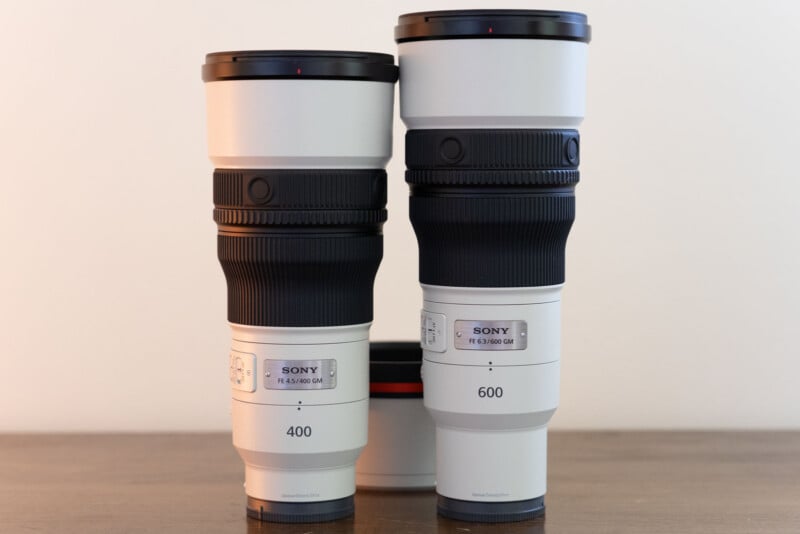
As detailed in PetaPixel’s initial announcements and comprehensive reviews of both the Sony FE 400mm f/4.5 GM OSS and the Sony FE 600mm f/6.3 GM OSS, the similarities between the two optics are immediate and profound. Beyond their shared visual aesthetic—featuring Sony’s signature white finish and robust professional build quality—their physical dimensions and weight are nearly indistinguishable.
When placed on a scale, the weight difference between the two telephoto primes comes down to a mere single gram. To put that in perspective, one gram is equivalent to a standard paper clip, a single dollar bill, or a light pinch of salt. Physically, the 600mm f/6.3 GM OSS is longer than its 400mm counterpart, but only by a fraction of an inch—a negligible difference that translates to virtually identical handling in the field.
For the average working photographer, these shared traits dictate a seamless user experience. Both lenses feature the exact same advanced autofocus motor systems, identical minimum focusing distances for tight framing, matching on-barrel control layouts, and comprehensive weather-resistant sealing. Most importantly, both deliver exceptionally sharp image quality that meets the rigorous demands of professional G Master glass. For most shooters, knowing that both lenses handle brilliantly and resolve immense detail is all that is required to make an informed decision.
However, for those curious about what happens beneath the surface, the engineering story inside each barrel takes a fascinating turn. Half of the optical design shared by both lenses is not merely similar; it is entirely identical. From the single large front optical element all the way back to the intricate focusing group positioned near the middle of the barrel, the 400mm and 600mm lenses share a fraternal twin relationship.

This shared architecture includes the critical optical group housing Sony’s specialized Super ED (Extra-low Dispersion) glass elements. These components play a central role in mitigating chromatic aberration and delivering the high-contrast, sharp imagery expected from top-tier telephoto glass.
As the optical paths progress toward the camera mount, the design divergence becomes slightly more apparent to accommodate the differing focal lengths. The FE 600mm f/6.3 GM OSS integrates two additional elements housed within a single extra group, bringing its total configuration to 24 elements arranged in 17 groups. This specialized grouping is necessary to achieve the higher magnification of the 600mm reach.

The difference in maximum aperture—f/4.5 on the 400mm versus f/6.3 on the 600mm—is governed by fundamental optical physics. Achieving a longer focal length using the same physical front entrance pupil inevitably results in a slower relative aperture. It is a matter of straightforward mathematics rather than a compromise in optical performance.
This strategic approach represents a remarkably clever engineering feat by Sony. Developing an entirely new super-telephoto lens requires a massive investment in research, development, and sophisticated manufacturing tooling. By utilizing a shared foundational design for two separate products, Sony has bypassed the necessity of doubling its development workload. Much of the intensive engineering and component manufacturing has been successfully leveraged across two distinct commercial lenses.
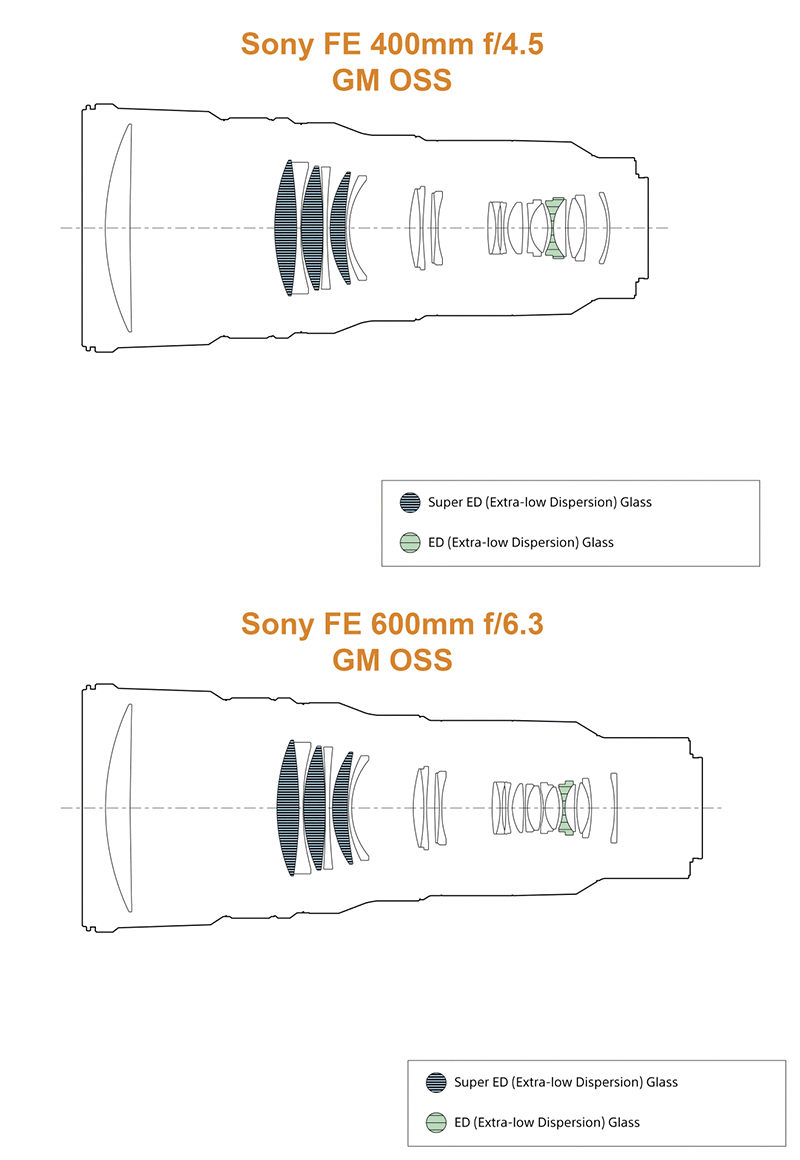
While lens manufacturers constantly build upon historical designs and proprietary technologies rather than reinventing the optical wheel with every release, this particular strategy stands out as exceptionally smart business execution. The concept echoes historical moves in the industry, such as when Fujifilm developed the Fujinon GF 500mm f/5.6 R LM OIS WR lens for its medium-format GFX system and subsequently adapted it with an X mount to create a portable 750mm-equivalent super-telephoto prime for its smaller sensor X Series cameras.
What Sony has accomplished here is arguably an even more impressive commercial maneuver, yielding two entirely separate full-frame lenses while maximizing shared infrastructure. For consumers, the practical implication is that there is virtually no optical downside to either choice. Neither lens represents a compromised design, and photographers investing in either focal length can expect exceptional results in the field.