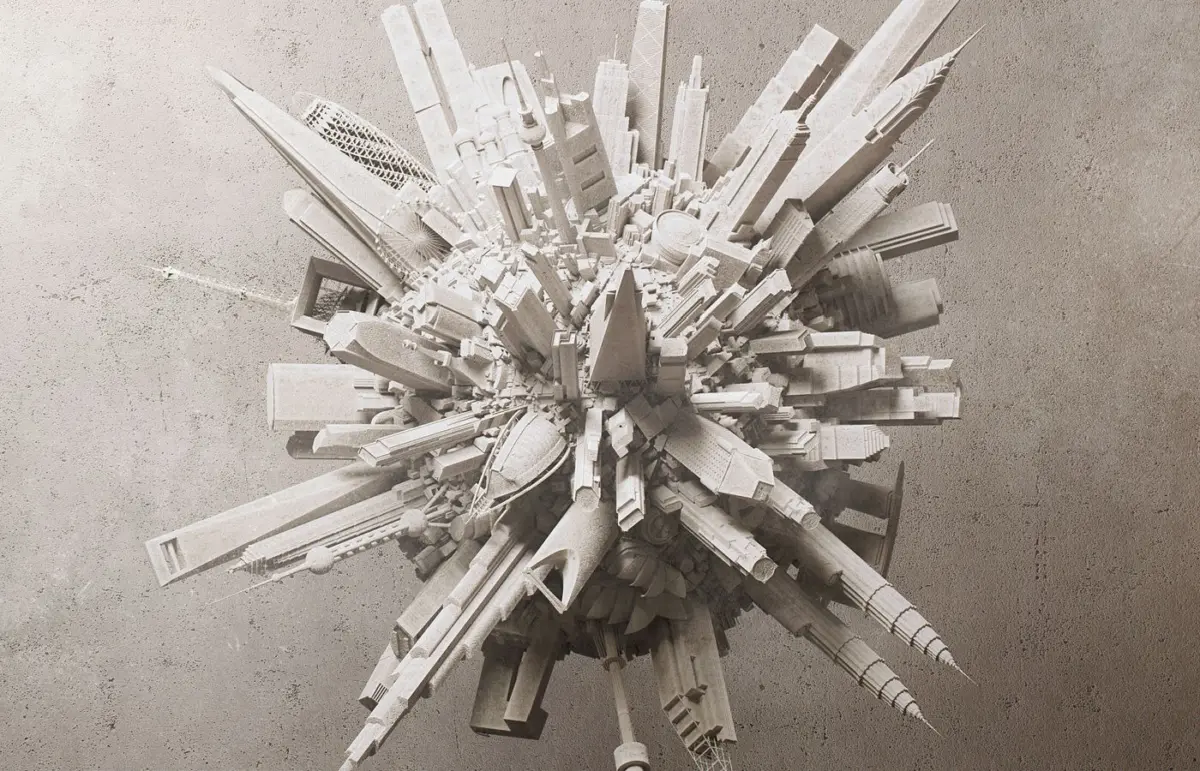
Cities used to grow by accident. Throughout most of human history, a settlement’s initial location usually made logical sense—positioned someplace defensible on a hill or an island, near an extractable resource, or at the confluence of transport routes. However, what happened next was largely ad hoc. The people who worked in the local fort, mines, port, or warehouses needed places to eat, sleep, and worship. Infrastructure threaded through the hustle and bustle, including water, sewage, roads, trolleys, gas, and electricity, forming vast networks of improvisation. While historians can find planned exceptions such as Alexandria, Roman colonial towns, specific districts in major Chinese cities, or Haussmann’s Paris, the vast majority of urban expansion was driven by happenstance, luck, and the layering of new structures directly on top of old ones.

At least, that is how things worked for centuries. Around the second decade of the 20th century, the paradigm shifted. Cities started to happen on purpose. Beginning with New York City’s landmark zoning laws in 1916, development began to occur by commission rather than omission. Laws and regulations dictated the shape of the architectural envelope, meaning functional decisions determined aesthetic outcomes—not always for the best.

Fast forward to the present day. A century or so after human beings first put their collective minds toward designing cities as integrated wholes, urban planning is entering a golden age. High-tech materials, sensor networks, modern scientific breakthroughs, and superior data analytics are empowering architects, designers, and planners to work smarter and with greater precision. Today, cities are becoming more environmentally sound, engaging, and aesthetically pleasing. This transformation arrives just in time, as a majority of the human population now resides in urban environments rather than rural ones.

Examining global projects across various continents reveals a profound shift in how metropolitan areas are managed. From the meticulous detail of a new streetlight network to sacred cities in a state of constant flux, masterful museums, and advanced infrastructure built specifically for bicycles, the future of urban life is taking shape. While the cities of tomorrow might still assemble themselves haltingly at times, done right, the process is no longer accidental. Every block, building, and brick represents innumerable deliberate decisions, proving that when a city is designed well, it becomes a marvel of modern engineering and design.

LA Goes LED and Gets Connected
Los Angeles is currently retrofitting 4,500 miles of orange-yellow sodium-vapor streetlights with a moonlight-hued matrix of energy-efficient light-emitting diodes. While roadways will appear noticeably brighter, they will also become deeply interconnected. Every individual lamp links wirelessly back to the Bureau of Street Lighting, transmitting real-time operational data to headquarters regarding whether the light is active, inactive, or malfunctioning.

Looking forward, the city envisions adaptive lighting that shifts in response to immediate surroundings. These smart lights might blink to alert drivers of an approaching police car or ambulance, or brighten dynamically to guide pedestrians safely home after a major sporting event. While other international municipalities deploy LEDs primarily to cut financial costs or introduce splashes of urban color, Los Angeles is building a comprehensive network that offers insights into the entire metropolitan ecosystem.

An Airport Within an Airport for Elite Fliers
More than 70 million travelers passed through Los Angeles International Airport (LAX), navigating a jet-lagged gauntlet of rolling luggage and travel accessories. To combat this friction, LAX initiated an $8 billion overhaul encompassing everything from concession areas to moving walkways. Airline carrier Delta contributed $229 million to completely revamp Terminal 5. This modernization includes the Delta One lounge, a specialized space functioning almost as an airport within an airport, catering directly to high-net-worth individuals and celebrities.

Upon arrival at the terminal, a curbside attendant verifies passenger names in a velvet-rope style protocol. Once checked in, travelers retreat to a private, upscale lounge. When boarding time arrives, dedicated escorts guide passengers up a private elevator and down a corridor directly to the front of the line at a priority security checkpoint. Returning travelers can also opt for an express exit via VIP Select service, receiving a chaperone directly to the tarmac where a hybrid Porsche transports them across the airfield to a waiting vehicle on Century Boulevard.

To Beat the Drought, LA Turns to Less-Thirsty Landscapes
The iconic palm trees lining Hollywood Boulevard are not native to Los Angeles. As California battles persistent, severe droughts, landscape architects are actively replacing imported plants and water-intensive turf with native, drought-resistant flora. This emerging aesthetic, often termed California Dry, prioritizes creative textures and geometric shapes over traditional lawns.

Property owners are increasingly ditching traditional grass in favor of decomposed granite or mulch, complemented by rocky pathways, decorative planters, and bridges to add visual variety. Structural plants such as pointy foxtail agave and spiraling echeveria are arranged in clean, organized rows, while native flora introduces softness and color to the heavily structured landscape.

A Mobile Opera Cruises Downtown LA
For the production of Hopscotch, an opera staged across 24 limousines and SUVs traversing downtown Los Angeles, audiences sit knee-to-knee with vocalists and instrumentalists. Over the course of the autumn run, vehicles navigate three distinct routes following a narrative about the search for a lost love. Actors and dancers equipped with wireless microphones perform on sidewalks and passing cars, intermingling seamlessly with the natural choreography of everyday city life.

Director Yuval Sharon notes that Los Angeles itself functions as the central character of the production. Limited to just 96 audience members per performance, participants periodically exit the vehicles to enter physical buildings and public spaces, with each transit route revealing a fraction of the overarching narrative.

An Evolving Museum Spirals Between Past and Present
Shanghai has experienced a vertical explosion of skyscrapers in recent decades, but the Shanghai Natural History Museum takes the opposite approach. Situated in a park near the Pudong financial district, the building spirals downward into the earth, evoking an archaeological excavation of the city’s pre-urban history. A central courtyard inspired by traditional water gardens of Suzhou honors ancient Chinese cultural appreciation for natural beauty, while a honeycombed glass wall modeled after plant cell structures floods the interior with daylight.

Architect Ralph Johnson of Perkins+Will drew inspiration from the nautilus shell to naturally regulate visitor traffic. Descending ramps guide large crowds through a chronological exhibition of life on Earth, featuring roughly 11,000 specimens, including a towering Mamenchisaurus skeleton and prehistoric fauna native to Shanghai’s historic wetlands. Advanced climate and water systems, including the cooling courtyard pool, ensure the facility balances modern ecological sustainability with historical reflection.

Medellín’s New Cable Cars Unify a Fractured City
Nestled within a high Andean valley, Medellín historically housed many of its most economically disadvantaged citizens in informal comunas clinging to steep mountain slopes. During the turbulent 1990s, drug cartels and guerrilla fighters held sway over these narrow hillside streets. As violence gradually subsided, residents faced a severe geographic barrier: simple daily transit was exceptionally difficult.

To bridge this fractured urban landscape, municipal leaders introduced an innovative public transit solution—cable cars. Rather than navigating perilous hillsides, residents could board a gondola and soar directly to established metro transit stations. The initial Metrocable line opened in 2004, establishing an affordable link between marginalized hillside communities and central employment hubs. By enabling citizens of all socioeconomic backgrounds to traverse the city safely, the cable car system helped foster a renewed civic investment in Medellin’s future.

Combining Libraries and Parks Into Safe Spaces for All
Building upon the success of the Metrocable network, municipal project director Alejandro Echeverri championed the use of high-quality architectural design to address deep-seated urban challenges in low-income neighborhoods. Echeverri argued that dignified public transit, beautiful buildings, and accessible cultural spaces generate a psychological sense of civic inclusion.

This philosophy directly inspired the construction of a series of architecturally striking libraries surrounded by public greenery throughout the city. These "library-parks" provided unprecedented safe public spaces for neighborhoods that previously lacked them. Departmental teams worked street by street, planting trees, upgrading local schools, and ensuring that infrastructural investments were collaboratively woven directly into the fabric of the communities they served.

Community Activists Fight Back With Graffiti
Grassroots community organizing has played an equally vital role in Medellín’s broader cultural transformation. Local artists and educators, including Daniel Felipe Quiceno—known locally as Perrograff—have utilized spray paint and muralism to reclaim neglected public spaces in areas like Comuna 13. By covering run-down walls with historical murals illustrating local heritage and memorializing victims of past violence, residents transformed troubled street corners into vibrant community hubs. These grassroots art initiatives and urban gardens demonstrate how physical neighborhood spaces can be revitalized from the ground up alongside major municipal engineering projects.

The Hovenring Lets Cyclists Pedal Over the Traffic Jam
Eindhoven transitioned from a sleepy provincial manufacturing town into a vibrant technology and research hub following the expansion of the Philips lighting corporation. This rapid economic growth generated heavy commuter traffic across busy intersections, creating dangerous conditions for cyclists. Seeking a permanent solution, the city commissioned design firm ipv Delft to construct a dedicated, grade-separated bicycle route.

Completed in 2012, the $8 million Hovenring features a 1,000-ton steel deck suspended by 24 steel cables from a central pylon. Enhanced with dynamic LED lighting, the floating circular structure allows thousands of daily bicycle commuters to glide smoothly above vehicular traffic without stopping.

How Saudi Arabia Prepares for Millions of Pilgrims
Every year, the Kingdom of Saudi Arabia experiences a massive demographic surge as roughly three million Muslims arrive to perform the sacred rites of the Hajj in Mecca. To manage these immense crowds safely while preserving Islamic traditions, the government has continually collaborated with international architects and engineers to upgrade regional infrastructure.

A Purpose-Built Airport for a Massive Wave of Visitors
Designed to resemble traditional Bedouin tents, the 2.8-million-square-foot Hajj Terminal at King Abdulaziz International Airport features twin cable-stayed, Teflon-coated fiberglass roofs. The open-air terminal utilizes natural ventilation to maintain comfortable ambient temperatures for pilgrims enduring lengthy transit delays before traveling onward to Mecca.

Managing Waste With Underground Pneumatic Tubes
To handle the staggering accumulation of 600 tons of daily waste generated during peak gatherings, engineers installed a subterranean pneumatic waste disposal network. Trash deposited into hundreds of collection points is pulled at high speeds through underground tubes spanning over a mile to a central processing facility, keeping surface streets clean and manageable.

Expanding the Great Mosque to Handle Bigger Crowds
The Masjid al-Haram, which surrounds the sacred Kaaba, has undergone continuous architectural expansion to accommodate swelling numbers of worshippers. Gensler architecture firm introduced tiered, eight-sided platforms surrounding the holy site to improve pedestrian traffic flow and double visitor capacity without compromising the emotional and spiritual experience of the pilgrimage.

Constructing a City of Fiberglass Tents in the Mina Valley
During the midpoint of the Hajj, pilgrims traditionally lodge in the Mina Valley. Following historical fire hazards, the government replaced traditional cotton encampments with a permanent city of over 100,000 air-conditioned, Teflon-coated fiberglass tents equipped with modern fire hydrants and dedicated medical infrastructure to ensure pilgrim safety.

Multilevel Engineering at the Jamarat Bridge
The Jamarat Bridge, the site of the traditional stoning ritual during the Hajj, was re-engineered into an expansive five-level structure. This multi-tiered architectural design significantly improves pedestrian access to the pillars and incorporates numerous wide exit ramps designed to facilitate rapid crowd dispersal.

Taming a Chaotic Minibus Network With an Orderly Map
Transportation across Nairobi relies heavily on an informal network of privately operated minibuses known as matatus. While affordable and abundant, these vehicles historically lacked fixed schedules or standardized route maps, making navigation difficult and occasionally intimidating for unfamiliar passengers.

To solve this transit challenge, researchers and urban designers launched the Digital Matatus project, equipping local university students with smartphones to track actual GPS routes and stops. The resulting subway-style transit map successfully cataloged over 100 routes. The mapping data was subsequently integrated directly into global digital platforms like Google Maps, lending official recognition to the informal transport network and providing a replicable model for other developing cities worldwide.

Coworking Spaces Deliver Much More Than a Desk and a Phone
The modern concept of the workspace has evolved significantly, extending far beyond traditional corporate offices and cubicles. Coworking operators like WeWork have established multi-service professional environments featuring open-plan communal areas, private rooms, and integrated networking opportunities designed to foster creativity and collaboration among remote teams and independent startups. By offering flexible lease terms and fully managed operational infrastructure, these urban workspaces have transformed how professionals gather and operate in major metropolitan centers like San Francisco.

Dubai’s Turbine Interchange: Where Design and Velocity Intersect
Emirates Road once suffered from severe traffic congestion centered around an outdated roundabout that required motorists to come to a complete stop before merging. To eliminate these bottlenecks, city officials authorized a major redesign, opting for a modern turbine interchange configuration.

Originally devised in the United Kingdom during the 1960s, the turbine interchange allows drivers approaching from multiple directions to execute turns without slowing down or weaving through crossing traffic. Although turbine interchanges consume substantial amounts of land due to their wide turning radii, the sprawling geography of Dubai easily accommodated the structure. Completed in 2008, the nearly third-of-a-mile-wide interchange successfully balances high-speed transit capacity with streamlined visual symmetry.