When architect Paul Williams first stepped onto the site of the new London Museum a decade ago, it felt less like entering a standard construction zone and more like walking directly into an undisturbed time capsule. The old Smithfield General Market, situated in the heart of the British capital’s central Farringdon neighborhood, had ceased commercial trading two decades prior, leaving behind a profound stillness that caught the design team off guard.
“There were the trolleys, meat hooks, ledgers,” Williams recalls, picturing the scene from his first exploratory visits. “Calendars marked. Life suddenly left and traders just moved out. There was a ghostly feeling of that presence still there.” He pauses, reflecting on the weight of the space. “It was very moving.”
Those architectural ghosts remain visible today, carefully preserved rather than scrubbed away by modern development. While multiple tiers of shops and offices that once lined the market’s periphery have been removed to open up the volume of the rooms, the cavities where the structural timber beams once rested are still exposed to view. The historic brickwork carries a complex palette, blackened in some areas by decades of soot and tinged a faint blue in others—lingering vestiges of historic office partitions and long-gone wall coverings.
The original fireplaces, too, have a curious presence. Each one was meticulously dismantled, restored by conservation specialists, and then reinstated in its exact original vertical position. Because the new floor level sits differently than the Victorian layout, these fireplaces now hang high and spectral above the newly established ground level. Dwarfed by the cavernous, soaring space around them, they resemble iron postage stamps affixed to massive brick walls—silent relics of the market’s past life and deliberate storytellers of its new cultural chapter.
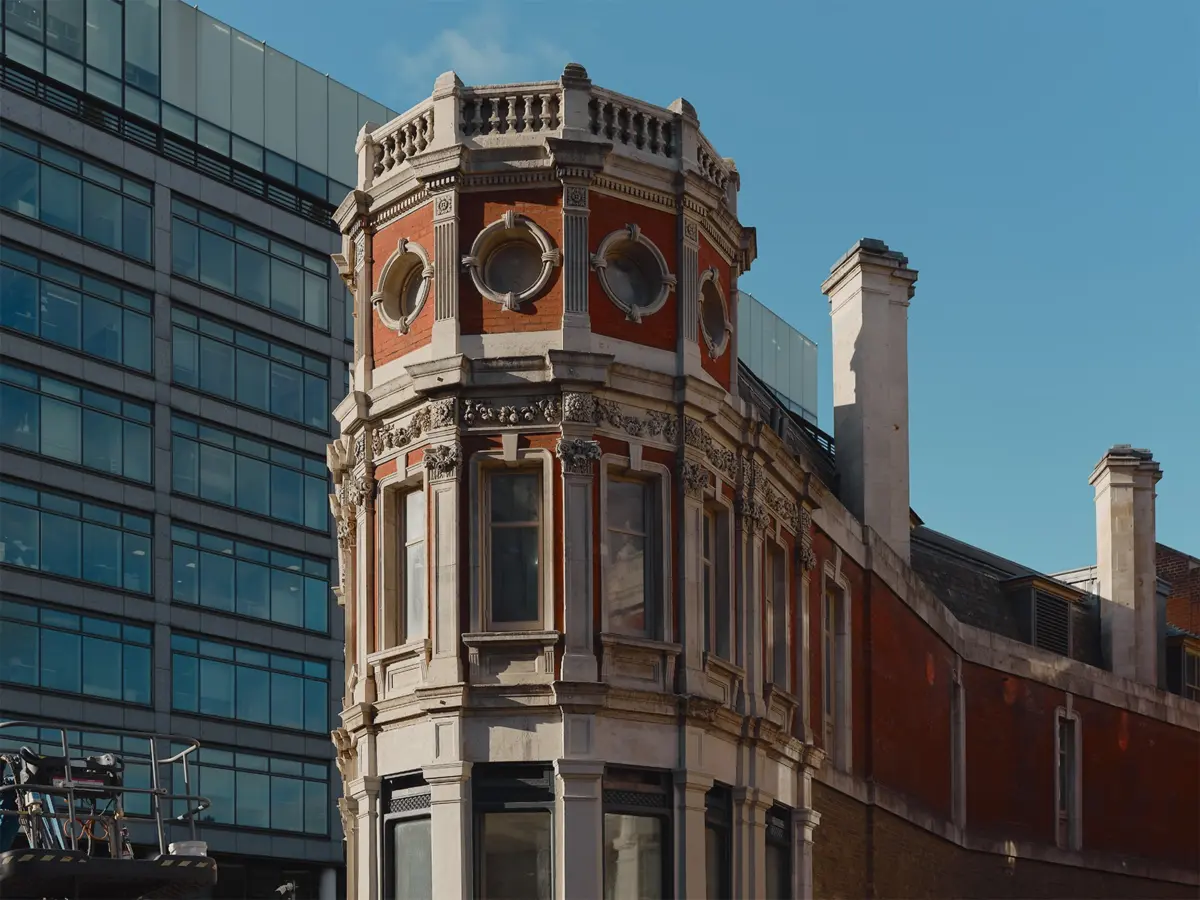
Given its original commercial purpose, the structure inspires an unlikely level of architectural awe. Designed and built between 1879 and 1883 by the prominent Victorian architect Horace Jones—whose portfolio also includes Tower Bridge and Billingsgate Market—the complex is a masterclass in civic engineering. A great, soaring dome at the heart of the ceiling evokes a cathedral-like reverence, drawing the eye upward through light and ironwork. Wrought-iron berries and leaves intricately decorate the capitals of the Phoenix columns that dot the vast, open floor plate.
The building’s functional identity evolved significantly over time. Originally constructed to serve as a wholesale market for fruit and vegetables, the space was subsequently repurposed to sell fish before cementing its legacy in 1898 as a sprawling meat market. For well over a century, this building served as the beating heart of London’s meat trade—a gritty, high-octane commercial ecosystem that roared to life every night as crowds of laborers strung up massive sides of pork and heaved heavy carcasses over their shoulders through the predawn hours.
When Monocle visits the site in early November, Smithfield is once again bustling with intense human activity, though the sights and sounds have radically shifted. The bloodstained white coats of twentieth-century butchers have been replaced by contemporary hard hats and high-visibility jackets; the hanging shanks and ribs of beef have given way to spirit levels, laser measures, and towering scaffolding poles. The complex project—designed by architecture firm Stanton Williams alongside collaborating architect Asif Khan and conservation specialists Julian Harrap—is rapidly approaching completion, marking the final stretch of a massive endeavor to transform a nineteenth-century trade hall into the largest city museum in the world.
When the institution officially opens its doors to the public, visitors will likely arrive via West Poultry Avenue, a historic street that has now been cleverly enclosed and integrated within the museum’s architectural envelope. Here, a steady stream of data regarding contemporary London will be shared in real time, grounding the historical exhibits in the immediate present.
On one side of this enclosed thoroughfare sits the Poultry Market, scheduled to open as part of the broader London Museum campus in 2028. On the other side stands the magnificent, domed General Market, which will house the "Our Time" galleries—dedicated to displaying objects and personal histories that pertain directly to living memory.

Beneath the General Market lies the subterranean "Past Time" section. This deep-level space inhabits what was once a sprawling railway goods depot, infrastructure that historically helped to streamline the heavy logistics and operations of the market above. Past Time charts the sweeping narrative of London from its prehistoric origins up
to 2012, the monumental year the city hosted the Olympic and Paralympic Games. In a striking design choice that links the museum directly to the pulsing transit network of the modern metropolis, a massive three-meter-by-six-meter window exposes the subterranean gallery directly to the passing Thameslink train as it carries commuters on its route toward nearby Farringdon Station.
In 2027, visitors will gain access to an unexpected subterranean asset that was entirely omitted from the original architectural plans. During the early phases of development, it was widely believed by historians and planners that a vast network of Victorian storage vaults had been completely demolished near the tail end of the Second World War. However, two years into construction, a contractor working on site broke through an unexpected infill wall.
“We shone the torch and it was our Indiana Jones moment,” Williams says, recalling the sudden discovery. “We saw this amazing vault. It was very dirty, with one or two little creatures moving around—but you could see the barrel vault above.”
Once the blocked spaces were safely cleared and stabilized, roughly 800 square meters of brick-lined, barrel-vaulted chambers revealed themselves to the astonished team. Sitting a full seven meters beneath the main floor of the museum, these hidden rooms rest at roughly the same elevation as ancient Roman street levels. Adding a final layer of historic craftsmanship, the jack arches of the vaults are tipped with specialized white-gold bricks—reflecting surfaces that nineteenth-century porters once used to find their way through the pitch-black storage tunnels.
The upcoming launch at Smithfield represents the latest chapter in a long, peripatetic history for the institution. The very first iteration of the London Museum opened its doors in 1912 within the state apartments of Kensington Palace. In the decades that followed, the museum underwent several moves, relocating into a historic mansion house before returning once again to Kensington Palace.
Then, in 1976, the institution relaunched under a consolidated identity as an amalgamation of two distinct cultural bodies, housed within a purpose-built, brutalist building located deep inside the Barbican complex in the City of London. That Barbican home became famous not only for its extensive collections, but also for being notoriously difficult for first-time visitors to locate within the labyrinthine concrete estate.
Among the institution’s longest-serving staff members is chief technician Cliff Thomas, who has worked at the museum since its final days back at Kensington Palace. For Thomas, the latest relocation to Smithfield—which organizers hope will be the museum’s permanent home—feels very much like a homecoming. His own family history is intertwined with the site; Thomas’s father previously worked as a clerk and later in personnel for Swift and Company, operating directly out of the Smithfield market.
As a young boy during school holidays, Thomas had virtually free run of the sprawling market complex. “When I was about eight years old, one of the crews took me down into the freezers,” he remembers with a smile. “I was in my school uniform—shorts, mac, cap, and long woolly socks, whereas they were all done up like Michelin men with their padding. Within two minutes, I was freezing and they had to drag me back out.”

The Smithfield market property tells its own profound story of London—a narrative written in architecture, commerce, grueling labor, and urban evolution. It now provides a physical framework to display artifacts drawn from the London Museum’s staggering collection of seven million items. Each object, in its own distinct way, captures a facet of the capital’s character: from Neolithic-era polished-flint axe heads and medieval pointed poulaine shoes to handmade signs created to support the National Health Service during the coronavirus pandemic, alongside a 1920s Art Deco elevator carriage salvaged from Selfridges department store.
Among the more unconventional items acquired by the museum is a piece of London’s hidden infrastructure. In 2017, the infamous “Whitechapel fatberg”—a massive, 250-meter-long, 130-tonne congealed block of fat, wet wipes, cooking oil, and other household detritus—was discovered blocking the Victorian-era sewers underneath the UK capital. Recognizing its cultural significance as a monument to modern urban consumption, the museum successfully procured a section of the mass.
“I think that we broke museum standards and made history in collecting a great big piece of rancid fat,” says the institution’s ebullient director, Sharon Ament.
Annette Day, the lead curator for the museum’s permanent galleries, notes that the acquisition strategy consistently prioritizes human connection over mere aesthetic value. “We are always looking for objects that have some kind of human connection,” Day explains—whether those objects are recovered from a blocked sewer, unearthed as ancient Roman relics, or salvaged from the original signage of a local Morley’s chicken shop.
Williams shares that emotional philosophy regarding the built environment. “We want visitors to feel something,” he says. “I just want people to be moved. I want them to come away feeling that they have been uplifted—not just by the stories being told but by the building too.”
Literary connections to the site run deep. In his classic novel Great Expectations, Charles Dickens immortalized the gritty, chaotic open-air market that occupied the location long before Horace Jones constructed his grand Victorian halls. Describing his journey through the neighborhood, the novel’s narrator, Pip, recounts how he “came into Smithfield, and the shameful place, being all asmear with filth and fat and blood and foam, seemed to stick to me.”
Dickens himself now holds a permanent place within the museum’s holdings in the form of an oxblood leather armchair that once belonged to the legendary author. There is arguably as much of the city embedded in the worn leather of that chair as there is within the pages of Dickens’ novels, his memorable characters, and his historical observations.
While the grime, the pungent stench, and the hanging carcasses of the nineteenth-century meat trade are long gone, something of their spirit endures within the physical layers of the architecture—and, as Londoners are quick to note, it still sticks to the city’s inhabitants today. Asked what makes the British capital so endlessly compelling, Ament clasps her face with her hands and slowly shakes her head, smiling at the sheer magnitude of the metropolis she serves.
“What a city,” she says. “What a city this is.”