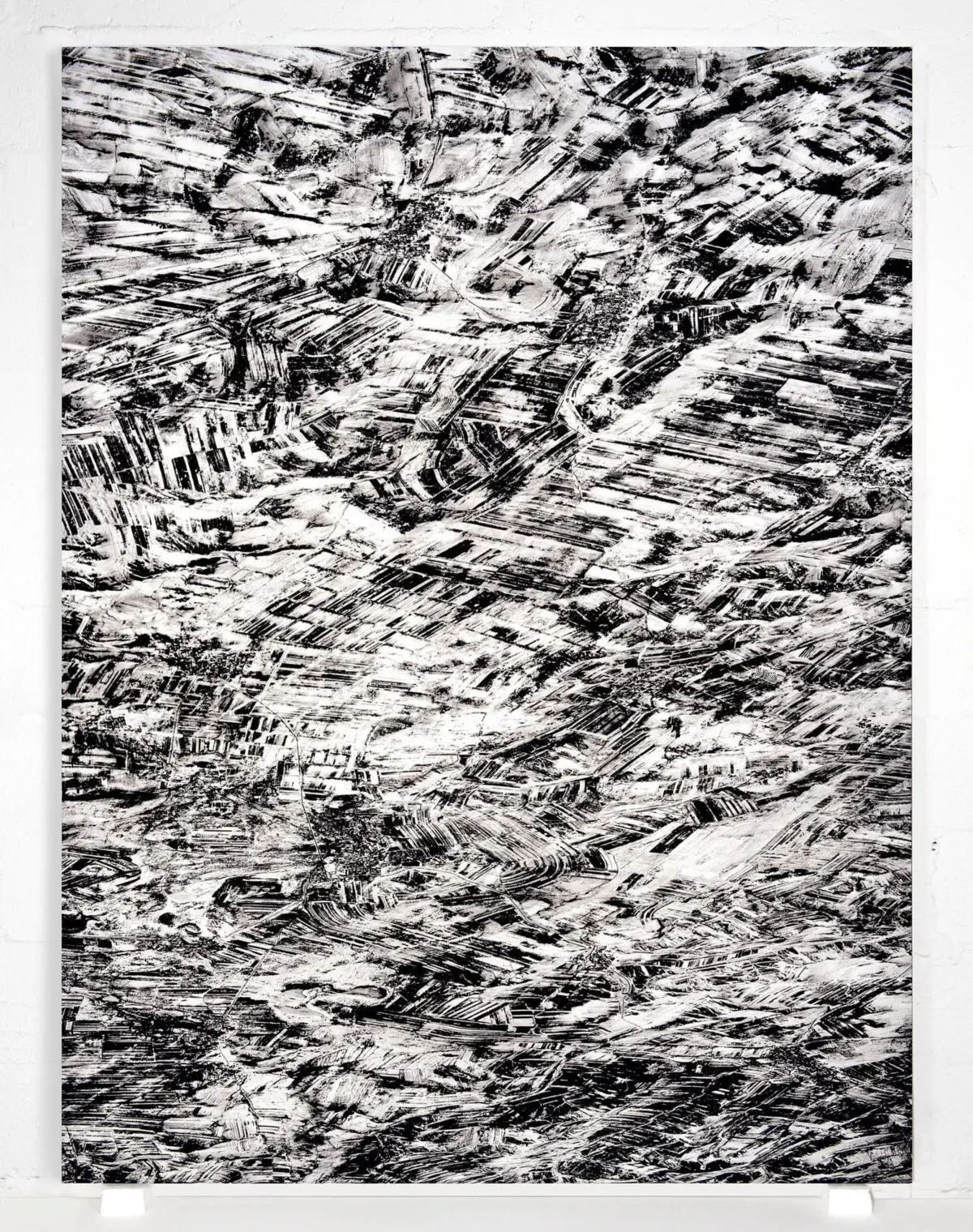
From a certain vantage point, standing inside Justin Brice Guariglia’s sprawling Brooklyn studio, it is nearly impossible to tell what exactly hangs on the back wall. Viewed from a distance, a massive 16-foot print immediately commands the room, presenting itself as a heavily textured painting with jagged, organic edges that practically invite the viewer to reach out and touch the physical relief. Yet, upon stepping closer, the illusion shifts; the eye realizes the image is entirely flat, possessing the smooth visual characteristics of a high-resolution photograph.
In reality, this striking trompe l’oeil occupies a deliberate space somewhere between the two distinct mediums. "They’re paintings derived from photographs," explains Guariglia, summarizing a meticulous creative process that seeks to challenge how viewers perceive both art and the natural world.
This particular monumental work originates directly from Guariglia’s recent, high-altitude flight alongside NASA’s Operation IceBridge mission. It captures a breathtaking, terrifyingly clear shot of the Jakobshavn Glacier, widely recognized as Greenland’s largest and fastest-melting body of ice. The piece forms a central component of an expansive series of landscape prints that the artist assembled for his major upcoming exhibition, Earth Works: Mapping The Anthropocene, scheduled to open at the Norton Museum of Art in Palm Beach, Florida.
The journey that brought Guariglia to this intersection of fine art, environmental science, and cutting-edge industrial technology spans more than a decade of creative evolution. He originally established himself as a freelance magazine photographer working extensively across Asia, capturing fleeting moments and transient news cycles for editorial publications. However, the inherent ephemerality of the medium began to weigh on him. Photographs printed on standard magazine stock are routinely discarded, recycled, or left to disintegrate in the relentless churn of media consumption. Guariglia sought a radical change in permanence. He wanted to create art that could
endure, pieces that would stand the test of time and outlive the very subjects they depicted.
For his latest museum show, Guariglia successfully engineered a groundbreaking method for printing his arresting aerial photographs directly onto rigid, industrial-grade surfaces of aluminum and polystyrene canvases. This deliberate choice of materials carries a profound conceptual weight. "The physical object in the photo is already gone," he reflects, acknowledging the rapid pace of climate change and glacial retreat. "But the actual image will last forever—as long as we don’t recycle it."
The raw source imagery for these expansive works is gathered from extreme vantage points, typically captured from aircraft flying at altitudes ranging anywhere from 1,500 to 40,000 feet. From these dizzying heights, Guariglia’s camera transforms ordinary human geography and vast arctic landmasses into mesmerizing, complex abstract forms. He visually bends the rules of terrestrial representation, turning sprawling Asian farmlands into gleaming, gilded geometries while rendering majestic glaciers as ambiguous, haunting vistas of pure, blinding white.

Many of the most striking photographs featured in the exhibition were secured during his flights with NASA’s IceBridge mission. The initiative deploys low-elevation research planes soaring directly over Greenland to gather critical scientific data on the country’s rapidly deteriorating glacial sheets. During these harrowing, turbulent flights, Guariglia would frequently lay prone at the very feet of the aircraft’s pilots, snapping high-speed photographs of the ever-changing, fracturing landscape below through the specialized drop windows of the research plane.
Back in his Brooklyn studio, Guariglia practices a disciplined form of artistic restraint, consciously choosing to avoid heavy digital manipulation or excessive post-processing. "I’m mostly just trying to reduce the image to its most basic essential form," he notes, emphasizing his desire to let the raw power of the landscape speak for itself.
To achieve this minimalist vision, he employs a massive, industrial-grade printer that maps the complex digital images onto sheets of polystyrene and gold-leafed aluminum. The machine itself is a marvel of modern engineering, handmade in Switzerland and commanding a market price roughly equivalent to the cost of a very nice apartment in Brooklyn. For Guariglia, this multi-ton apparatus functions directly as the artist’s paintbrush.
The printer operates by meticulously dispensing a microscopic, ultra-fine layer of acrylic ink onto the chosen surface before powerful ultraviolet lights instantly cure and bind the pigment directly to the material. While the device is typically utilized within the commercial sector for high-end signage and industrial displays, Guariglia pushes the hardware far beyond its intended design parameters. "I make it do things it’s not supposed to do," he says, describing how he forces the machine to print directly onto difficult polystyrene substrates or lay down an unprecedented 150 layers of heavy ink at a staggering 900 percent saturation rate.
Mastering this unconventional technique required years of trial and error. "I’ve logged about 1,500 hours testing material and printing processes," Guariglia reveals. The resulting output bridges the gap between digital photography and heavy sculpture, producing a photographic print that effectively lasts forever, standing in stark, poignant contrast to the profound ephemerality and rapid disappearance of the subject matter it preserves.
Every element of Guariglia’s intricate process, his harrowing subject matter, and his deliberate choice of industrial materials is meticulously designed to represent the Anthropocene—the current, unofficial geological age defined entirely by humanity’s profound, irreversible impact on the Earth’s ecosystems and climate. The ultimate goal of the exhibition, as he explains it, is to actively implicate not just himself as an artist utilizing heavy industrial materials that will inevitably become part of the future geological fossil record, but also every single viewer who stands before the work.
The monumental prints serve as an unyielding visual reminder that the massive environmental crises humanity currently faces are driven predominantly by our own collective actions. Yet, by capturing these overwhelming vistas, cropping them with cinematic precision, and anchoring them onto solid rectangular panels of aluminum and polystyrene, Guariglia brings the incomprehensible scale of planetary decay down to a level where it is at last undeniably clear and impossible to ignore.