At Advertising Week, amid endless panel discussions concerning the management of agents, the rise of digital creators, and the constant battle against audience fragmentation, an unusual and traditional topic kept forcing its way to the forefront: out-of-home advertising.
For years, the out-of-home industry—a catchall term for physical media formats including traditional billboards, wheatpastes, transit posters, and leaflets—was often viewed as a fusty, legacy channel. Yet, in recent years, it has taken on a renewed and vital relevance. The sector has benefited from a surprising and powerful confluence of industry tailwinds, transforming how marketers view physical presence in an increasingly digital world.
Its digital counterpart, somewhat unimaginatively designated as digital out-of-home media, or DOOH, is increasingly seen by media planners as offering the absolute best of both its digital and analog components. It delivers the unskippable, attention-commanding nature of physical formats while integrating the targeted, programmable capabilities traditionally associated with programmatic digital buying.
The financial metrics vividly reflect this profound resurgence of interest. According to data from the Out of Home Advertising Association of America, U.S. out-of-home advertising revenue grew 10.7% year over year in the second quarter, climbing to a record-breaking $3.16 billion. Digital-out-of-home grew at an even more rapid pace, surging 18.5% and accounting for nearly 40% of the entire category’s total revenue.
Taken more broadly, the sudden resurgence of out-of-home reflects a potentially more consequential structural shift across the entire advertising landscape. As the open internet becomes noticeably less trustworthy, less heavily trafficked, and increasingly mediated and filtered by artificial intelligence, physical space is rapidly becoming more valuable to brands seeking authentic consumer connection.
Dedicated observers of the media industry will recognize a vital part of this dynamic already playing out in publishing. For media companies striving to survive, in-person events have stood out as one of the few consistent bright spots in an otherwise severely challenged advertising environment. Publishers ranging from Condé Nast and Semafor to ADWEEK itself have invested heavily and strategically in their live events businesses. For some organizations, these physical gatherings now account for more than half of their total revenue streams.
There are several clear explanations driving that growth. The widespread rise of remote work has created a more distributed professional workforce, leaving individuals with fewer consistent, organic opportunities for face-to-face networking and convening. Live events solve that fundamental human problem neatly. More broadly, in-person media offers something that digital channels are finding increasingly scarce: a tangible, memorable experience, rather than the ephemeral interaction of scrolling past a display ad or skipping through an audio ad read.
Now, a host of new technological and economic factors are making that distinction between physical and digital environments even more meaningful for major brands.
The rapid rise of artificial intelligence has unleashed an unprecedented onslaught of low-quality online content—frequently referred to by critics as "slop"—whose true provenance will only become harder for everyday consumers to discern as underlying machine learning models continue to improve. Consumers are already growing increasingly skeptical of what they encounter online. According to a comprehensive 2024 report published by Adobe, 87% of U.S. consumers stated that the rapid proliferation of generative AI has made it significantly harder to distinguish objective fact from manufactured fiction across the web.
That steady erosion of digital trust was precisely one of the primary reasons Mariano Jeger, the former executive creative director at Droga5, cited for his high-profile departure to Outfront Media. As digital and social content become effortlessly manufactured and correspondingly difficult to authenticate, corporate brands have powerful new incentives to reconsider the relative value of appearing within those chaotic environments.
But artificial intelligence is changing far more than just the quality of what consumers encounter on their screens. It is fundamentally altering whether they need to visit the open web at all.
Emerging answer engines such as ChatGPT, Claude, and Gemini increasingly provide direct answers to complex user queries without requiring those users to click through to the original websites from which that verified information was initially sourced. For digital publishers, this evolution threatens to severely reduce vital referral traffic, ultimately shrinking the audiences—and by extension, the valuable advertising inventory—that the open web can sustainably offer to marketers.
Autonomous software agents threaten to accelerate that profound structural shift even further. Products designed to accomplish complex multi-step tasks on behalf of consumers promise to bypass not just individual websites themselves, but the underlying digital advertising that traditionally subsidizes their operations.
Consider a recent high-stakes dispute where Amazon actively blocked an autonomous agent from crawling its e-commerce website. Whatever the specific corporate motivations behind the public disagreement, the clash highlights an existential crisis for advertising-supported digital destinations: An automated agent can seamlessly extract the absolute utility of a website without ever exposing its human user to the ads that help pay for its creation.
Taken together, these accumulating forces—the accelerating decline in trust regarding online content, the growing technological ability to bypass publisher websites altogether, and the rapid rise of algorithmic intermediaries that do not consume advertising—threaten to make major parts of the digital ecosystem considerably less valuable to traditional marketers.
At the exact same time, out-of-home advertising has evolved to become considerably more sophisticated.
New, eye-catching creative assets can now appear on digital screens programmatically, providing marketers with much of the precise targeting and tactical flexibility they have grown to expect online, while carefully retaining the single most defining advantage of physical advertising: A consumer quite literally cannot scroll past a DOOH display.
Furthermore, as a growing number of corporate enterprises have embraced the fundamental logic of transforming themselves into media businesses, the available market opportunity has expanded exponentially. Ride-sharing services, airlines, grocery stores, major traditional retailers, and other businesses possessing extensive physical footprints and captive consumer audiences can increasingly turn those tangible environments into lucrative advertising inventory.
In a very real sense, the foundational logic of retail media is successfully escaping retail entirely. Any corporate entity that controls a physical space where human beings spend their time possesses the essential ingredients required to become an independent media owner.
Yet, the exact same economic forces making physical space vastly more valuable to advertisers simultaneously risk making those exact physical spaces significantly less pleasant for everyone else who inhabits them.
In dense urban environments like New York City, this phenomenon can already feel like an urban scourge, as cherished public spaces increasingly give way to digital kiosks and towering screens featuring a relentless, unyielding stream of commercial advertising. In a recent episode of his widely followed podcast, New York Times journalist Ezra Klein candidly bemoaned the current situation.
"A column I have wanted to write—and have not written, in part because I’ve been afraid of the reaction to it—is that as a newcomer to New York City (I moved here three years ago) I find the presence of the advertising on the New York City subway and on the buses really sad," Klein shared with listeners.
The natural counterargument frequently raised by transit authorities is that those advertisements help directly subsidize public transit systems, keeping fares more accessible for everyday riders. However, the Metropolitan Transportation Authority receives only about 1% of its total operating revenue from advertising sources, according to Klein’s analysis. He raises an intriguing and challenging economic question: Would public transit users willingly accept a modest fare increase in exchange for a completely ad-free subway system?

That pointed question directly highlights a growing commercial tension that will only expand in importance if the current out-of-home boom continues unchecked.
Across nearly every traditional advertising channel, professional marketers must carefully balance audience reach against frequency. Expose a potential customer to a specific commercial message too many times, and its overall effectiveness rapidly declines; eventually, mere familiarity curdles into active annoyance. Within digital environments, advertisers can easily deploy frequency caps to strictly limit that exposure. Moreover, consumers retain an even simpler, ultimate option: They can easily set down their smartphones, turn off their televisions, or close the digital magazine tab.
Out-of-home media is fundamentally different.
As increasingly larger portions of the physical world are converted into commercial advertising inventory, consumers are left with systematically fewer ways to opt out. An individual can easily close a browser tab or delete an annoying mobile application. They cannot, however, easily close a physical subway platform.
For the better part of two decades, the advertising industry steadily followed consumers as they migrated away from the physical world and onto the digital internet. Today, the disruptive rise of artificial intelligence may finally be helping push some of that core advertising value right back in the other direction.
The critical unanswered question facing the industry is precisely how much of the physical world consumers are ultimately willing to surrender to it.
Talking Heds
Scripps Substack: The major local broadcast company Sinclair, whose television stations reach roughly 38% of U.S. households, is launching an ambitious national news brand directly on Substack, titled The National Press, according to a recent report from Axios. The new outlet will feature original reporting sourced from across the expansive Sinclair network, which encompasses approximately 1,200 journalists working across 60 local newsrooms, according to Sinclair president and CEO Chris Ripley. The rollout represents an unusually experimental gambit from an otherwise traditionally staid news organization. Through this new venture, which will feature both free and paid subscription tiers, Sinclair will be able to directly gauge the genuine news appetite of the broader Substack ecosystem.
Express Brew: Morning Brew acquired the creator-led editorial brand Express Checkout in an all-cash transaction, Morning Brew CEO Robert Dippell confirmed. Express Checkout, a lean two-person operation co-founded by Nate Rosen and Jenna Movsowitz, covers the fast-moving consumer packaged goods industry through a curated mix of newsletters, podcasts, and short-form social video. Through the completed deal, Morning Brew secures 100% intellectual property ownership of Express Checkout, while Rosen and Movsowitz will transition to Morning Brew as full-time employees, backed by clear performance incentives designed to accelerate brand growth. While many traditional publishers merely talk about working with independent creators, Morning Brew continues to actively partner with them, noting that its creator-focused monetization lines are up more than 50% year over year.
Skydance Rises: Warner Bros. Discovery is now officially Skydance, marking the culmination of a massive media empire engineered by David Ellison that, just three years ago, did not even functionally exist. Today, the corporate structure encompasses Paramount, Discovery, Warner Bros. Discovery, CNN, HBO, CBS, TNT, Nickelodeon, and numerous other prominent properties. It also carries approximately $80 billion in accumulated debt. The newly minted corporate entity would superficially appear to be an unstoppable behemoth, yet from a competitive streaming perspective, it remains firmly entrenched in fourth place. There is undeniably far more to modern media than direct-to-consumer subscribers, but this massive entertainment assemblage will still face an uphill battle in convincing skeptical advertisers that its collection of sub-scale platforms constitutes a must-buy proposition.
Uncensored Offering: Piers Morgan and his two-year-old Uncensored Media business are charting a new path on YouTube. Morgan stands out as one of a select handful of highly recognizable legacy news personalities who successfully decamped to YouTube in recent years, where he has built a thriving media enterprise spanning various Uncensored franchises covering international soccer, royal news, and historical deep dives. The company outlined its strategic plan to launch individual $4.99 monthly subscriptions for its distinct franchises, part of an overarching corporate mandate driven by new CEO Rashida Jones to aggressively grow the bottom line by diversifying revenue sources. Jones, who assumed the role in March after departing MSNBC, has also spearheaded concerted efforts to expand the brand’s lucrative licensing and live events businesses.
OpenWeb Falters: The prominent adtech firm OpenWeb, which assists premium digital publishers in monetizing their website audiences, formally requested insolvency protections in an Israeli court. The acute financial strain is the direct result of a cascading series of disruptive events—including Microsoft, a critical enterprise client, abruptly ceasing its business relationship with OpenWeb, which subsequently caused a key lender to panic, perceive a material threat to the business, and demand immediate repayment of its capital. However, the fundamental root cause remains the ongoing structural contraction of the open internet, largely driven by the rise of AI-powered search engines. Just four years ago, OpenWeb commanded a staggering valuation of $1.5 billion, counted The New York Times as an early investor, and seated prominent industry figures like Scott Galloway on its board of directors. A turbulent boardroom coup, coupled with persistent macroeconomic headwinds facing open web advertising, ultimately left the company on its back heel.
Quote/Unquote
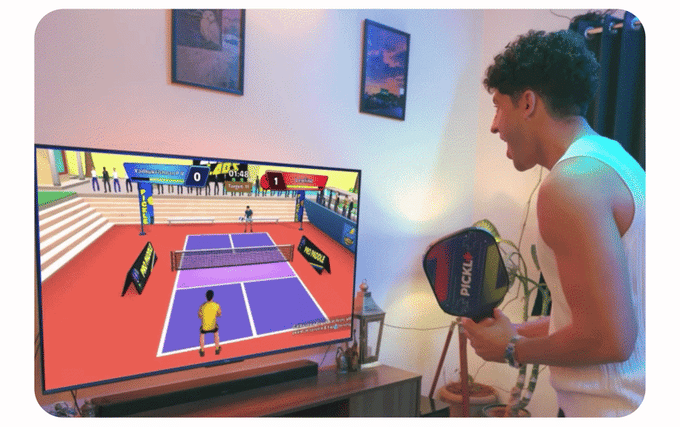
The world of video games has historically been relatively late to embracing traditional advertising, but that dynamic is poised for a dramatic transformation. Electronic Arts announced its very first dedicated ad platform, allowing major brands to buy ad space within games much like traditional television—minus the heavily distracted viewers. Simultaneously, major entertainment firms like Netflix and LG are investing heavily to convert passive streaming audiences into active video game enthusiasts, which could dramatically expand the total pool of potential gamers.
As a result, Wes Morton, the co-founder and CEO of Creativ Company, firmly believes that automated advertising will soon become entirely ubiquitous within the core video game experience itself. If that trajectory holds true, in-game programmatic advertising could easily establish itself as one of the single largest advertising mediums on the planet within the next five years, driven by improved underlying technology, significantly lowered barriers to entry, and a newly motivated wave of industry-adjacent corporate entrants.
Mark Stenberg: Why are so many game companies launching ad businesses now?
Wes Morton: They’re all actively looking for fresh ways to monetize their massive audiences. Game publishers were historically always open to custom partnership deals, but now they are truly professionalizing their operations. To put the audience in proper context, The Game Awards routinely captures significantly more viewership than all of the other major traditional award shows combined. I firmly believe video games will become the absolute biggest advertising medium in the next five years.
Mark: It’s nearly 2027. Why has this evolution taken the industry so long?
Wes: Measurement is inherently far more complicated in gaming environments. A traditional website is a flat, static page that human eyes look straight at. Inside a complex video game, the virtual view is constantly rotating and shifting, which makes standard viewability metrics vastly harder to accurately measure. The Interactive Advertising Bureau recently released official in-game advertising standards, which represents a massive step forward for the sector.
Mark: What still needs to happen before programmatic ads fully infiltrate video games?
Wes: The foundational technical pipes still need to be built out properly. Right now, programmatic partners will let you buy across various disparate titles, but you still cannot buy efficiently studio by studio or publisher by publisher. No major powerhouse names have successfully emerged in programmatic gaming ads yet. Unity has a genuinely great shot at seizing that mantle, and Roblox is deeply interesting. There are currently a lot of ambitious players trying to tap into this lucrative audience.
Mark: Entertainment companies outside of traditional gaming are moving into the space as well. What is driving that movement?
Wes: Companies like Netflix and Amazon are spending substantial capital on gaming because they clearly recognize it as the next major entertainment frontier. Gaming is already outperforming traditional television and movies in terms of total revenue generated and actual consumer time spent.
Mark: What happens when the ultimate barrier to entry is simply owning a standard television set?
Wes: Ease of entry is hugely, critically important. The mobile phone is already the single biggest gaming device by total revenue, easily outpacing dedicated home consoles. One prediction I love to make is that we will soon see high-fidelity video games streamed directly to the home television, utilizing the smartphone as the primary controller. The user experience isn’t quite fully there yet, but that is purely a temporary technology constraint, not a lack of consumer desire. Once those technical hurdles are cleared, the industry will be able to distribute immersive entertainment in entirely new and compelling ways, which will be massive for the entire ecosystem.