As the movement of oil out of the crucial Strait of Hormuz steadily approaches pre-war levels, international shipping markets may finally be witnessing the beginning of the end for the worst of the freight rate escalations that have plagued global supply chains since the onset of the conflict in the Middle East.
While container shipping prices originating from China and heading toward the United States West and East Coasts have experienced staggering surges—climbing 344 percent and 335 percent respectively since February 28, according to data released Friday by ocean and air freight benchmarking platform Xeneta—industry experts suggest that these heavily elevated rates have likely reached their ceiling.
"We can say with a level of confidence that the market has reached its post-Hormuz crisis peak in 2026," said Peter Sand, chief analyst at Xeneta, during a weekly market update on Friday. "Demand is not strong and rates have now peaked, but they will not collapse, so shippers should expect to pay elevated freight costs for the remainder of the year."
The pricing divergence between the two U.S. coasts has widened significantly during the crisis, with the spread accelerating to $3,177 per 40-foot equivalent unit (FEU). Containers bound for the U.S. East Coast have reached an average of $11,523, while West Coast-bound boxes are currently averaging $8,346. Before the geopolitical crisis erupted, the gap between the two coasts was a modest $772, highlighting the severe logistical imbalances brought on by the regional conflict.
Sand anticipates that this dramatic cost spread will eventually compress as a broader market correction takes hold during the final months of the year. This normalization is expected to be driven primarily by a sharper downward correction for the U.S. East Coast, given its much higher starting baseline. Looking forward over the next three quarters, spot rates for the East Coast could retreat to a range of $6,000 to $7,000, while West Coast rates are projected to settle between $4,500 and $5,500.
Despite the broader trans-Pacific stabilization, localized rate pressure remains exceptionally high for the rare instances where commercial cargo must actually pass directly through the Strait of Hormuz. The United Arab Emirates’ National Association of Freight and Logistics reports that the total cost of moving cargo directly into the Persian Gulf remains running at three to five times pre-war levels. These stubborn financial burdens are driven primarily by an accumulation of high risk surcharges, necessary cargo rerouting, and expensive land-transport alternatives, rather than standard base ocean rates. These localized costs had not subsided as of early October.
Meanwhile, the security situation within the vital waterway has grown increasingly volatile, with direct attacks on commercial vessels intensifying to unprecedented levels. Maritime security sources cited by Reuters confirmed that attacks reached their highest weekly frequency since the war began, with at least 12 separate strikes targeting oil, liquefied natural gas (LNG), and liquefied petroleum gas (LPG) tankers during the week of September 28 to October 5. Separately, the International Maritime Organization verified nine hostile incidents during that same week, surpassing the previous peak of eight incidents recorded during the week of July 13.
The relentless wave of violence continued into the following week. On Tuesday, an unknown projectile struck the Panama-flagged tanker On Peace, resulting in injuries to 12 crew members, according to information provided by India’s foreign ministry. This followed an even more intense weekend of violence that saw two separate tankers struck on Sunday—an inbound LPG carrier and the product tanker Lipsi. Furthermore, the UK Maritime Trade Operations (UKMTO) reported that the Islamic Revolutionary Guard Corps (IRGC) forced a commercial tanker near Oman to turn back on Monday. The U.S. Navy-led Joint Maritime Information Center noted on Sunday that the IRGC continues to demonstrate a clear intent to assert its presence along key transit lanes through aggressive drone overflights and ongoing surveillance activities.
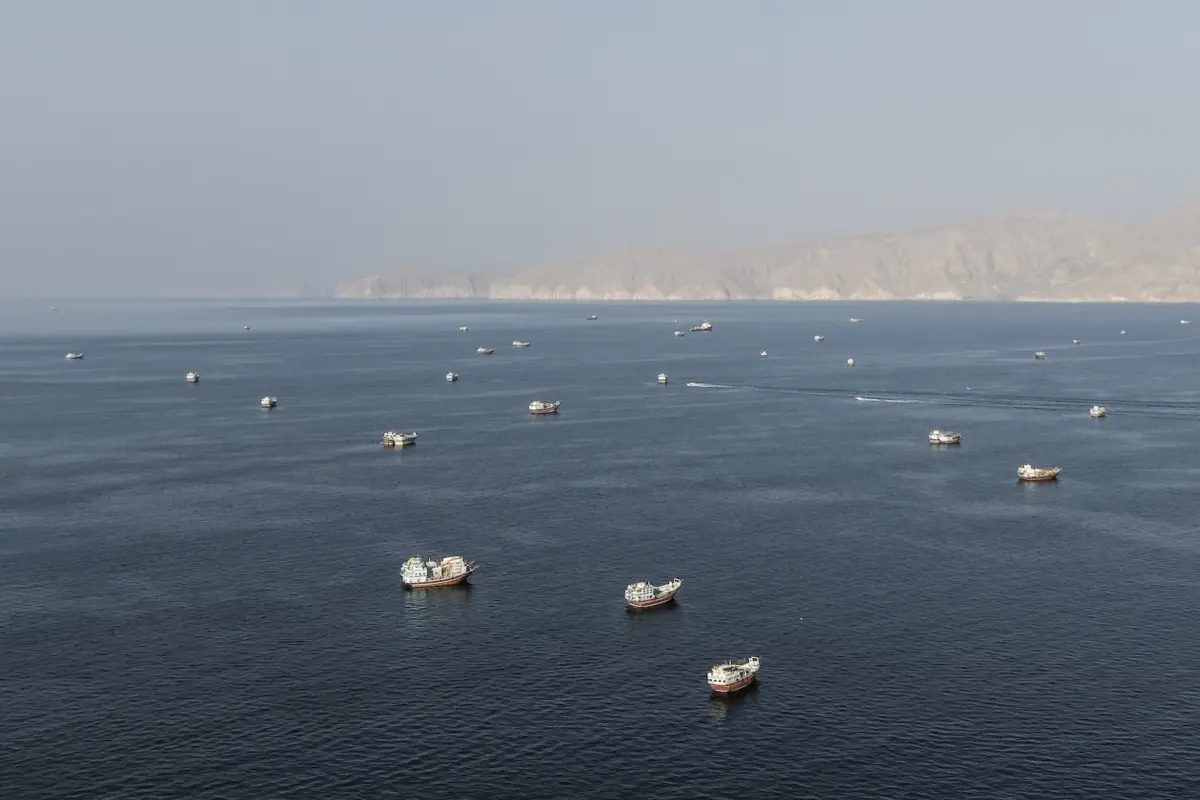
Unsurprisingly, direct vessel movement through the strait remains severely depressed amid these constant threats. Maritime intelligence software company Windward recorded a meager 11 tanker and cargo vessel crossings during the 24-hour period ending Tuesday, consisting of just three inbound and eight outbound transits. Overall vessel movements through the corridor remain a fraction of the pre-war norm, which typically saw approximately 125 vessels traversing the strait daily.
Even so, the region’s vital oil supply is successfully finding its way to international markets, albeit through alternative logistical channels rather than traditional direct passage through the strait. According to the latest briefing from energy intelligence firm Kpler, the confirmed total Hormuz clearance volume now stands at a seven-day average of 11.5 million barrels per day (bpd). While this figure represents a volume roughly one-third below the pre-war baseline of 17.1 million bpd, direct strait transits alone are currently averaging 9 million barrels per day. However, ongoing attacks on tankers and persistent logistical constraints continue to cast a shadow of uncertainty over the outlook for sustained higher flows.
To circumvent the dangerous waters of the strait, approximately 40 percent of regional oil exports are now bypassing the corridor entirely. Shipments are being redirected through terminal facilities at the UAE’s Port of Fujairah and utilized in ship-to-ship transfer operations taking place safely in the Gulf of Oman. As a result of these adaptive workarounds, total regional export averages have climbed to 21.7 million barrels per day, bringing output to just 7 percent below pre-war baseline levels.
Addressing the geopolitical standoff during a diplomatic visit to Athens on Wednesday, U.S. Secretary of State Marco Rubio asserted that Iran has "lost complete control" of the strait, pointing out that "there’s almost as much oil flowing out now as there was before this conflict began."
In stark contrast, just hours after Rubio’s remarks, IRGC adviser General Mohammad Reza Naqdi told the Fars News Agency that "the Strait of Hormuz is closed, and the armed forces of the Islamic Republic of Iran have full control over it." He further warned that what Tehran views as "illegal routes" hugging the coast of Oman would soon be shut down by Iranian forces.
On the diplomatic front, U.S. Vice President JD Vance told Reuters on Wednesday that Iran must enact a "meaningful" reduction in its uranium enrichment capacity. Defense and foreign policy analysts widely interpreted this stance as a notable softening from Washington’s previous hardline demand that Tehran abandon its nuclear enrichment program entirely.
Against this complex backdrop of recovering supply lines, persistent geopolitical rhetoric, and lingering security threats, international energy markets experienced moderate pricing pressures. Brent crude oil futures traded at approximately $101 per barrel on Wednesday, while West Texas Intermediate (WTI) hovered near $89 to $90 per barrel. These prices found upward support from Houthi strikes targeting Saudi airports earlier in the week, though further spikes were effectively capped by the steady recovery of Gulf oil exports and the prospective release of emergency stockpiles by G7 nations.