Piloting an F-35 over the desolate expanse of the Nevada desert, your Monocle correspondent attempts a barrel roll. It proves surprisingly easy, so she does a few more, prompting the former Marine Corps pilot overseeing the flight to nudge the aircraft in the direction of the enemy. Finger on the trigger, I follow his directions and gently press the red button, sending a few small dots flying across the screen towards another vague target in the distance.
Considering that I am sitting in the seat of a simulator for one of the most advanced fighter jets in the world, the experience is a little lacking in theatrical drama. But there is no lack of tension when it comes to the F-35’s position in geopolitics today. With a raft of new orders pouring in from Europe and mounting controversy over potential sales elsewhere, this ultimate symbol of United States air superiority is undeniably having a defining moment.
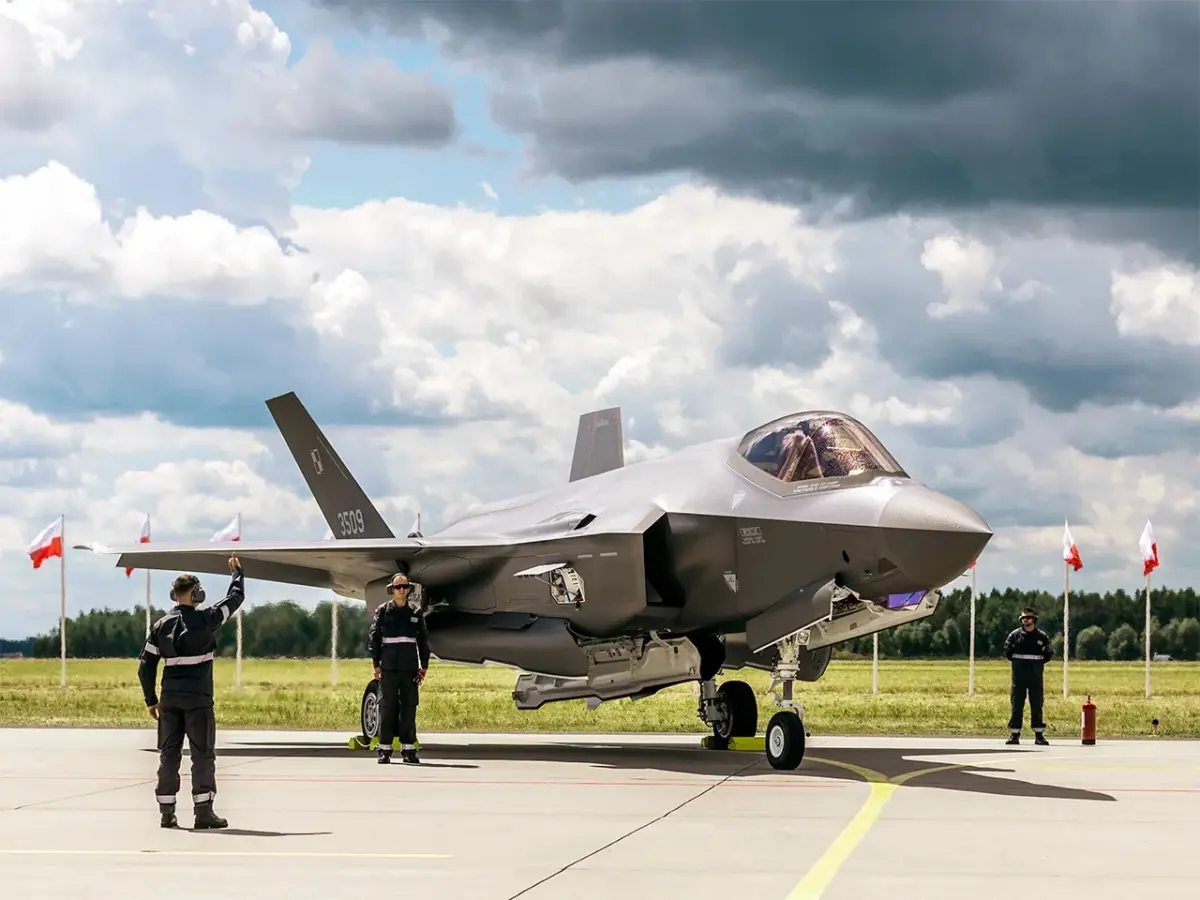
The physical deliveries match the surging diplomatic interest. In September, aerospace manufacturer Lockheed Martin officially handed over Germany’s first F-35A Lightning II, marking the beginning of a fleet that will eventually grow by 34 more aircraft. Just a week later, Finland officially welcomed its first of 64 F-35As into its national defense network. Meanwhile, Poland received the initial delivery of its own modern F-35 fleet in May, accelerating a broader modernization wave across the European continent.
“We are getting very strong international demand,” says James King, director of the US Navy F-35C programme at Lockheed Martin. He adds that the company currently maintains the capacity to produce 156 of the stealth aircraft each year. “That is what the Joint Program Office wants us to execute. We obviously believe that we could do more. We would like to do more, but that’s going to take a consistent demand signal to increase that capacity.”
It is hardly a surprise that European nations are urgently clamouring for the finest military technology the United States has to offer. With Russia’s brutal assault on Ukraine grinding deep into its fifth year, concerns are rapidly growing among neighboring states about the potential spillover of hostilities into the rest of Europe. These anxieties are not merely theoretical. Germany’s intelligence chief warned this week that the country risked stumbling directly into a “violent conflict” with Russia, pointing specifically to a concerning drone attack on Leipzig airport in August that sharply escalated regional tensions.
Echoing these severe warnings, Polish Prime Minister Donald Tusk cautioned last month that Moscow could actively be planning future drone and missile strikes directed at European nations that have steadfastly supported Ukraine. Against this volatile backdrop, a sudden and massive uptick in F-35 orders is entirely understandable. The aircraft is widely regarded as one of the most advanced stealth fighters operating in the skies today, with more than 1,355 operational units currently deployed around the globe.
Speaking at the Lockheed Martin Global Vision Center in Arlington, Virginia, Dan Tenney, senior vice-president for global business development and strategy, referred to the countries that purchase the F-35 simply as “allies.” However, determining precisely who qualifies as an eligible ally is entirely outside Lockheed Martin’s hands. The export and sale of F-35s are strictly and meticulously controlled by the United States government. Any sovereign nation wishing to acquire the sophisticated fighters must do so through a formal application to the US State Department, subjecting itself to a notoriously lengthy, rigorous vetting and approval process.
The F-35A Lightning II was originally developed by the United States with vital financial and technical assistance from seven international partner nations in the Joint Strike Fighter programme: the United Kingdom, Canada, Italy, the Netherlands, Australia, Denmark, and Norway. Beyond these core partners, sales to 12 other countries have successfully cleared the approval hurdles. Turkey was initially an integral participant in the Joint Strike Fighter scheme, but it was abruptly removed from the consortium in 2019 after purchasing and testing Russian-made S-400 air defense systems. Yet, political winds can shift rapidly; Donald Trump has recently suggested that Turkey might yet receive the jets, telling reporters at July’s NATO summit that he harbored “no concerns” over the Russian missile systems integrated into Turkish military infrastructure.
Complexity and controversy extend far beyond Europe. The State Department also approved a massive potential $24.3 billion sale of 48 F-35 fighters to Saudi Arabia last month. At present, Israel remains the exclusive nation in the Middle East equipped with F-35s—a deliberate strategic decision engineered by Washington to ensure a definitive qualitative military edge for its key partner in the region. This potential Saudi transaction has understandably raised alarm bells in Tel Aviv, as well as in certain cautious corners of Washington. Riyadh has previously conducted joint military exercises with China, igniting lingering fears that sensitive data or elite US technological secrets could eventually find their way into Beijing’s hands. The United States Congress retains the constitutional authority to review major foreign military sales, and that delicate legislative oversight process is currently ongoing.
Lockheed Martin executives declined to address questions regarding the sensitive geopolitics of who ultimately receives the F-35, reiterating that such decisions rest firmly with the federal government. Yet, with persistent, escalating security concerns gripping Europe, and a US administration constantly searching for reliable allies in a Middle East thrown into severe turmoil by regional conflicts and Iran’s posture, Lockheed’s James King might soon get his wish for sustained, higher-volume orders.