MILAN — Annalisa Tani and her team at Ginori 1735 have spent a significant amount of time testing their luck on the winding track of the Game of the Goose. Long before it inspired the Tuscany-based, Kering-owned porcelain house’s latest home decor line, the historic board game was popularized across Italy during the 15th and 16th centuries. Historically documented as a favorite pastime among powerful dynastic families such as the Medici and the Aragon, it holds the distinction of being the earliest commercially produced board game.
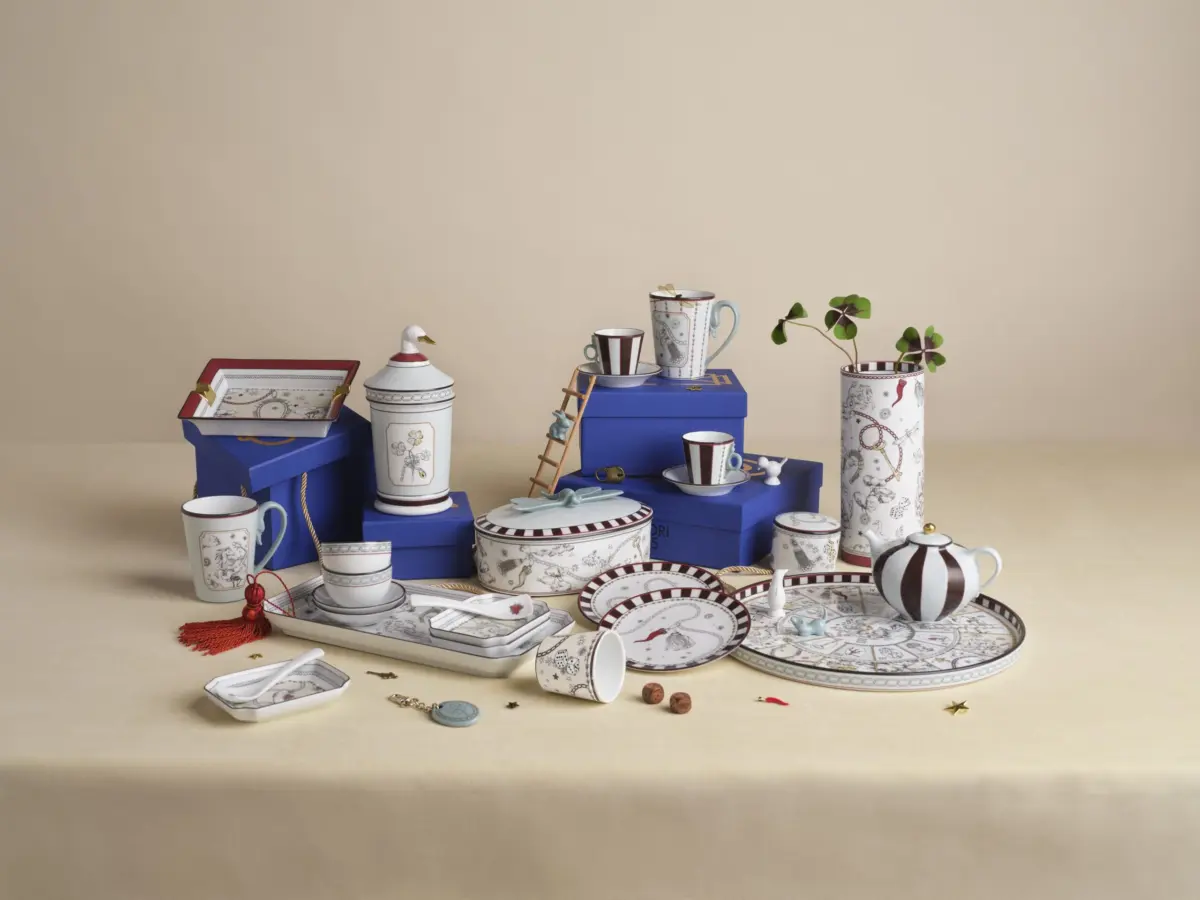
That rich history, combined with a modern fascination for symbolism and thoughtful gifting, forms the cornerstone of Fortunae. Launching on Wednesday, the new collection of collectible porcelain and home accessories draws directly from the whimsical path and goose motif of the Renaissance board game.
Priced between $140 and $850, the collection introduces an array of playful talismans—including geese, dragonflies, clovers, horseshoes, dice, keys, and ladybugs—emblazoned across trays, teapots, mugs, decorative boxes, miniatures, and espresso sets. Designed with both everyday function and display in mind, the pieces blend Ginori’s signature vibrant color palettes and delicate touches of gold with a lighthearted approach to contemporary interior styling.
In a recent interview, Collection Director Annalisa Tani discussed the creative journey behind Fortunae, the evolving nature of gift-giving, and how the storied porcelain house continues to balance a 300-year heritage with contemporary design strategies.
Exploring Luck, Superstition, and Meaningful Gifting
WWD: How did the idea for Fortunae, inspired by a game associated with the Medici court, come about?
Annalisa Tani: It began with the universal relationship between luck and objects. Across cultures, people have objects they use as superstitions or good-luck charms. Sometimes we believe an object brings us luck; sometimes we give an object to wish someone “stai bene” or “buona fortuna.” I wanted to explore that connection between objects, wishes, and the light-hearted idea of keeping fears at bay. The collection combines decorative and functional objects, with each piece designed around both its use and its story.
WWD: Why did you choose the Game of the Goose as a cultural reference?
A.T.: The idea of luck is shared across cultures: the Japanese have their symbols, Americans have the horseshoe, and Italians might have the cornetto, or crescent horn. The Medici gave the Game of the Goose to the King of Spain. It was one of the earliest court board games and represented the course of life: you can fall, rise, move forward, or move backward.
I liked reintroducing a board game into our highly digital lives—something cultural, playful, and functional, almost like a tray. The goose itself was a good-luck symbol, which is why the game was named after it.
WWD: What does Fortunae say about the act of giving?
A.T.: When we give something, we instinctively give a wish too—good luck, happiness, or well-being. The gift market has grown because consumers are increasingly drawn to objects with meaning and lasting value, rather than things that feel disposable in an already very digital world.

Fortunae pieces can be given individually or combined into small sets. They are also multifunctional. A box might hold jewelry beside the bed or chocolates on a table. The idea is to create small worlds that can interact with one another.
Adapting to Shifting Consumer Habits and Modern Living
WWD: Are younger consumers changing the way Ginori is used and gifted?
A.T.: That’s where the idea for the gift collection came from: young people come into the store asking for ideas for Valentine’s Day or for a graduation present. Graduations and weddings, for example, are another channel that’s working extremely well. Traditional wedding favors and gifts are increasingly being replaced by products—or somewhat more precious pieces—that fit this concept, last longer, and have lasting value.
WWD: In 2025, Ginori 1735 released the “New Table Manners Campaign” in which messy plates of spaghetti sit alongside markers, candies, and spilled tomato sauce. Above all, it was an indication that old rules are changing. How does Ginori 1735’s design strategy reflect this shift?
A.T.: We asked ourselves some questions, and even when you go to someone’s home—especially a high-end home—the table may be set formally at first, but it naturally becomes more relaxed. Young people relate to one another in the same way, regardless of their social background.
So we began imagining how they would use it. Ginori 1735 can be incredibly formal, but it can also be wonderfully casual for an everyday quick lunch, while maintaining a very high level of aesthetic quality. That’s also part of what it means to be contemporary. People no longer host large, formal family meals as often as they used to.
WWD: Recent collections and collaborations balance consumers’ penchant for history, archival icons, and a contemporary spin. Case in point, Luke Edward Hall’s ongoing Neptune’s Journey for Ginori 1735, characterized by cartoonish images and an upbeat color palette. How would you describe Ginori’s current creative direction?
A.T.: We are working on several levels, with future collections that range from more classical to more daring. Fortunae already goes quite far, while maintaining the relationship between heritage and the future.
Ginori has never had only one voice for 300 years. But there must always be a narrative or story—one that is also somewhat contemporary and looks ahead, because so many things are still changing. Beauty is a given at Ginori, but there must also be a contemporary story that looks ahead.
WWD: How are you balancing heritage with contemporary design?
A.T.: We do not always begin with heritage. For Fortunae, we mainly recovered the idea of the game; the graphics are contemporary and often monochromatic, with carefully considered touches that support the forms.

Archival Discoveries and Crafting the Game
WWD: What has inspired you most in Ginori’s archives?
A.T.: I love Gio Ponti, and we have an incredible archive of artifacts, papers, and documents that form the foundation of global design. Every now and then I go through the archives and ask myself, “What on earth was this used for?” Sometimes it’s a strange object used to hold ice, or ice-cream holders. Back then there were no refrigerators—there were iceboxes, and glasses were placed upside down inside them to cool before being filled with ice cream.
There are so many other antique objects that are no longer used—one of the most beautiful examples is perfume bottles from around the 1700s.
WWD: What was it like to develop the Fortunae game itself?
A.T.: You should play it because it is very entertaining. We played it constantly while developing it. It was not easy to determine the spaces where you had to move three places forward or two backward. We changed the design 100 times because every element had to make sense.
We played with our children in groups of four or five and had a wonderful time. As they say, it is luck: you can land badly and not reach the end at all.
WWD: What responsibility comes with continuing Ginori’s legacy—and following in the footsteps of figures such as Gio Ponti, who served as artistic director of Ginori 1735, then Richard-Ginori, from 1923 to 1933?
A.T.: We always remind the team that we create things that remain. We work with enormous attention and passion because we would never want someone to look at a piece and say, “That is horrible.”
Ginori has a great responsibility behind it. We cannot remain still; the bar must keep rising. We must continue experimenting with new techniques while doing our best to create objects that are beautiful, meaningful, and made to last.