A high-stakes political and industrial campaign is intensifying across California as a delegation of federal lawmakers and powerful entertainment labor union leaders unite behind a sweeping push for a federal film incentive. With the clock ticking down toward the end of the legislative calendar, advocates are rallying momentum to pass the measure before the close of the year, framing the initiative as an urgent economic rescue mission for American entertainment workers.
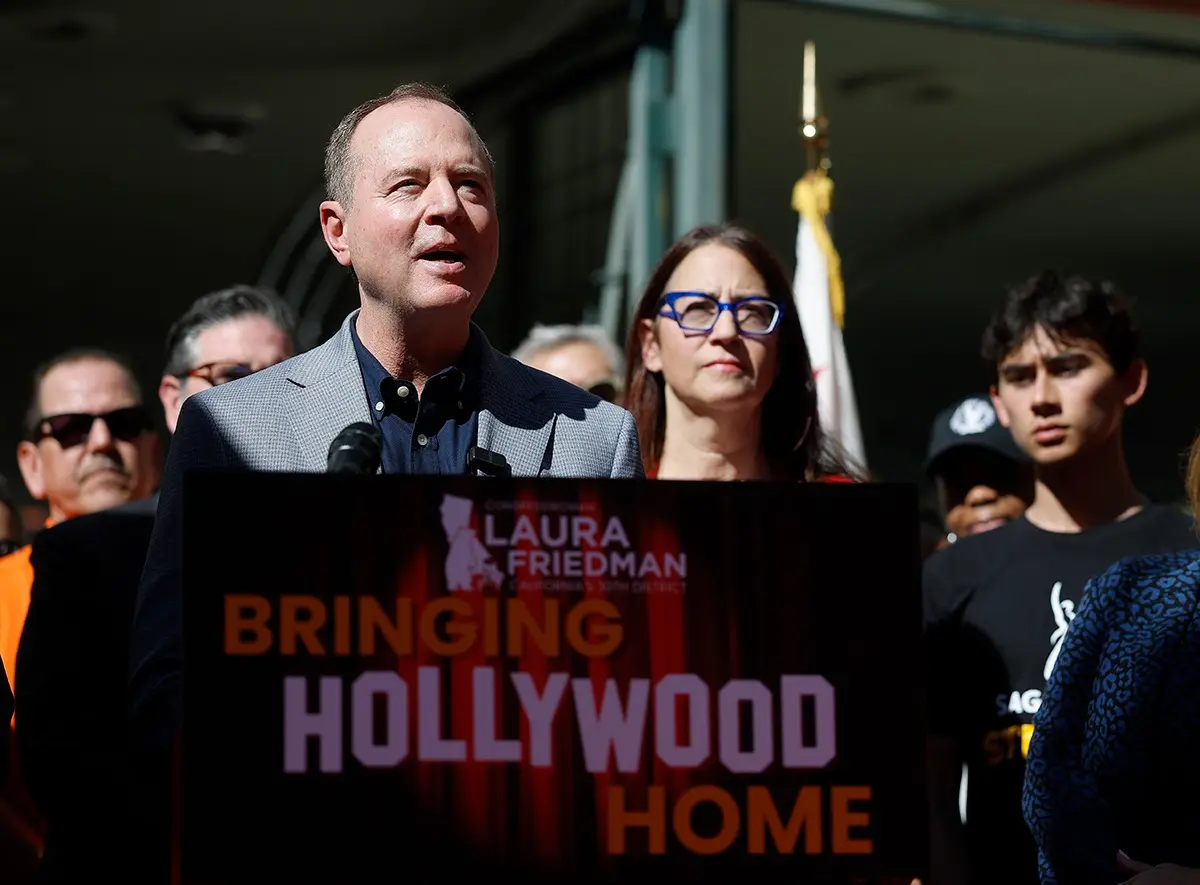
Gathered under a blistering 100-degree sun outside the historic Alex Theatre in Glendale, California, U.S. Senator Adam Schiff and a coalition of eight Democratic representatives from Southern California delivered a unified message on Tuesday. They argued that the United States government must act decisively to counter aggressive tax incentives offered by at least 65 foreign countries—measures that have steadily lured billions of dollars in American film and television production, along with thousands of high-paying technical and creative jobs, overseas.
"We are so close to getting this done," Senator Schiff told the assembled crowd of workers, union officials, and press, emphasizing the critical nature of the timeline. "Whatever we can do to get this done, that is job No. 1. It just can’t wait. It’s too important. The losses so far have been too extraordinary."
The legislative vehicle driving this push was formally introduced last month. The bill proposes the creation of a robust 20% to 30% transferable tax credit designed to offset domestic labor costs for qualifying film and television productions. According to updates provided by Schiff’s office during the Tuesday event, the legislation has successfully secured the backing of 12 senators, evenly divided with six Democrats and six Republicans. Among the latest lawmakers to sign on as cosponsors are Senator Thom Tillis, a North Carolina Republican, and Senator Chris Coons, a Delaware Democrat, signaling a growing bipartisan appreciation for the economic vulnerability of the domestic entertainment sector.
Proponents of the bill face a compressed and challenging window to shepherd the legislation through Congress. Lawmakers will have roughly a five-week legislative window during the upcoming lame-duck session following the general election to secure its passage. Representative Laura Friedman, whose congressional office organized Tuesday’s high-profile press conference, expressed a measured outlook regarding the bill’s legislative prospects in Washington.
"We need to have this on the president’s desk by mid-December, as far as I’m concerned," Friedman said in a subsequent interview, noting her preference for the bill to be enacted in essentially its current form as a critical component of a broader end-of-year tax package.
Reflecting on the grueling legislative journey required to reach this juncture, Friedman added context to the steady accumulation of political capital behind the proposal. "This has been almost two years of constant work. It hasn’t just come together in the last few weeks. It’s been a snowball effect. It started out as this idea, and then we just kept building and building and building. So I feel like we have a great momentum."
The intricately drafted proposal contains several targeted provisions designed to maximize geographic impact and industry participation. Notably, the bill incorporates a 5% bonus for productions that choose to film in designated disaster areas. Under the current parameters of the text, this bonus would apply to the entirety of Los Angeles County through January 2030, offering a vital economic bridge for a region still working to recover from the devastating impacts of last year’s wildfires. In addition to the disaster-area bonus, the legislation includes specialized provisions and incentives tailored to support independent filmmakers and encourage location scouting within rural opportunity zones nationwide.
When stacked alongside existing state-level incentives—such as those established in major production hubs like California and New York—the cumulative effect of the federal tax credit could push total incentives to 50% or more. Supporters argue that this aggressive structure would easily eclipse the financial incentives currently offered by international competitors, making the United States fiercely competitive on the global stage once again.
Labor leaders echoed these sentiments, pointing to the aggressive global competition as an existential threat to the American entertainment infrastructure. Duncan Crabtree-Ireland, the executive director of SAG-AFTRA, pulled no punches when describing the disparity between domestic policy and the aggressive economic strategies deployed by foreign governments.
"It is fair to say that these other countries—they recognize the quality of these jobs—that’s why they put these measures in place," Crabtree-Ireland stated during the rally. "That’s why they are eating not only our lunch, but our breakfast and our dinner as well. And we have to change that. This is our opportunity to do it."
The urgency expressed by union leadership is underpinned by stark, empirical data. A comprehensive report published on Monday by a coalition of major industry unions laid bare the long-term erosion of U.S. production market share over the past 25 years. According to the findings of the report, the United States’ share of global film spending plummeted dramatically from 74% down to 42%. A similarly steep decline was documented in the television sector, where the U.S. share dropped from 94% to 64%. While both film and television industries have experienced considerable overall growth in absolute terms over the quarter-century span, the American share of that expanding pie has steadily eroded as foreign territories successfully poached major projects.
The economic anxieties surrounding the industry have also captured attention at the highest levels of the federal government. In August, former President Donald Trump publicly called on Congress to act without delay, urging lawmakers to "immediately" pass a federal film incentive while declaring that "Hollywood is a Complete and Total Disaster!"
Meanwhile, industry associations representing major Hollywood studios have engaged closely with the legislative process. The Motion Picture Association (MPA) has worked to emphasize that the economic benefits of the proposed bill would extend far beyond traditional coastal strongholds like California and New York, reaching economies across all 50 states. However, the MPA has adopted a more cautious posture regarding the legislative timeline, balancing the acknowledged need for swift action with the imperative to "get this right."
Despite the calls for careful deliberation from certain institutional corners, union representatives insisted on Tuesday that their rank-and-file members are facing an immediate crisis that leaves no room for prolonged delays or bureaucratic hesitation. For hundreds of thousands of below-the-line crew members, craftspeople, actors, and writers, the implementation timeline is a matter of immediate financial survival.
"When this passes in this lame-duck session, it will immediately impact production in 2027," said Mike Miller, vice president of IATSE. "And there are hundreds of thousands of entertainment industry workers that are counting on it."