When Apple introduced the iPhone 6, the company quietly challenged a cardinal rule of industrial design. Featuring a glassy screen measuring 5.5 inches diagonally, the device was simply too large for users with smaller hands to comfortably reach the top corners. To compensate for this ergonomic hurdle, Apple introduced a software workaround known as Reachability. By executing a quick double-tap on the home button, users could shift the screen’s entire interface downward by two inches, bringing applications within the range of smaller hands.
The feature was less a triumphant solution to an ergonomic oversight and more an admission of an inescapable truth: when building consumer products for millions of people, one size rarely fits all. "The double tap is the most obvious human factors workaround," says Luke Westra, a designer at Chicago-based design studio IA Collaborative.
When designers like Westra speak of human factors, they are referring to a specialized field of study primarily concerned with how human bodies interact with their physical environments, a discipline more commonly known as ergonomics. All skilled designers must consider human factors when developing a product, from handheld electronics to commercial furniture. Those who fail to account for these physical realities often end up creating flawed products—stools that are too short for standard tables or office chairs that inevitably leave employees with chronic backaches.
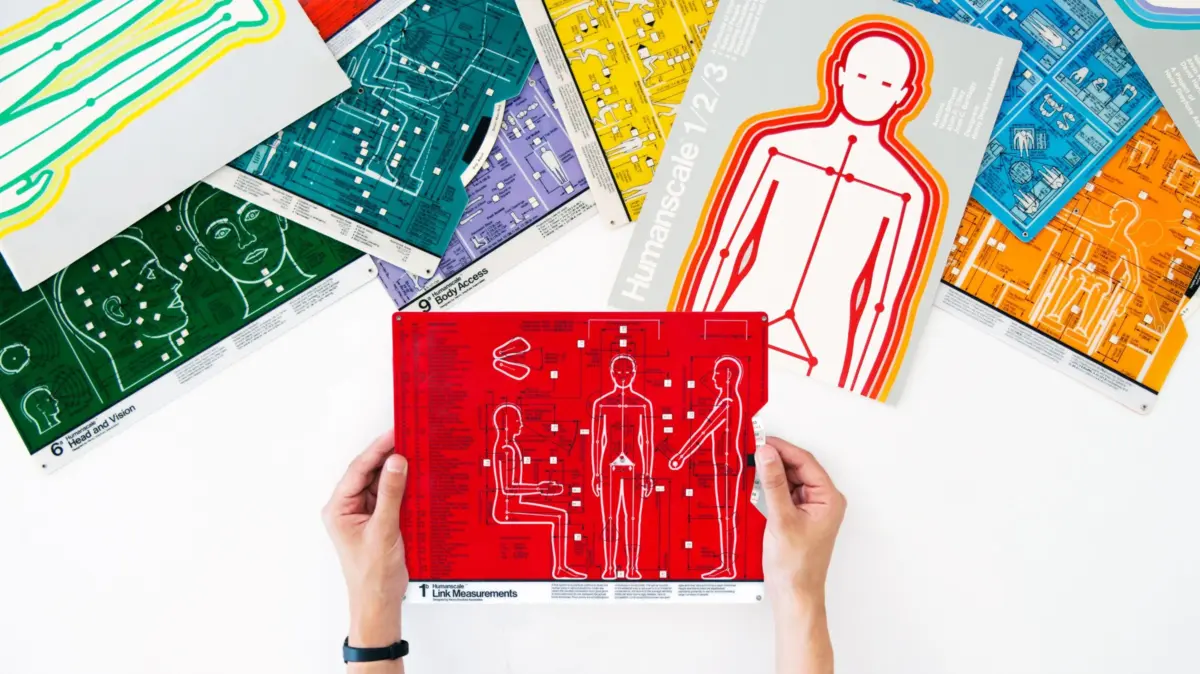
Long before Steve Jobs and Jony Ive utilized advanced computers and CAD software to sculpt the final form of the iPhone, industrial designers relied heavily on a remarkably sophisticated analog tool to help them comprehend the complex dimensions of the human body. This physical reference system, known as Humanscale, consisted of a set of nine rotating disks packed with more than 60,000 individual data points. By spinning the cardboard selector wheel in any direction, a series of precise numbers would align within transparent windows, revealing the exact measurement values required for the specific demographic or subject a designer happened to be developing for at the time.
Throughout the 1970s and 1980s, industrial designers utilized the reference tool as an indispensable cheat sheet to secure quick, reliable data points. However, after MIT Press halted its production in the mid-1980s, the physical sets drifted out of mainstream circulation and transformed into rare collector’s items. Pristine copies began fetching upwards of $2,000 on online auction platforms like eBay. Now, Humanscale is staging an unexpected return to the professional design world, thanks to Westra and a dedicated team at IA Collaborative’s Venture arm, who have launched an official reissue campaign to bring the classic design tool back to the market for $79 per print or $199 for the complete set.
The original Humanscale was the masterwork of Henry Dreyfuss & Associates (HDA), the legendary design firm responsible for shaping some of the most iconic consumer and industrial objects of the twentieth century, including the classic Honeywell circular thermostat and Bell’s ubiquitous tabletop telephones. The firm’s founder, Henry Dreyfuss, was an early and passionate champion of ergonomic design, steering his studio to approach the practice with rigorous scientific discipline. Under his leadership, form strictly followed function, and function followed data—specifically, vast amounts of precise data.
No product left the HDA studio without the team first consulting an exhaustive catalog of bodily statistics, including average human heights, arm spans, sitting hip widths, and optimal viewing angles from a standard desk. "The big problem back then was that data wasn’t necessarily in a nice, easily usable form," explains Bill Crookes, who worked at HDA from the early 1970s until the firm closed its doors in the early 2000s.

While valuable human measurement data certainly existed decades ago, it was scattered across disparate industries and institutions in a piecemeal fashion. If an industrial designer wanted to determine the precise dimensions of the average North American man’s leg, they had to sift through military records. If they needed to know the maximum decibel level comfortable to the human ear, they had to look up environmental statistics from regulatory agencies. Recognizing this persistent inefficiency, one of the firm’s partners, Niels Diffrient, became determined to consolidate this fragmented ergonomic data into a single, highly portable, and easy-to-use tool that designers could physically bring with them out into the field.
Diffrient and his dedicated team, which included Crookes, spent years meticulously gathering human engineering statistics. In the process, they uncovered fascinating granular details—such as the finding that the average height of a fedora hat was precisely two inches, a seemingly minor measurement that proved crucial when architects and industrial designers took standard doorframe clearances into consideration. They combed through official government sources for information concerning the ergonomics of wheelchair-bound men and women. They carefully measured the subtle differences in gripping postures when a human hand grasps a cylinder, a sphere, or a pencil, and subsequently organized every collected metric onto Humanscale’s themed, rotating disks.
"They laid out every little bit of info on these tools by hand with a square triangle and a compass on a drafting table," notes Nathan Ritter, a design researcher at IA Collaborative.
The physical design of Humanscale was a masterclass in information design. Illustrations featured prominently on the front and back of the disks depicted human bodies and specific anatomical parts in a wide array of functional positions, accompanied by detailed arrows annotating dozens of critical measurement points. Manually rotating the disks filtered the underlying data sets, allowing professionals to isolate and examine information specifically tailored to women, men, and children across various statistical percentiles.
Humanscale stood out as a triumph of information design and is widely regarded among veteran industrial designers as one of history’s earliest interactive data visualizations. Although the physical disks eventually became relics, replaced over time by more technologically advanced tools such as proprietary digital ergonomics databases that modern design corporations license for thousands of dollars annually, their fundamental utility has never truly diminished.
For the team at IA Collaborative, allowing the legacy of the Humanscale disks to fade permanently into obscurity would have represented a major missed opportunity for the contemporary design community. "They’re still just as relevant today as when they were just launched," Ritter says.
Initially, the designers are focusing their efforts on reissuing the original physical disks and accompanying books in faithful detail. However, their long-term roadmap includes digitizing the extensive archive of information to develop a modern, interactive digital interface for the data. The team believes that today’s generation of digital and physical product designers can still benefit immensely from having an intuitive, tactile reference tool to anchor their work in human reality.
"You can design anything in a vacuum," Westra concludes. "लेकिन if you’re not considering the people who are going to use it, they’re not going to have a great experience."