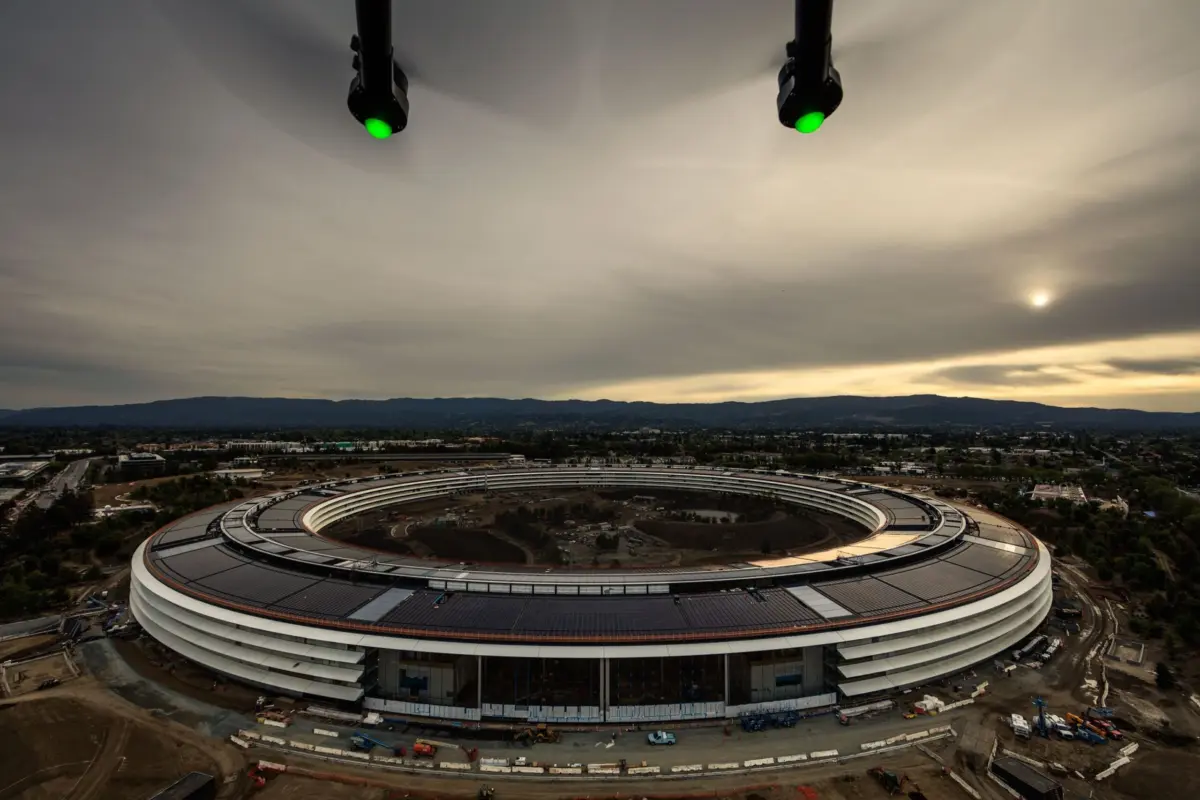
For the 12,000 employees fortunate enough to work inside the main ring-shaped building, the amenities are unmatched. An arborist carefully selected thousands of drought-tolerant trees for the grounds, while the fitness center boasts a climbing wall featuring pre-distressed stone. Parking lot walls feature smoothed, rounded concrete edges, and the fire suppression systems are adapted from luxury yachts. Even the wood paneling inside the facility was harvested in mid-winter—the exact time of year demanded by Steve Jobs—to ensure the sap content remained appropriately low, avoiding the pitfalls of inferior material.
Often called the Ring, the Death Star, or the Spaceship, the massive structure has undeniably alighted in Cupertino with an elegance that few can question. Yet, when evaluated beyond its gleaming glass panels and obsessive craftsmanship, Apple’s new headquarters reveals a profound contradiction. From a site-planning perspective, Apple Park is a retrograde, inward-looking development that displays a deep disconnect from the city it inhabits and modern urban planning principles as a whole. While Apple routinely defines the look and feel of the future through science-fiction-grade consumer technology, its mega-headquarters borrows heavily from the mid-20th-century playbook, exacerbating the severe regional challenges of the 21st-century Silicon Valley suburbs: transportation, housing, and economic strain.
The Architecture of Isolation
Apple Park is by no means the first high-end, suburban corporate campus; in fact, such developments were once the standard for corporate America. During the 1950s and 1960s, companies regularly established stunningly beautiful, high-modernist headquarters in suburban environments, such as the Connecticut General Life Insurance headquarters in Hartford or John Deere’s facilities in Moline, Illinois.
According to Louise Mozingo, a landscape architect at the University of California, Berkeley, and author of Pastoral Capitalism: A History of Suburban Corporate Landscapes, these corporations utilized cutting-edge technology to create glass-sheathed buildings that established a seamless relationship between indoor and outdoor spaces, while remaining entirely dependent on the automobile.
"They were stunningly beautiful, high modernist buildings by quality architects using cutting-edge technology to create buildings sheathed in glass with a seamless relationship between inside and outside, dependent on the automobile to move employees to the site," Mozingo explains. "There was a kind of splendid isolation that was seen as productive, capturing the employees for an entire day and in the process reinforcing an insular corporate culture."
By abandoning downtown skyscrapers for suburban plots, corporations of that era reflected prevailing attitudes toward cities, which were frequently viewed as dirty, crowded, and unpleasantly diverse. Suburbs offered exclusive, aspirational, and architectural blank slates that were easier to secure and prevented workers from frequenting local lunch spots where they might encounter competing job offers. It was, in essence, corporatized white flight.
Silicon Valley, however, historically operated under a different model. While companies like IBM occasionally constructed research sites modeled on East Coast corporate redoubts, Silicon Valley generally thrived on interchangeable office buildings. A startup might begin in a garage, expand into half a floor of an unglamorous office park, advance to a full floor, take over an entire building, and eventually secure venture capital to move to a superior office park. Eventually, companies like Google grew into sprawling empires of office buildings clustered along major transit corridors.
When economic downturns occurred or business strategies shifted, companies could easily let leases lapse or divest from real estate. Notably, more than half of the lot where Apple sited its new campus previously belonged to Hewlett Packard, just as the Googleplex formerly occupied space belonging to Silicon Graphics.
When a company constructs a hyper-idiosyncratic statement building like Apple’s Spaceship, however, that real estate cycle breaks down entirely. If Apple were to face severe economic distress, repurposing the ring-shaped fortress would prove nearly impossible—mirroring the fate of Union Carbide’s legendary abandoned headquarters. Modern, successful buildings typically engage fluidly with their surroundings, yet Apple Park is largely concealed behind artificial earthen berms, functioning much like an exclusive theme park attraction.
"They’re all these white elephants. Nobody knows what the hell to do with them. They’re iconic, high-end buildings, and who cares?" Mozingo notes. "You have a $5 billion office building, incredibly idiosyncratic, impossible to purpose for somebody else. Nobody’s going to move into Steve Jobs’ old building."
The Landscape of Silicon Valley
While the long-term adaptability of the structure remains a future concern, Apple’s immediate challenge lies in how the campus integrates into Cupertino and the broader, congested Silicon Valley housing market. Between 2010 and 2015, the San Francisco Bay Area added 640,000 jobs, with more than a third of that regional growth concentrated in the technology sector. However, the region failed to construct a commensurate amount of housing. With the exception of a brief spike during the boom years preceding the 2008 financial crisis, the rate of new housing construction in San Francisco and surrounding municipalities has trended steadily downward.
The inevitable consequence of housing supply failing to match economic demand has been staggering cost increases. The median price for a home in the Bay Area climbed to $800,000, with Silicon Valley figures reaching even higher levels. Although San Francisco and San Jose have initiated pipeline projects for tens of thousands of new housing units, the smaller suburban municipalities stretching along the 101 and 280 corridors—home to tech giants like Apple, Google, and Facebook—have historically resisted building new residential developments despite continuously importing thousands of high-tech workers.
Apple’s arrival in Cupertino presented distinct local governance challenges. Aarti Shrivastava, Cupertino’s assistant city manager, acknowledges the immense economic weight the company carries. "Apple’s obviously very important to the city, and when they came in with that plan, we understood this wasn’t going to be just any development," Shrivastava says. "They had certain needs."
Chief among those needs was heightened security, which ultimately resulted in public access being restricted and a major public road being closed. In the project’s early stages, municipal reports indicated that Apple was initially resistant to participating in financial "community benefits." An effort by the sitting mayor to institute a dedicated business tax on the company failed to secure support from the city council, which was wary of antagonizing one of its largest employers and taxpayers.
Over time, however, negotiations yielded various concessions. Apple committed funding to help mitigate traffic congestion and parking strains. "We had to bring them into our world. They don’t do urban design. They don’t do planning. We needed to talk to each other," Shrivastava notes.
Prior to Apple’s acquisition of the site, the former Hewlett Packard facilities accommodated approximately 5,000 workers; the new Apple complex more than doubles that capacity. Although only about 10 percent of Apple employees reside within Cupertino, the project’s Environmental Impact Report projected that local demand for Cupertino housing would surge by 284 percent. To offset this, Apple agreed to pay a Housing Mitigation Fee calculated on overall square footage. Because the company was only adding roughly 800,000 square feet of net new building space compared to the previous layout, and because local fees had been previously halved, the final mitigation payment amounted to approximately $5 million.
Because 90 percent of the workers inside the Spaceship must commute from outside Cupertino—primarily from San Jose to the east and San Francisco to the north—transportation infrastructure is a critical pressure point. The Bay Area’s fragmented regional transit network heavily favors private automobiles, prompting tech companies to deploy private shuttle fleets. While Apple operates an extensive network of shuttles across the peninsula and has pledged to increase non-single-occupancy vehicle commutes to 34 percent, internal data indicates that only 1.5 percent of commutes to existing Apple facilities utilize public transit.
In addition to housing and transit mitigations, Apple provided $8.2 million to fund a public park elsewhere in Cupertino to compensate for public space absorbed by the campus. The company also funded feasibility studies and intersection improvements to ease local traffic, alongside restitution payments of $250,000 to Santa Clara and $500,000 to Sunnyvale to offset neighborhood parking overflow. Furthermore, Apple agreed to share 65 percent of its business-to-business sales tax revenue with Cupertino—reversing a previous exemption—and invested roughly $5 million in a pipeline system to transport recycled water from Sunnyvale to maintain the campus landscaping.
Despite these contributions, critics argue that corporate concessions fall short when measured against Apple’s immense financial reserves and the region’s compounding crises. Allison Arieff, editorial director for the San Francisco Bay Area Planning and Urban Research Association (SPUR), points out that the tech giant possessed the capital to pursue truly transformative regional infrastructure investments, such as doubling the frequency of CalTrain commuter rail service or funding a dedicated transit center in Cupertino.
"Apple could have done anything. Money was no object," Arieff says. "They want to be innovative in everything, and they’re not innovative in this thing… If the intractable problems of the region are housing and congestion, they’re giving the finger to all that."
The Complexities of California Planning
The systemic challenges facing the Bay Area extend far beyond the footprint of any single corporate campus. Local governments must continuously balance the economic advantages of job creation against the immense costs of expanding public services, schools, and transit required to support new housing. These difficulties are compounded by Proposition 13, a landmark 1978 California law that drastically limits annual property tax increases. While the proposition shielded long-term property owners, it severely restricted state and local revenue for public education and basic services, transforming real estate into the primary vehicle for personal wealth accumulation in California. Consequently, property owners face powerful financial disincentives to support any local development, such as apartment buildings, that might negatively impact their property values.
Concurrently, California cities grapple with surging pension obligations for retired municipal employees, consuming ever-larger shares of local budgets. Lacking the ability to meaningfully tax legacy residential properties or easily approve new housing, local municipalities frequently turn to commercial real estate developments and tech booms as vital fiscal lifelines.
"It’s a lot to ask a corporate campus to fix those problems," Arieff notes.
Nevertheless, alternative corporate approaches exist. Cloud storage provider Box situated its primary building directly across the street from the Redwood City CalTrain station, opening its parking facilities to downtown visitors on weekends. Urban planners view this contemporary, transit-oriented approach as vastly more effective than concealing a campus behind artificial hills far away from rapid rail links.
For transnational technology corporations operating on a global scale, aligning with local conditions presents an inherent challenge. "Tech tends to be remarkably detached from local conditions, primarily because they’re selling globally," observes Harvard economist Ed Glaeser. "They’re not particularly tied to local suppliers or local customers." Consequently, these firms possess minimal economic incentive to resolve regional planning failures, which governance structures are ostensibly designed to address.
Contemporary commercial architecture increasingly favors vertical density over horizontal sprawl. For instance, the 60-story Salesforce Tower in San Francisco accommodates 1.5 million square feet of office space across roughly one acre, maintains a direct connection to the regional Transbay Terminal, and was constructed at a fraction of the cost of Apple’s circular campus.
Toward a New Paradigm
Cupertino historically fit the standard description of a sleepy, nondescript suburban town, but local leadership has gradually embraced mixed-use development. Newer commercial projects like Main Street Cupertino integrate retail shops, restaurants, and multi-story residential housing around public gathering spaces, signaling an institutional recognition that Silicon Valley must evolve.
Historically, industrial capitalists recognized the mutual benefit of partnering with public authorities to finance essential infrastructure, water systems, and regional transit networks like the Bay Area Rapid Transit (BART) system. Modern tech companies are beginning to take cautious steps in similar directions, with Google incorporating thousands of apartments into its North Bayshore development plans, and Facebook designing community-accessible spaces for its upcoming headquarters.
Whether Apple could have pursued a more integrated, urbanist design remains a subject of debate, particularly given Cupertino’s traditional resistance to high-density vertical building. However, by prioritizing an insular form factor over regional integration, the world’s most valuable technology company chose to gaze inward. Steven Levy observed that Apple Park was Steve Jobs’ final great project—an ultimate expression of his corporate vision. Ultimately, beneath its circular geometry, the monument may reflect the priorities of a vanished past rather than the complexities of a sustainable future.