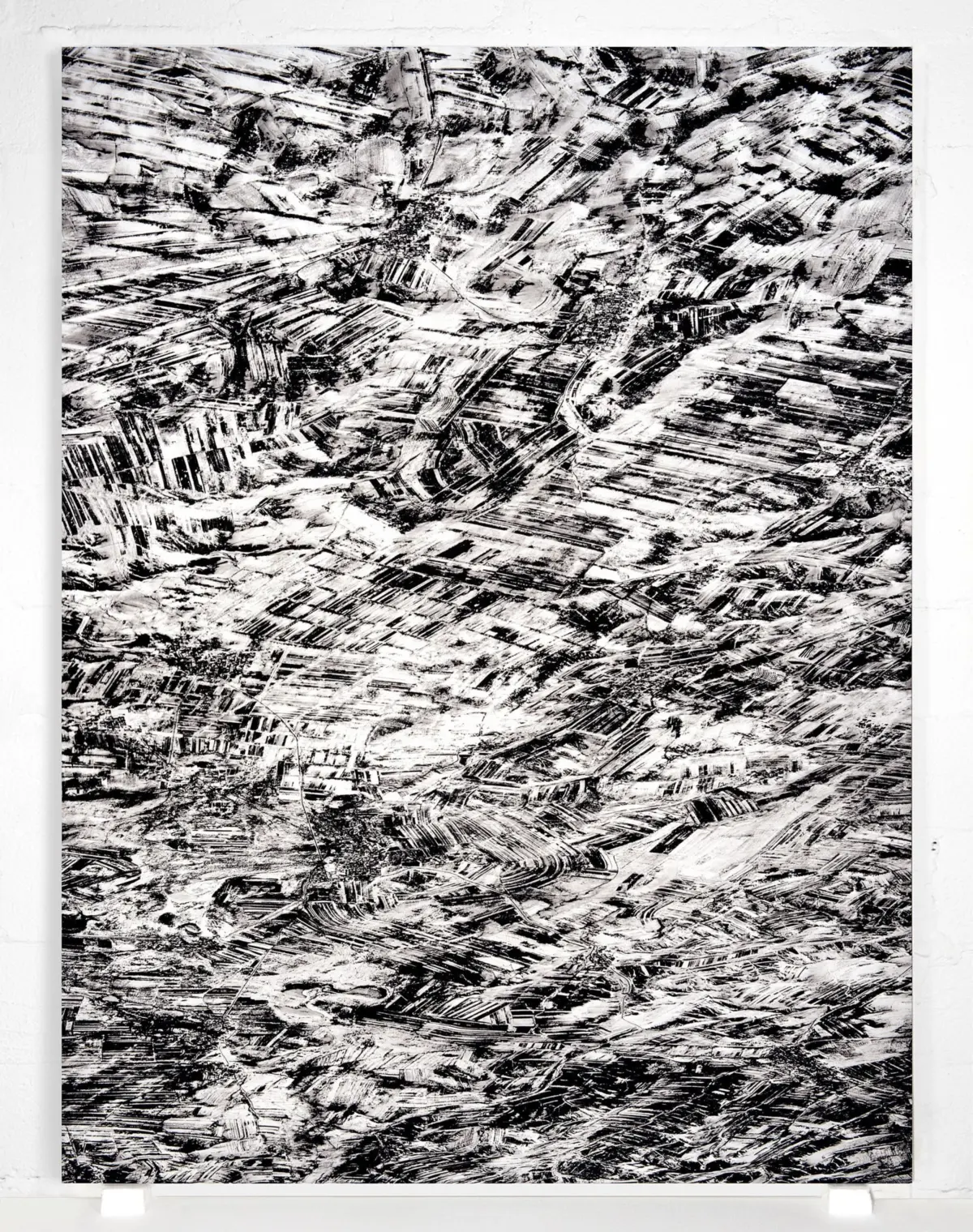
From a certain vantage point within Justin Brice Guariglia’s sprawling Brooklyn studio, it is nearly impossible to tell what exactly hangs on the back wall. At a distance, a massive 16-foot print commands the space, resembling a heavily textured painting with jagged, tactile edges that practically invite the viewer to reach out and touch its surface. Yet, upon closer inspection, the illusion dissolves; the eye realizes the image is entirely flat, possessing the smooth characteristic of a photograph. In reality, the work exists in a fascinating liminal space—a visual trompe l’oeil that straddles the boundaries of multiple mediums. "They’re paintings derived from photographs," Guariglia explains, describing the intricate intersection of contemporary art, industrial technology, and environmental documentation.
This particular monumental piece traces its origins to a high-stakes, high-altitude flight with NASA’s Operation IceBridge mission. The image captures the Jakobshavn Glacier, widely recognized as Greenland’s largest and fastest-melting body of ice. It forms a central component of an ambitious series of landscape prints created by Guariglia for his exhibition, Earth Works: Mapping The Anthropocene, which is scheduled to open at the Norton Museum of Art in Palm Beach, Florida. Through this striking collection, the artist confronts viewers with the stark visual evidence of a rapidly transforming planet, leveraging the gallery space as a medium for ecological reflection.
Guariglia’s journey to this point has been marked by a profound evolution in his artistic philosophy and practice. He began his career as a freelance magazine photographer working extensively across Asia, capturing the shifting realities of rapidly developing regions. However, a decade ago, he made a decisive pivot toward fine art. The motivation was rooted in the ephemeral nature of traditional publishing. Photographs printed in glossy magazines are routinely discarded, recycled, or forgotten within days of publication. Guariglia wanted to break free from this cycle of disposability. He sought to create enduring works of art that would stand the test of time, objects whose physical presence would outlast the fragile landscapes they depict.
For his latest exhibition, Guariglia devised an innovative method to print his sweeping aerial photographs directly onto rigid, industrial canvases made of aluminum and polystyrene. The conceptual weight of this material choice is heavy and intentional. "The physical object in the photo is already gone," he observes, pointing to the rapid retreat of the glaciers and the transformation of the earth’s surface. "But the actual image will last forever—as long as we don’t recycle it." By embedding vulnerable landscapes into permanent industrial materials, he creates a permanent monument to impermanent phenomena.
The photographs themselves are marvels of scale and abstraction, captured from dizzying altitudes ranging anywhere from 1,500 to 40,000 feet. By shooting from these extreme vantage points, Guariglia transforms the familiar geography of the Asian countryside and the vast, frozen expanse of arctic landmasses into mesmerizing abstract forms. Agricultural land is visually altered into gilded geometries that evoke ancient maps or precious metals, while melting glaciers are rendered as ambiguous, blindingly white vistas that defy immediate scale.

Many of the most striking images in the collection were born out of Guariglia’s direct collaboration with NASA’s Operation IceBridge. The mission deploys low-elevation aircraft over Greenland to gather crucial scientific data on the country’s rapidly deteriorating glaciers, monitoring ice sheet thickness, surface changes, and bedrock topography. Participating in these grueling scientific flights was no ordinary artistic residency. To capture his unique perspectives, Guariglia would lay prone at the very feet of the aircraft pilots, snapping photographs of the ever-shifting, fractured landscape below through the specialized drop windows of the plane.
Back in his Brooklyn workspace, Guariglia resists the urge to over-manipulate his captures through excessive digital tinkering. "I’m mostly just trying to reduce the image to its most basic essential form," he says. To execute this vision, he employs an extraordinary tool: an industrial-grade printer, handmade in Switzerland, with a price tag roughly equivalent to the cost of a very nice apartment in Brooklyn. This formidable piece of machinery functions effectively as the artist’s modern paintbrush. The printer works by dispensing an ultra-fine layer of specialized acrylic ink onto the substrate, immediately followed by high-intensity ultraviolet lights that instantly cure and permanently bind the ink to the material.
The printer is a commercial device typically reserved for high-end signage and industrial manufacturing, but Guariglia bends its capabilities far beyond its intended design parameters. "I make it do things it’s not supposed to do," he notes, explaining his unorthodox techniques, which include printing directly onto delicate polystyrene or laying down an astonishing 150 layers of ink at 900 percent saturation. Achieving this level of precision required years of trial and error. "I’ve logged about 1,500 hours testing material and printing processes," he shares. The painstaking experimentation yields photographic prints that possess an unprecedented permanence, defying the rapid degradation of the very subject matter they portray.
Every aspect of Guariglia’s artistic ecosystem—his grueling field process, his urgent ecological subject matter, and his deliberate choice of durable industrial materials—is meticulously designed to represent the Anthropocene. This current, unofficial geological age is defined entirely by humanity’s profound and often devastating impact on the earth’s ecosystems and climate. The ultimate goal of the exhibition, as the artist explains, is to subtly implicate not just himself as an artist consuming and utilizing materials that will inevitably become part of the future geological fossil record, but every single person who stands before the work.
Ultimately, these towering prints serve as a sobering reminder that the environmental crises facing modern humanity are vast, complex, and largely self-inflicted. Yet, by capturing, cropping, and translating these overwhelming planetary shifts onto structured rectangular panels, Guariglia brings them into a human scale where they can finally be confronted, examined, and understood.