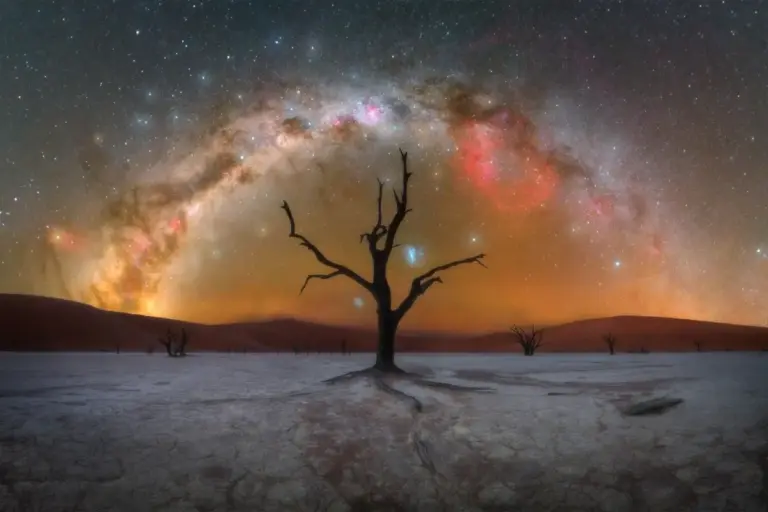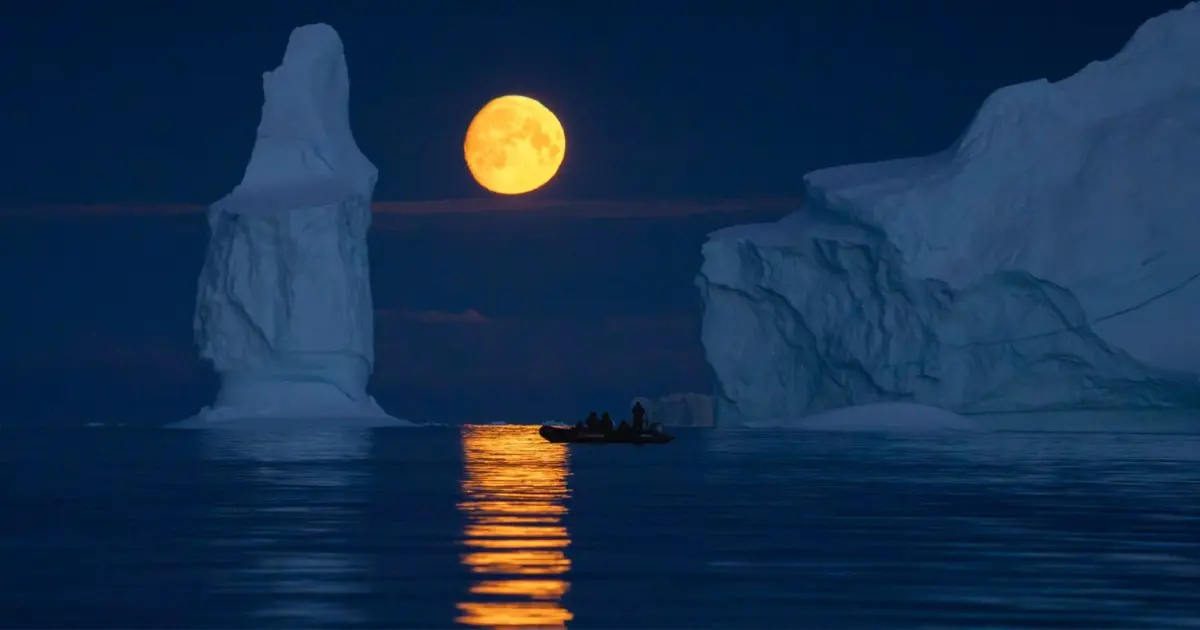
Photographing East Greenland at night is an exercise in meticulous preparation, sharp observation, and constant adaptation. The landscape is immense, the environmental conditions can be demanding, and the opportunities to capture a specific, fleeting image may be limited to a mere few minutes. Towering icebergs, drifting sea ice, fog, low clouds, and the ever-changing Arctic sky create an environment where light can completely transform the way a scene is perceived. Yet having spectacular scenery directly in front of the lens does not necessarily guarantee a strong photograph. The core challenge is to recognize what makes a moment worth capturing, understand how the available light interacts with the massive landscape, and make the right creative and technical decisions before that precise moment disappears entirely.
During a recent photography expedition in East Greenland, hosted by Secret Atlas in October 2026, expedition leaders spent several evenings managing a specialized photographic project. The project targeted enormous icebergs illuminated by the rising moon, alongside the vibrant Northern Lights appearing above the surrounding fjords and ice. These two distinct subjects offered radically different photographic challenges and required a unique, one-of-a-kind night operation that tested the limits of both equipment and crew coordination.
Photographing Icebergs by Moonlight
Four Days of Anticipation
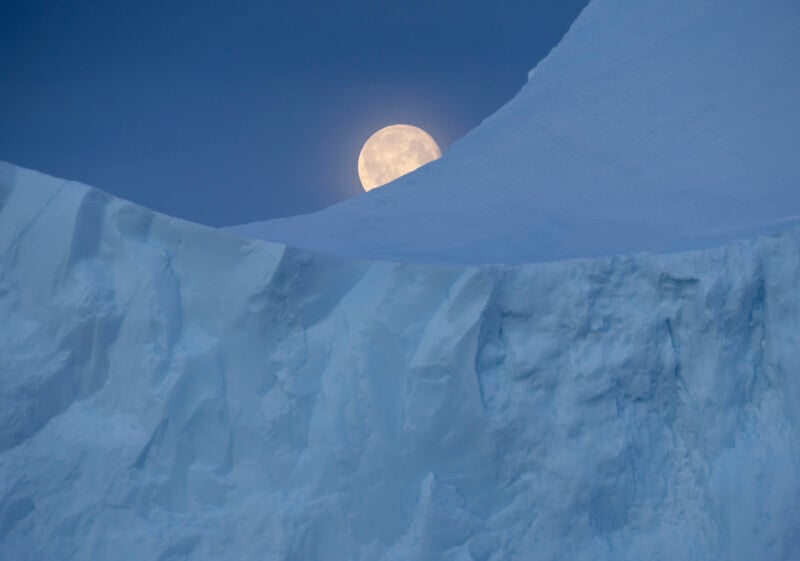
Some photographs begin long before the camera is ever taken out of its protective bag. The moonrise series executed during the October 2026 expedition was precisely one of those projects. Across four days, the expedition team monitored and followed changing weather windows and lighting opportunities to photograph the rising moon among the colossal icebergs of East Greenland. The objective was not simply to record a simple moon above the horizon, but to forge a compelling visual relationship between the moonlight, the complex architecture of the icebergs, a palpable sense of exploration, and the overarching polar landscape.
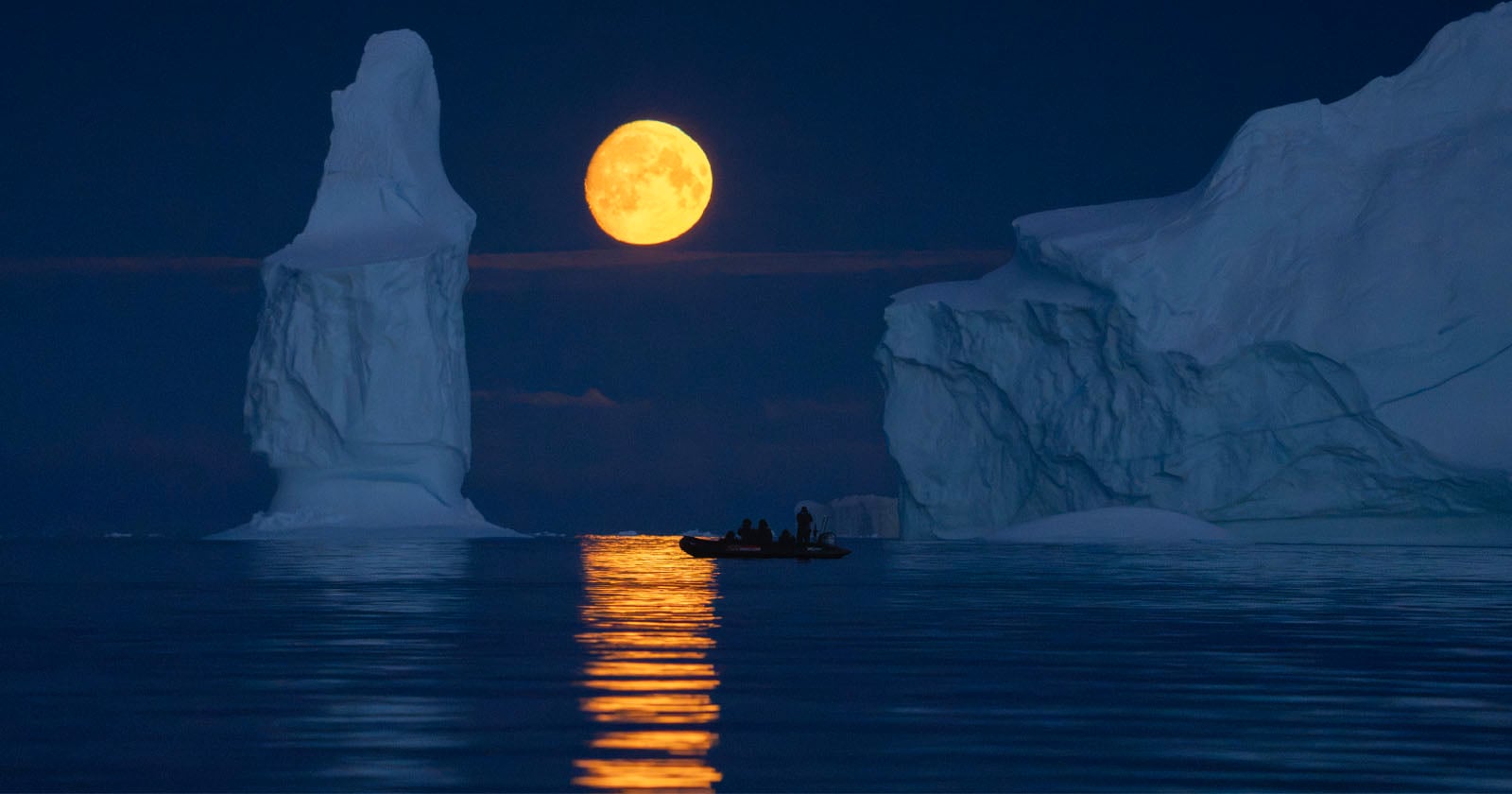
The first viable opportunity to photograph the sequence materialized around 8 p.m. on the third day of the expedition, when the timing and the available ambient light finally began to align. In the high Arctic, twilight can retain considerable ambient light even as the moon rises above the jagged horizon. This transition creates a delicate and fascinating balance: the landscape may still hold deep detail, while the moon begins illuminating the sheer faces of the ice from a dynamic, low-angle perspective.
A rising moon and a monumental iceberg are undeniably impressive subjects individually, but merely putting them together within the same frame is not enough. Their relative positions, scale, degree of illumination, and visual separation from the background all influence how the resulting image is read by the viewer. Anticipating these complex relationships is essential, particularly when the operational window for making the photograph is exceptionally short.
Working From a Zodiac
Photographing these scenes from a Zodiac adds another distinct dimension to the technical process. The presence of polar bears in East Greenland severely limits the ability of expedition teams to operate safely on land during low-light conditions. Unlike working from stable, solid ground, the shooting position on a small inflatable watercraft is never entirely fixed, and even minor movements from wind, current, or shifting passengers can affect the framing—particularly when utilizing a long focal length lens.
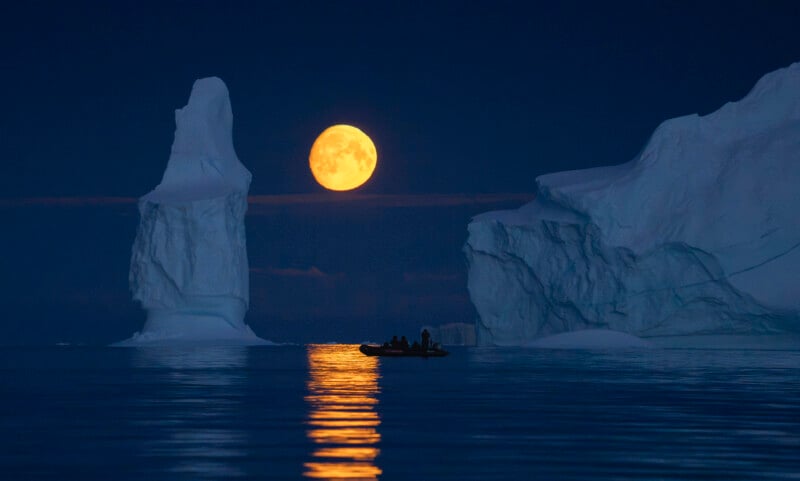
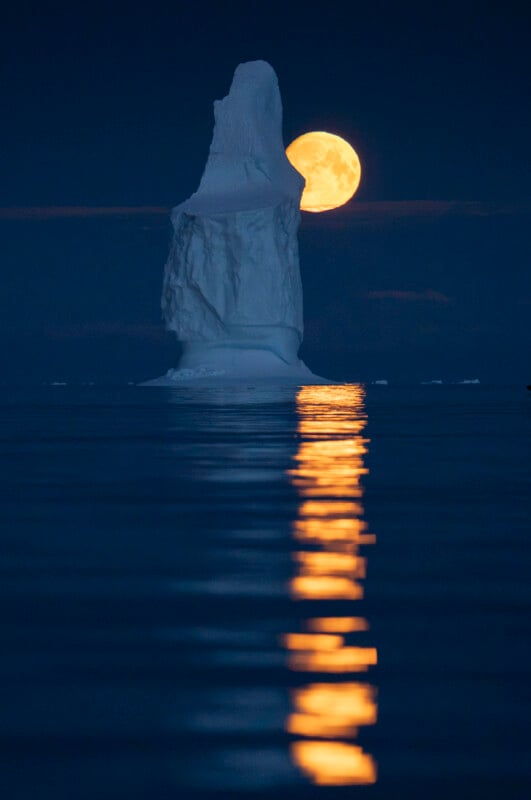
The primary objective during these waterborne sessions was to find a viewpoint from which the massive iceberg formations could be visually separated and the rising moon incorporated cleanly into the composition without losing the profound sense of scale. Icebergs are inherently difficult subjects to photograph because their colossal dimensions can be notoriously hard to communicate effectively in a two-dimensional photograph.
Choosing a Focal Length and Reading the Light
Focal length plays a critical role in communicating scale to the viewer. A wide-angle lens can emphasize the vastness of the surrounding environment, while a longer telephoto lens can compress the scene, bringing distant geological and glacial formations visually closer together to create layered, dramatic compositions.
Exposure requires a similar level of care and technical precision. A gradually brightening moon against a dark, star-filled sky can make it exceedingly difficult to preserve the bright highlights on the ice without losing crucial detail in the deep shadows of the water and surrounding cliffs. Rather than attempting to make every single part of the photograph equally bright, the strategy centers on retaining the crisp texture of the illuminated ice surfaces while allowing darkness to remain an integral part of the image, preserving vital highlight and shadow information.
Photographing the Northern Lights: Our One-of-a-Kind Night Operation
A Different Kind of Light
The Northern Lights create a completely different set of photographic challenges compared to moonlight. The position of the moon can be accurately anticipated days in advance, allowing photographers to plan around a relatively predictable source of illumination. The aurora borealis, by contrast, changes rapidly and unpredictably in brightness, structural shape, color intensity, and physical movement across the sky.
Operating from their main expedition vessel, the team navigated carefully through the dark fjord in search of an aesthetically pleasing iceberg to frame their shot. They positioned the ship meticulously to achieve the greatest possible vessel stability while maintaining the operational flexibility to adjust their orientation depending on where the aurora was expected to flare up. The moment the Northern Lights began to emerge, close coordination via VHF radio with the bridge team became an absolute necessity. As photographers prepared to shoot from the ship’s outer deck, the vessel was brought to a complete standstill, reaching zero speed over ground. This temporary immobilization allowed the team to capture the scene with maximum stability, even utilizing exposures of around half a second, while the iceberg and the dancing aurora created a harmonious natural composition.
Composition Before Spectacle
Aurora photography involves a continuous series of compromises between shutter speed, aperture, and ISO settings. A longer exposure collects more ambient light, which can be immensely helpful when the auroral display is faint, but it can also blur the finer, delicate structures of a rapidly moving aurora curtain. Conversely, a shorter exposure preserves much more detail in the complex draperies and patterns of the light, but it requires enough overall light sensitivity to produce a clean, usable image.
There is no single universal exposure setting for the Northern Lights. The correct settings depend entirely on the brightness and speed of the display, the available ambient light, the lens choice, and the specific amount of detail the photographer wants to retain. Adjustments must be made dynamically according to the behavior of the sky rather than relying on a fixed recipe.
Our Zodiac Operation to Reach the Special Image
As the sun dipped below the horizon, the team left the comfort of the main vessel and ventured out aboard their Zodiacs for a reconnaissance ride through the icy waters. Their mission was to explore the immediate landscape, identify one or two particularly striking icebergs, and select the perfect setting for what they hoped would become an unforgettable night of aurora photography. Capturing the Northern Lights in these conditions is as much about patience and preparation as it is about being in the right place at the right time. With exposures ranging from half a second to four, five, or even six seconds, absolute stability is essential. Even the slightest vibration or movement can compromise an image. Surrounded by the vastness of the polar wilderness, creating a stable photographic platform proved to be one of the greatest challenges of the night.
The operational plan was to return after dark, launching the Zodiacs from the main vessel and navigating through the freezing waters in search of newly formed sea ice near one of the pre-selected icebergs. This young ice, measuring approximately one centimeter in thickness, offered the unique opportunity to carefully position the bow of a Zodiac against its edge, allowing the crew to wedge the watercraft into place and generate the physical stability required for long exposures. Finding a sufficiently wide area of newly formed ice also granted the team the freedom to reposition themselves as the auroras shifted and danced across different quadrants of the sky.
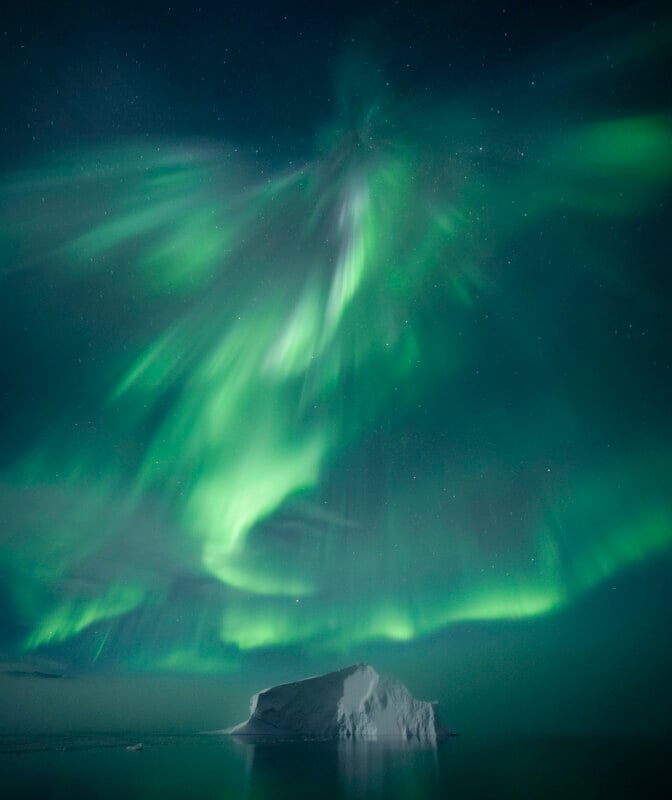
When planning such an operation, expedition leaders constantly look for ways to approach an iceberg while maintaining a safe distance and shooting from as low an angle as possible. The goal is to make the iceberg a powerful architectural element in the composition, rising beneath the aurora and giving the photograph a profound sense of scale and depth. The newly formed sea ice often adds another complementary dimension to the scene, with its delicate patterns, surface textures, and natural leading lines guiding the viewer’s eye toward the main subject.
By 11 p.m., the operation commenced. Leaving the main vessel, the team—led by photography guides alongside team members Signe-Maria and Myriam—navigated their group of photographers toward the giant icebergs and the fragile sheet of new sea ice. Behind them, the ship’s powerful searchlight illuminated their chosen iceberg, providing a vital guiding beacon across the pitch-black water. Upon reaching the area, they carefully positioned the Zodiacs against the edge of the young ice. Every movement had to be deliberate and controlled, ensuring stability while maintaining a safe distance from the looming icebergs.
The team had prepared for this exact moment long before leaving the safety of the ship. During daylight hours, they had assembled, adjusted, and practiced their photographic setups, ensuring every participant understood their role. Under the absolute darkness of the polar night, there was no time for hesitation. Photographers secured their tripods against the Zodiac’s pontoon, tilting them forward and carefully adjusting their positions to keep every part of the inflatable boat entirely out of the frame. One by one, they settled into their compositions, pointing their camera lenses toward the magnificent icebergs.
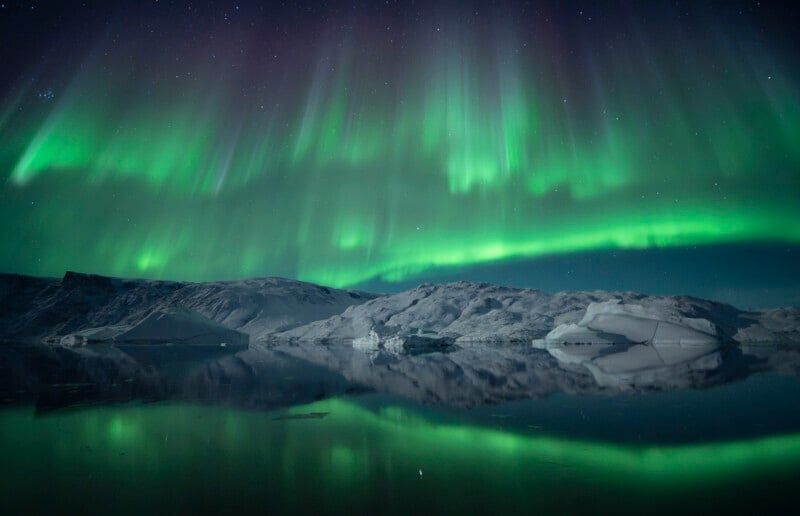
Everything was finally in place. Expedition leaders contacted the ship’s bridge via radio, requesting that all exterior lights be switched off. Instantly, the environment transformed. The powerful searchlight beam disappeared, and the group was completely immersed in the profound darkness of the polar night, resting silently on the newly formed sea ice before a gigantic iceberg beneath a breathtaking celestial display. Above, a star-dense sky stretched overhead while a half-moon gently illuminated the frozen landscape, revealing the intricate shapes and textures of the ice as the auroras began to dance across the heavens.
For a brief window, time seemed to stand still between the ocean and the ice. Cameras clicked continuously, shutters opened and closed, and each long exposure preserved a fleeting fragment of the ever-changing spectacle. While meticulous planning, rigorous preparation, and careful equipment management are foundational, nature ultimately dictates the final result. That night, the convergence of preparation, teamwork, adventure, and raw nature yielded an extraordinary experience beneath the auroras, leaving memories that will long outlast the files saved on the photographers’ memory cards.
Preparation Creates Possibility
There is a frequent tendency to describe successful photographs of the Arctic as the simple result of being in the right place at the right time. Luck undoubtedly plays a part—the moon must rise in a favorable alignment, weather conditions must cooperate to reveal the landscape, and the aurora must develop in a visually compelling way. None of these elements can ever be strictly guaranteed. However, merely being present when a spectacle unfolds is only a fraction of the process. A skilled photographer must recognize the potential of the scene, decide where to position the camera, choose the appropriate focal length, balance the exposure, and determine which elements belong within the frame. Thorough preparation does not control nature; rather, it makes it entirely possible to respond when an opportunity finally appears.