For landscape photographers worldwide, Namibia’s Deadvlei stands as one of the most mesmerizing and surreal locations on the planet. Situated deep within the boundaries of the Namib-Naukluft National Park, the famous white clay pan is ringed by some of the tallest red sand dunes in the world and punctuated by stark, blackened, long-dead camel thorn trees that have baked under the African sun for centuries. The stark contrast of the pale ground, the burnt orange dunes, and the skeletal remains of ancient trees creates an arresting visual tableau that has drawn visual artists and nature enthusiasts for decades.
Yet, capturing
the full magic of this remote destination comes with a monumental logistical hurdle: visitors are strictly forbidden from remaining inside Deadvlei after dark.
Day visitors are required to exit the park by sunset, while guests fortunate enough to lodge inside park boundaries must pass back through the inner park gate no later than one hour after sundown. This strict regulation ensures the preservation and safety of the pristine reserve, but it effectively locks out photographers wishing to capture the magnificent arch of the Milky Way as it stretches across the unpolluted night skies above the desert pan.
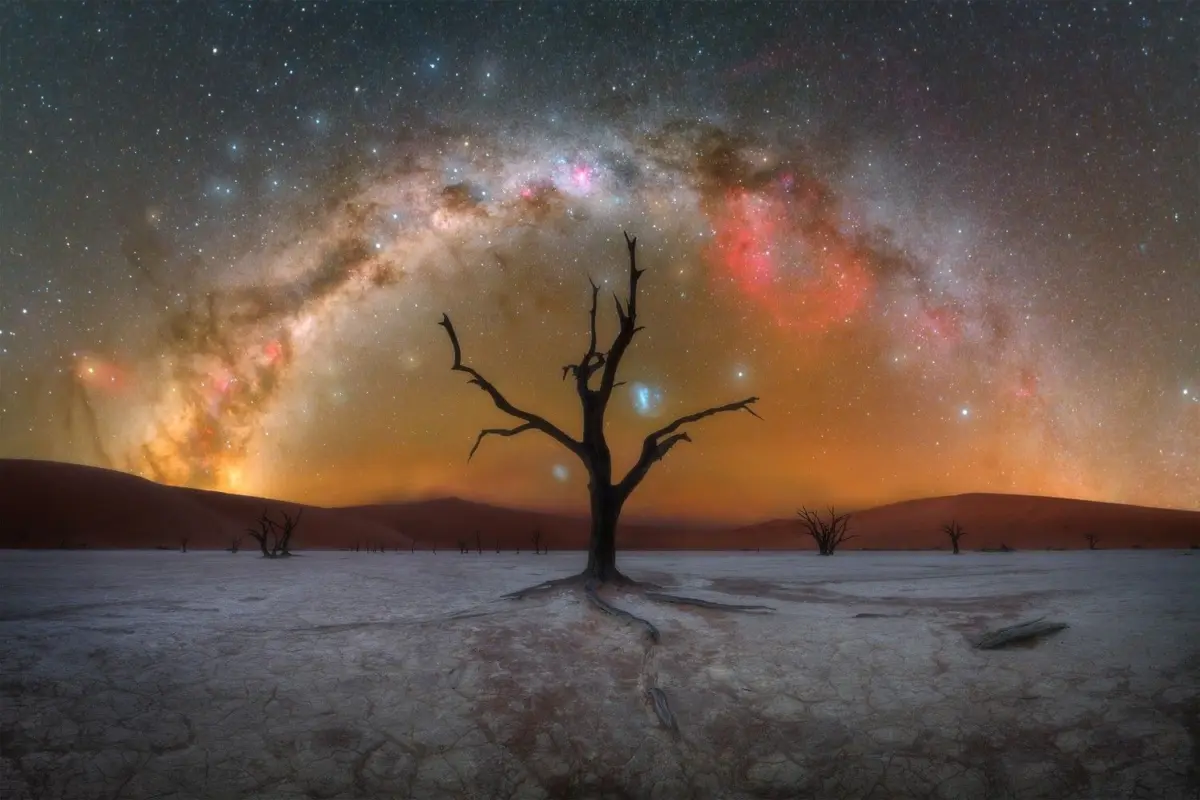
This strict nocturnal restriction is precisely what makes Deep Roots, a stunning new photograph by Israel-based landscape artist Alexander Seleznyov, so compelling. In the award-winning image, the majestic band of the Milky Way—glowing brilliantly with vibrant pink and red nebulae—arches gracefully from dune to dune across the star-studded night sky, positioned directly above a solitary, skeletal camel thorn tree. The breathtaking composition recently earned Seleznyov the gold medal in the Non-Professional Landscapes category at the prestigious 1839 Awards for 2026.
Confronted with rigid park rules and the logistical impossibility of a night shoot on location, Seleznyov had to find an innovative way to bring his vision to reality. By his own candid admission, achieving the shot required breaking conventional rules, a reality he openly acknowledged in statements accompanying his accolades.
"Park authorities strictly prohibit staying in Deadvlei after dark, so you have to cheat," Seleznyov explained in his commentary for the Global Lens Awards, which had previously recognized the striking composition. "Either by breaking rules, manipulating photos, or leaving a camera behind and hoping for the best."
However, rather than relying purely on blind luck or unauthorized rule-breaking under the cover of darkness, Seleznyov turned to meticulous advance planning and modern technological tools to bridge the gap between imagination and reality.
Planning the Impossible
Rather than sneaking into the park illegally, the photographer relied heavily on modern digital cartography and astronomical software to calculate the exact alignment of the cosmos.
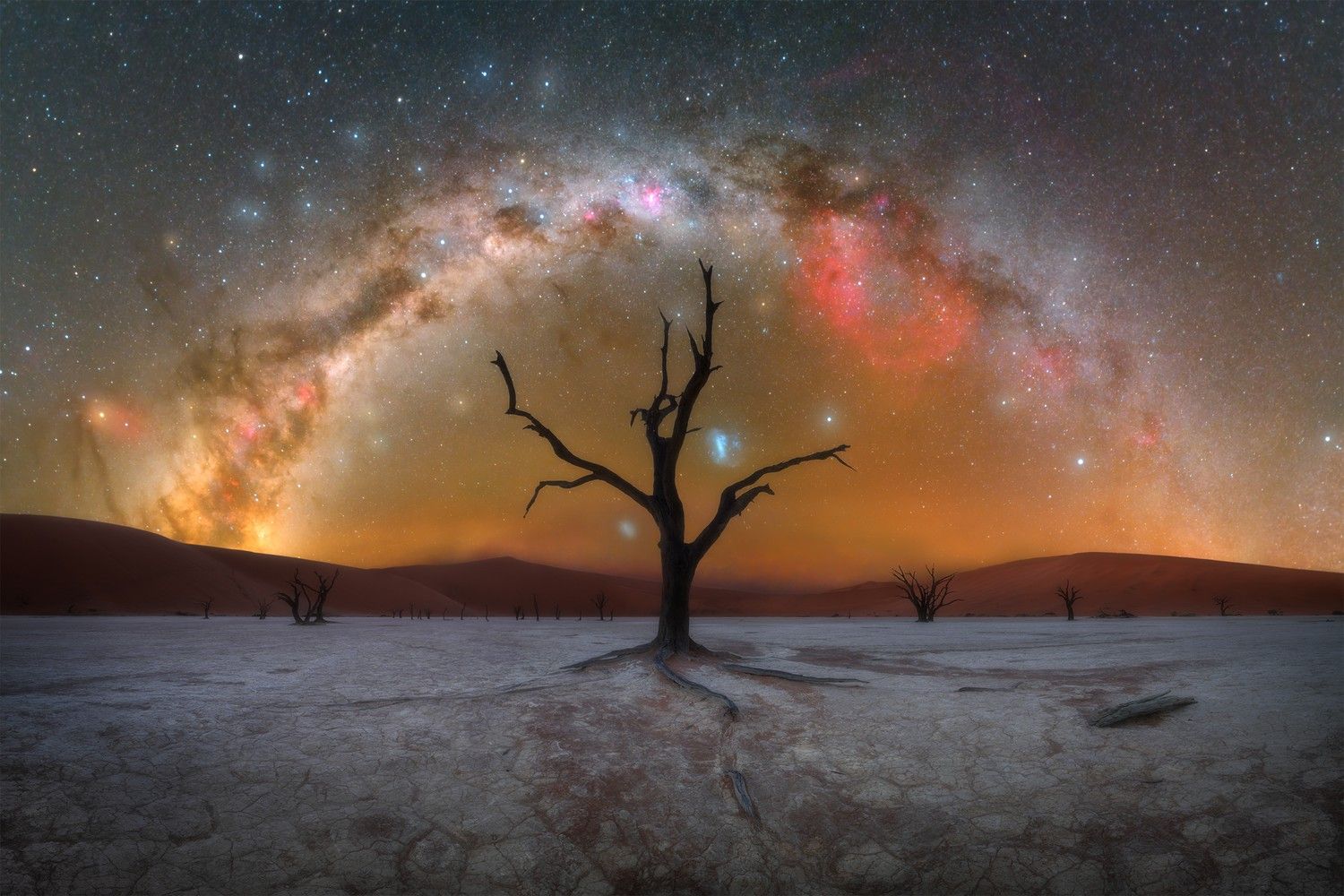
"Thankfully, modern night-sky tracking apps allow you to precisely predict where the Milky Way will align over the trees," Seleznyov noted. "Even if it’s a bit of post-processing magic, it brings a dream vision to life."
Rather than attempting to capture the entire scene in a single snapshot under impossible lighting constraints, the final image relies on precise astronomical forecasting and multi-exposure planning. This advanced technique involves capturing various elements of the landscape and the night sky under optimal conditions and blending them with digital precision to construct a cohesive, authentic representation of a fleeting astronomical alignment.
Reflecting on the philosophy of his craft when sharing the final piece on social media, Seleznyov quoted the legendary American landscape photographer Ansel Adams, emphasizing that "you don’t take a photograph, you make it."
For Seleznyov, the creation of Deep Roots was the culmination of years of dedication and artistic growth. Dated May 17, 2026, the image represents a significant milestone in his portfolio, though he admits the magnitude of the work took time to fully appreciate.
"This may well be my strongest work to date, though that took a while to sink in," he remarked. He explained that his most serious photographic projects typically end up serving as his personal desktop wallpaper—a deliberate strategy he uses to continuously spot minor mistakes, evaluate imperfections, and determine areas for future artistic improvement.
With this particular project, however, the photographer found that the longer he studied the composition, the deeper his appreciation grew. He noted that it took him four full years of practice and experimentation to surpass his previous personal bests, leaving him to ponder the creative journey ahead. "How long will the next one take, and what shot will that be?"
Global Recognition and Wider Industry Context
Deep Roots emerged as a standout triumph among dozens of category gold winners announced by the 1839 Awards, a prestigious international competition deliberately named in honor of the year photography was first introduced to the world, marking a foundational turning point in visual history.
The highest overall honors in this year’s competition were awarded to visionary artists pushing the boundaries of contemporary imagery. Giacomo Marchione claimed the title of International Photographer of the Year for The Invisible, a striking and technically demanding series documenting the nightly vertical migration of microscopic marine plankton. Meanwhile, the title of International Discovery of the Year was awarded to music video director Dammy Twitch for What If We Lived Among Gods, a captivating medium-format film series that brilliantly reimagines everyday life in Nigeria as an ethereal realm where mortal humans and ancient deities exist side by side.
As platforms like the 1839 Awards continue to highlight innovative approaches to traditional genres, works like Alexander Seleznyov’s Deep Roots demonstrate the evolving intersection of rigorous planning, advanced technology, and artistic vision. By combining precise astronomical forecasting with modern post-processing mastery, photographers are increasingly able to transcend physical limitations, bringing extraordinary visions of the natural world to audiences around the globe.