London-based architecture studio Bureau de Change has unveiled its latest retail destination, breathing new life into an 18th-century building on the prestigious rue Boissy d’Anglas in Paris to house a striking new boutique for renowned Greek jeweler Nikos Koulis. Marking the studio’s second major
collaboration with the luxury jewelry house—following their acclaimed work on the flagship store in Athens—the project seamlessly bridges historic Parisian character with contemporary architectural innovation.
The two-story interior is a masterclass in material juxtaposition and spatial storytelling. It brings together heritage architectural details and ultra-contemporary display furniture, utilizing a carefully curated palette of textures and finishes that honor both the building’s centuries-old provenance and the intricate craftsmanship inherent in traditional Parisian artists’ ateliers.
An 18th-Century Paris Building Becomes a Jewelry Atelier
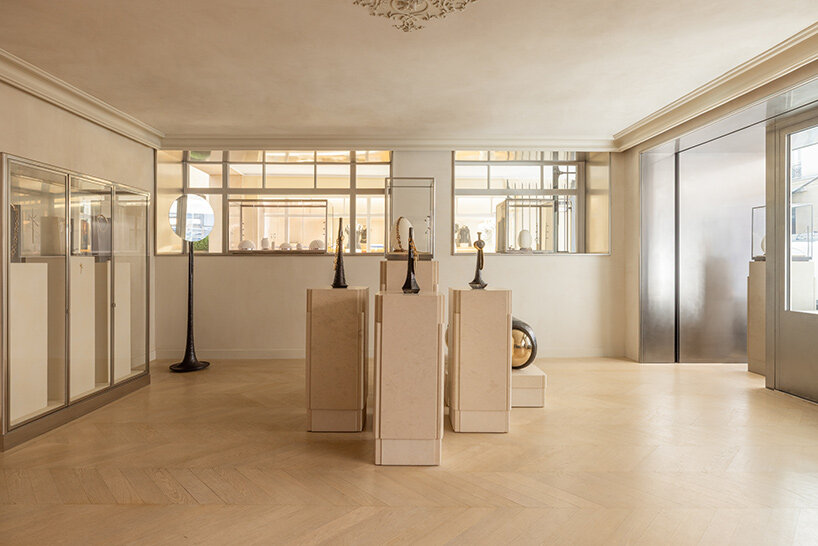
Stepping into the ground floor of the Paris boutique, visitors are immediately greeted by an atmosphere of refined elegance. Natural light pours across warm herringbone timber floors, illuminating powdery plaster walls that create a soft, inviting backdrop for the precious items on display. Monolithic stone plinths anchor the ground level, organizing the jewelry displays with architectural gravity, while slim metal frames wrapped around the windows introduce a sharper, cleaner geometry against the softer, organic surfaces of the plaster and wood.
This metalwork is far from arbitrary; it is rich with local context. The decorative edges of the window frames and fixtures reference the distinct ornamental profiles of traditional zinc bar counters found throughout the French capital. This subtle yet sophisticated architectural gesture roots the boutique firmly in the vernacular of older Parisian interiors, creating a dialogue between the local streetscape and the interior design.
Sculptural Limestone Displays Recall the Athens Flagship
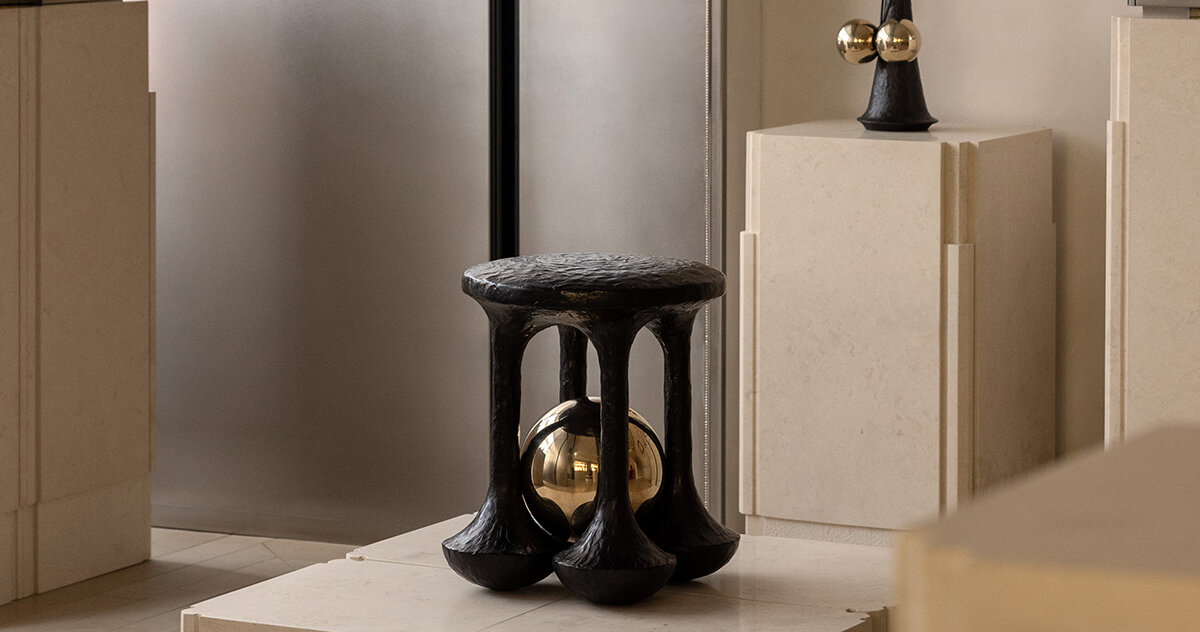
The custom display plinths found on the ground floor draw a direct conceptual line back to Bureau de Change’s earlier design for Koulis’s Athens flagship, yet they evolve the concept further for the Parisian audience. To create these striking modular pieces, the architects took the precise form of a metal display-case base and superimposed it onto a heavy block of limestone. They then physically extracted the form, leaving a permanent negative impression carved directly into the stone.
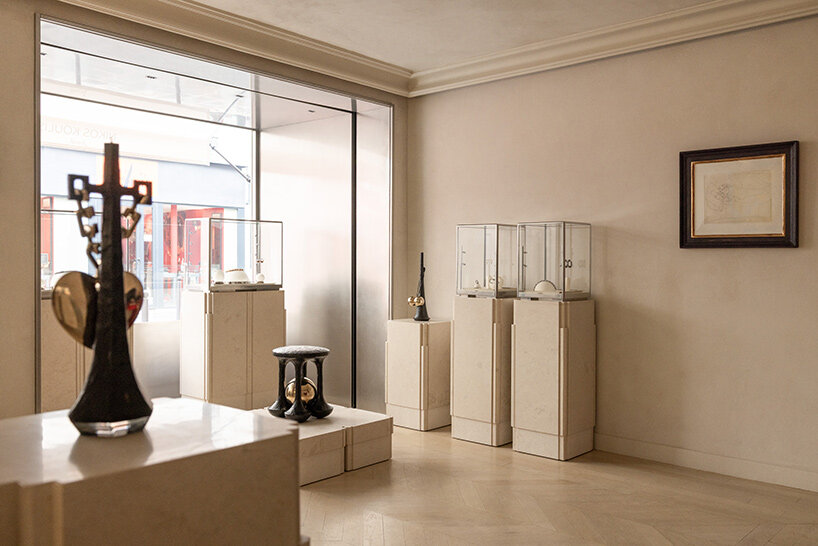
Each individual block bears the physical evidence of this manufacturing and conceptual process. The lower sections of the limestone retain a rougher, raw, and textured finish, while the upper surfaces are honed to a smooth, polished sheen. Sitting atop these stone foundations are delicate glass vitrines, bound by faceted metal junctions that mirror the exact geometric precision and stone-setting techniques of the fine jewelry housed within them.
Furthermore, these plinths have been engineered to be entirely modular. They can be effortlessly shifted, rearranged, or combined to accommodate changing retail needs, different seasonal collections, or private events. This spatial flexibility is increasingly vital as Nikos Koulis expands his creative output, a growing body of work that now encompasses limited-edition art objects and bespoke furniture alongside his signature fine jewelry collections.
Pink Marble and Stainless Steel Define the Smaller Details
As visitors move through the space, the design reveals a series of smaller, highly considered architectural interventions punctuated by unexpected materials. The design team has introduced delicate accents of pink marble throughout the boutique, beginning at the very threshold where chiseled pieces of the rose-hued stone form the entrance door handles. Their irregular, hand-finished surfaces are deliberately set against the sleek, smooth stainless steel casings that frame the windows.
This tactile pink marble reappears along the sculptural wooden staircase as a custom-designed, floating handrail. Its flowing, ergonomic form guides guests on their ascent from the bustling ground-floor retail environment up to the more intimate, apartment-like atmosphere of the upper level.
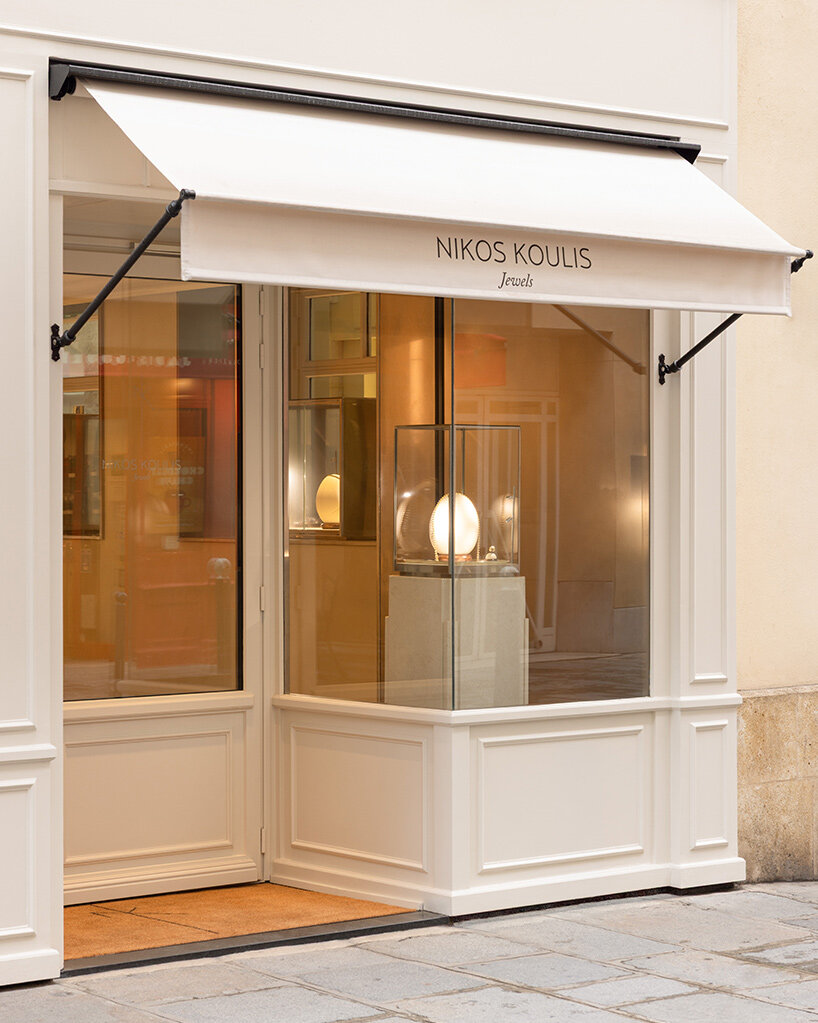
From the exterior, the carefully composed storefront frames selective, tantalizing views of the interior landscape. The restrained, sophisticated palette of natural stone, plaster, and warm wood continues uninterrupted, with recurring metal details tying the window surrounds and display furniture into a cohesive whole.
Cross-Shaped Cabinets Open into Deep-Blue Octagonal Rooms
Upon reaching the upper floor, the boutique shifts dramatically in character, shedding its commercial skin to take on the warm, inviting atmosphere of a private Parisian salon. Eclectic furniture pieces and carefully curated artworks drawn from Nikos Koulis’s personal collection fill the space, which has been designed to accommodate intimate, individual jewelry appointments as well as exclusive private dinners and high-profile industry events. Occasional bursts of vibrant red furniture punctuate the otherwise muted, earthy palette, serving as a subtle nod to the bold use of color seen in the Athens store.
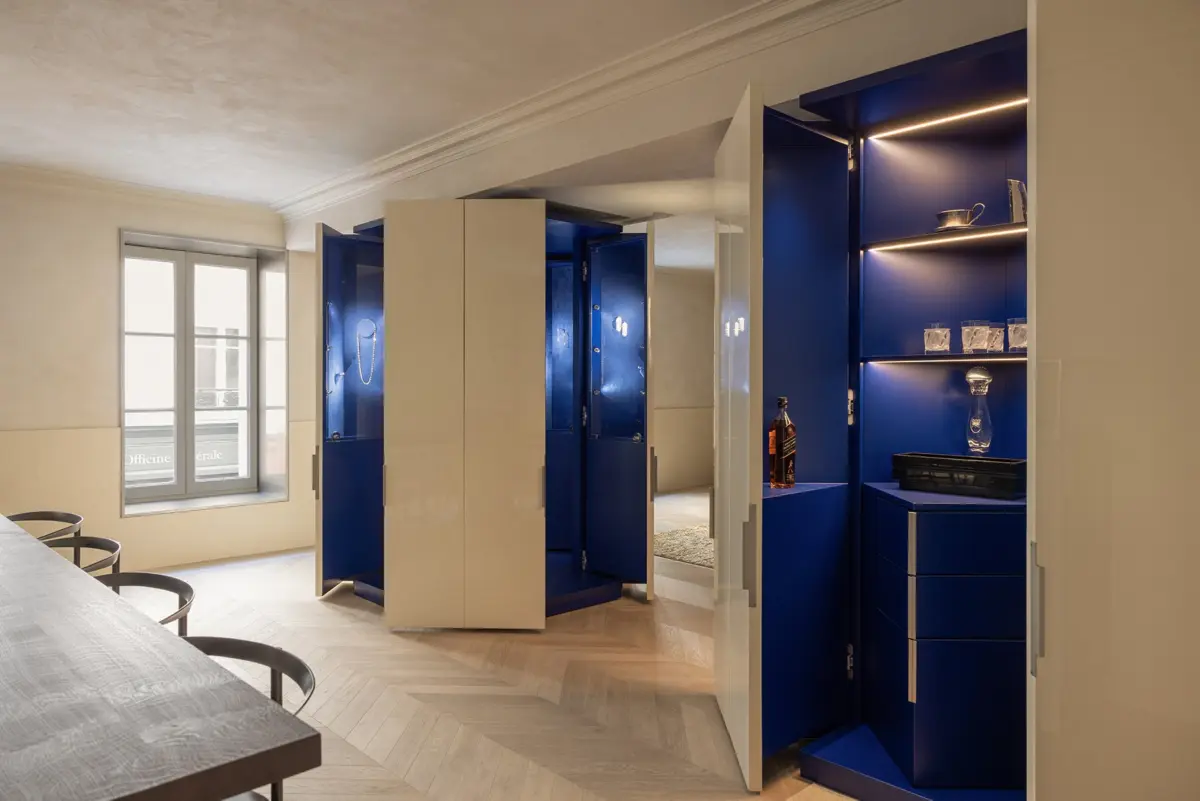
Without a doubt, the most architecturally ambitious and unusual elements of the entire boutique are two freestanding, full-height cabinets that subtly divide the sitting and dining areas. At first glance, each cabinet features a distinct cross-shaped floor plan, reading as a handsome, monolithic piece of bespoke furniture within the salon.
However, these structures possess a theatrical secret: when opened, they physically transform the architecture of the room by revealing hidden octagonal spaces within. One of the cabinets houses eight triangular jewelry vitrines arranged in a circle around a deep-blue interior, a chamber that visitors can actually step inside to experience the jewelry in total seclusion.
The second cabinet transforms just as dramatically into a fully functional bar, complete with triangular shelves and accessible drawers positioned for ease of use from either side. When closed, the two structures simply function as large, sculptural wood and metal fixtures within the salon. Once opened, they completely alter the spatial dynamics of the floor, concealing elaborate jewelry displays and entertaining facilities within their unexpected geometric forms, concluding a spatial journey that honors history while pushing the boundaries of modern retail architecture.