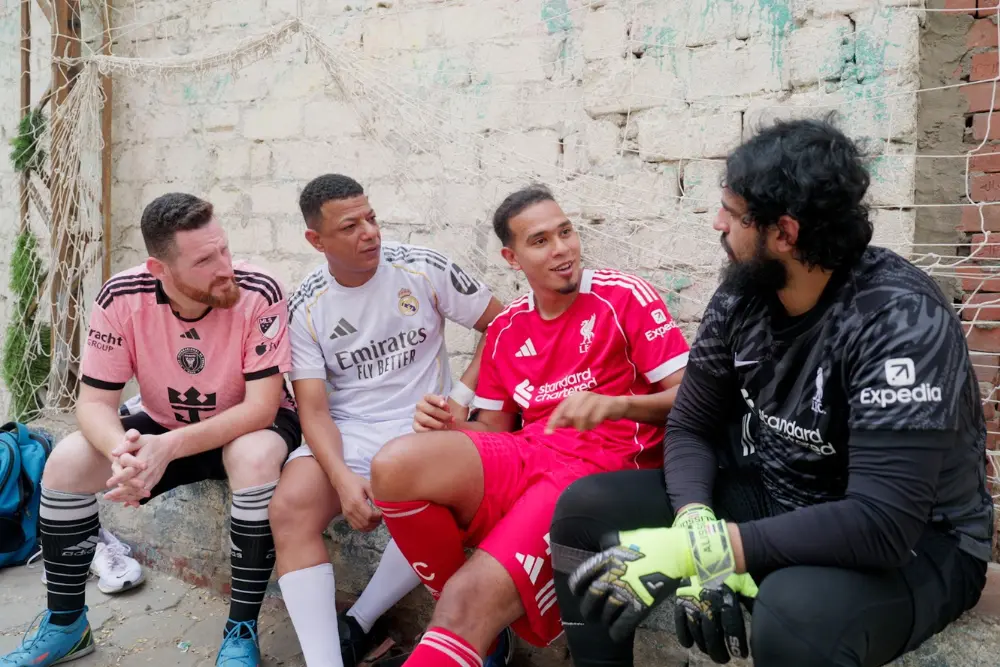
The growing commotion on the streets near a soccer stadium would easily lead one to believe superstar player Kylian Mbappé himself was signing fan autographs, sending ripples of excitement through the gathered crowd. But, as seen in “The Lookalike,” the intense furore and mobbing of adoration were not actually over the celebrated French forward, but rather a remarkably charismatic impersonator who manages to capture the very same energy and visual likeness. Premiering at the Cairo Film Festival, Nehal Elkoussi’s fascinating documentary follows three ordinary Egyptian men who live in the shadows of their famous lookalikes: Mbappé; legendary Egyptian singer and actor Mohamed Mounir; and the late, revered television preacher Sheikh Mohammed Metwalli Sha‘rawi. Produced by the Al Jazeera Documentary Channel, the film trails these distinct impersonators as they travel to meet passionate fans, struggle to reconcile their personal identities with their mirrored public personas, and reflect deeply on the profound impact that a simple biological happenstance has had on the course of their daily lives.
When asked about the underlying inspiration for the project, director Nehal Elkoussi tells Variety that she grew up frequently seeing Mohamed Mounir impersonators around her, but was ultimately struck by stumbling upon one of her film’s primary subjects on
social media. Upon further inspection, she realized he performed dozens of concerts a month and had successfully built an entire professional career around his striking resemblance to the beloved musical icon. That was when the core concept really clicked into focus for the filmmaker, prompting deeper questions about how these lookalikes manage to become an effective stand-in for the real star, what drives that phenomenon, and how they draw in such a massive audience that sees in them a star within reach. She also pondered what truly drives the public to create this unique kind of grassroots stardom for everyday people who merely share a face with the famous.
The director first began developing the ambitious project in August of 2024, going on to film for eight intensive months between 2025 and 2026. The immersive experience of following the lookalikes across various communities and trying to understand the public’s intense fascination with them came with several notable surprises for the filmmaker along the way. Among her most vivid recollections is the sheer joy witnessed during production. She recalls being consistently surprised by the genuine smiles on children’s faces in the streets whenever they happened to run into the Mbappé lookalike, reacting with absolute awe as if they were standing right in front of the real-life athletic icon. Furthermore, she was deeply surprised by how seriously the Mbappé lookalike took his unorthodox line of work, demonstrating a remarkable level of dedication and commitment as a modern content creator navigating the digital landscape.

The Mbappé impersonator ultimately opened a fascinating and unexpected avenue for the narrative of “The Lookalike,” as the subject naturally brought with him a whole roster of other soccer star impersonators operating within the same cultural ecosystem, ranging from Argentina’s Lionel Messi to Brazil’s standout goalkeeper Alisson Becker. This expansive network also allowed Elkoussi to cleverly build upon Egypt’s intense passion for the sport, as well as its massive growth in popularity across the broader Arab region following the historic 2022 FIFA World Cup held in Qatar, which ignited a renewed enthusiasm for football culture at every level of society.
As production continued, Elkoussi also realized how socioeconomic class played a massive, defining role in people’s profound attachment to the lookalikes. Observing these interactions up close, she notes that the poor often need a living, breathing lookalike to stand in for the real star whom they can no longer physically or financially reach in contemporary commercialized sports and entertainment. Whether it is the dedicated fans who travel to attend a Mounir lookalike’s concert in a modest village in Gharbia, the local kids eagerly taking photos with the Mbappé lookalike in the bustling street, or the devout individuals seeking blessings and spiritual comfort from the El-Shaarawy lookalike, these communities do not merely want a flat video glowing on a digital screen. They desperately need to feel that the star or revered figure is right there with them in flesh and blood—someone tangible they can stand near, touch, and converse with on a human level.
According to the director, this irreplaceable human warmth and authentic connection is something that artificial intelligence and modern digital cloning can never truly replicate. On top of that fundamental emotional resonance, she points to the incredible seriousness and personal dedication that these impersonators bring to what they do every single day. It requires consistent daily human effort, grueling hard work, and a genuine, empathetic attempt to bring joy and happiness to strangers, which stands in stark contrast to cold technology that merely copies the surface while completely draining the soul out of the experience.
Premiering at home at the prestigious Cairo Film Festival has proven to be a deeply special and rewarding experience for the filmmaker, particularly because all three of her main subjects were able to attend the screening and share in the public reception. She emphasizes that she made sure to share those unforgettable moments directly with them, knowing full well that they are the true makers and anchors of the film. According to Elkoussi, her subjects truly loved the finished documentary, feeling strongly that the production accurately captured their real lives and who they truly are without ever passing harsh judgment or criticizing their unusual choices. Having all of those powerful, validating emotions come back full circle toward the film made the director profoundly happy as her work met its audience.