For anyone who has ever engaged in the familiar, frustrating shuffle of patting down pockets for a stub of graphite, a stray square, or a misplaced level, the realization that measuring twice and cutting once skips several crucial preliminary steps is all too real. Somewhere between the initial measurement and the final cut, a maker inevitably needs a pencil, a pocket knife, a straight edge, and a measuring device, items that have a notorious habit of never being in the same place at the same time. While this chaotic preamble is often regarded as the least glamorous part of any crafting, woodworking, or DIY project, it has largely gone unaddressed by industrial designers—until now.
MakerPi, a design studio based in Hong Kong, has turned its attention to this perennial workshop inconvenience with the introduction of the Tiruler 2.0. Billed as a comprehensive pocket instrument, the device rethinks the humble folding ruler by integrating a suite of everyday workshop tools into a single, highly portable unit. Built from aerospace-grade materials and engineered with meticulous precision, the tool seeks to streamline the preparatory phase of crafting, allowing creators to measure, mark, and slice along the same edge without ever having to set anything down or dig through a toolbox.
A Titanium Body with Scales You Can Actually Read
At the core of the Tiruler 2.0 is a robust frame constructed primarily from Grade 5 titanium, the robust Ti-6Al-4V alloy heavily relied upon by aerospace engineers for its exceptional strength-to-weight ratio and superior resistance to environmental corrosion. This resilient gray metal is paired with brass scale plates that introduce a warm, contrasting golden hue. The device features two folding arms, each measuring 3.94 inches or 10 centimeters in length. To accommodate global users, the default configuration pairs a metric scale on one arm with an imperial scale on the other, effectively eliminating the need for mental unit conversions during intricate projects. Additionally, dedicated all-metric and all-imperial versions are available for individuals who operate exclusively within a single measurement system. Because the body is fashioned from titanium, the tool is naturally corrosion-resistant, ensuring that it will endure the rigors of riding daily in a pocket, tool bag, or backpack while maintaining its structural integrity and aesthetic appeal.
One of the most notable refinements in this second-generation iteration addresses user feedback regarding legibility. The original Tiruler utilized laser-engraved brass scales, which users found could occasionally become difficult to read once workshop grime, dust, and oils accumulated in the recesses. In response to this constructive criticism, MakerPi overhauled its manufacturing process for the Tiruler 2.0. The new scale markings are chemically etched directly into the material and subsequently filled with high-contrast black ink. The resulting numbers are exceptionally crisp and legible from a variety of viewing angles, employing a technique long familiar to designers of precision instrument dials. This enhancement ensures that the tool remains functional even under harsh workshop conditions, avoiding the pitfall of becoming an unreadable decorative stick.
Angle Stops, a Curve Wheel, and a Caliper That Reads to 0.1 mm
Beyond its primary function as a straight edge, the pivot end of the Tiruler 2.0 serves as a multifunctional hub for handling complex angles and curves. A built-in brass dial allows users to measure specific angles and draw them directly onto their work surface. Mechanical stops integrated into the hinge mechanism click firmly into place at standard 45-degree, 90-degree, and 180-degree intervals, ensuring that common corners and right angles can be established with absolute confidence and speed.
The same pivot assembly doubles as a mechanical measuring wheel. In this mode, one full 360-degree rotation of the wheel equates precisely to 3.94 inches or 100 mm. An audible click sounds each time the wheel passes the zero mark, enabling users to measure irregular contours, curved surfaces, or cylindrical objects such as bicycle frames and bottles. For measurements exceeding a single rotation, the user simply counts the audible clicks and adds the final partial reading, employing a reliable, analog method that requires no batteries or digital displays.
For dimensional verification, a pocket caliper slides smoothly out from one of the titanium arms, offering precision readings down to 0.1 mm via a classic vernier-style scale. The underlying principle of the vernier scale, first published by Pierre Vernier in 1631, remains as effective today as it was centuries ago. Outside measurements are easily taken to assess cylinders, bottle caps, rings, and various model parts. Furthermore, this new generation introduces inside measurements, facilitated by two 1.5 mm pins that span a range from 0.12 to 2.17 inches, or 3 to 55 mm. Because the inside measurement requires adding a baseline 3 mm offset to the brass scale reading—such that an apparent 11 mm reading translates to 14 mm—it introduces a minor mental calculation, yet it remains a remarkably convenient alternative to retrieving a dedicated set of workshop calipers.
A Magnetic Pencil That Doubles as a Compass, Plus a Blade
Storage and deployment are handled through secure magnetic retention systems designed to eliminate frustrating latches or mechanisms that could fail over time. The integrated mechanical pencil rests securely within a dedicated magnetic slot, allowing for effortless removal and replacement during fast-paced work. The pencil features a replaceable, water-resistant everlasting tip that requires no sharpening, ensuring a consistent mark over extended periods of use.
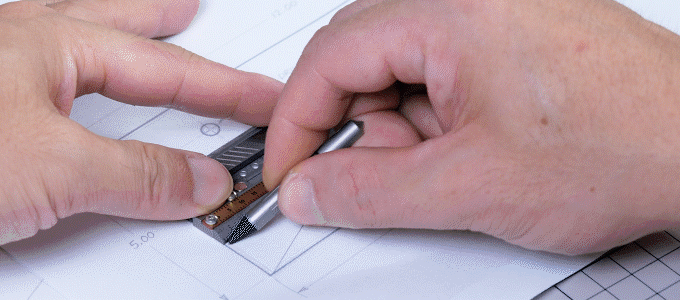
Unscrewing the top of the pencil reveals a fine steel pin, a versatile component that serves multiple secondary functions. It can act as a mobile phone SIM card ejector, a makeshift toothpick, a delicate hole punch, or a fine pick for manipulating tiny components. Crucially, this same pin also forms the pivot point for the tool’s built-in compass function. By planting the pin into a surface, dropping the pencil tip into one of the designated micro-holes spaced along the ruler arm, and rotating the instrument around the stationary anchor point, the user can draw precise circles while reading the desired radius directly from the engraved scale.
Adjacent to the pencil slot, a secondary magnetic cavity houses a compact cutting blade. To ensure safety and reliability during transport, the blade is supported by an additional mechanical retention feature that prevents it from dislodging when the tool is subjected to movement or pocket jouncing. The holder is engineered to accept standard number 11 scalpel blades, making replacements inexpensive and widely accessible. MakerPi notes transparently that the integrated blade is intended for light-duty tasks such as slicing paper, cardstock, and opening packages, and is not designed to replace a heavy-duty utility knife. Nevertheless, the ability to measure, mark, and make precise cuts along the exact same edge without putting the tool down represents a significant workflow enhancement.
Glow Tubes, Engraving, and Pricing Details
To round out its comprehensive feature set, the Tiruler 2.0 incorporates a small bubble level embedded directly into the chassis, proving useful for minor installations, component positioning, and detailed model-making tasks. For low-light visibility, two dedicated mounting slots are machined into the body to accommodate tritium vials or glass glow tubes. While tritium tubes emit a continuous, self-powered glow without requiring an external light source, glass tubes can be charged under ultraviolet light and will subsequently emit a fading phosphorescent glow in dark environments. Additionally, MakerPi offers an optional custom engraving service allowing up to 20 characters to be etched onto the body, making it straightforward to personalize the tool with a name or identification mark. A fitted genuine leather protective case is also available as an optional accessory for storage and carrying.
Crowdfunding and early-order pricing for the Tiruler 2.0 begins at $99, reflecting a discount from the planned standard retail price of $148. The standard configuration includes the dual-material titanium and brass body, the magnetic everlasting pencil, and the cutting blade. Optional additions include the custom engraving, glow tubes, and the leather storage case. MakerPi has confirmed that worldwide shipping is planned, with regional import and export duties included in the purchasing structure to prevent unexpected customs fees for backers in regions such as the United States. Deliveries to early supporters are anticipated to commence in March 2027.