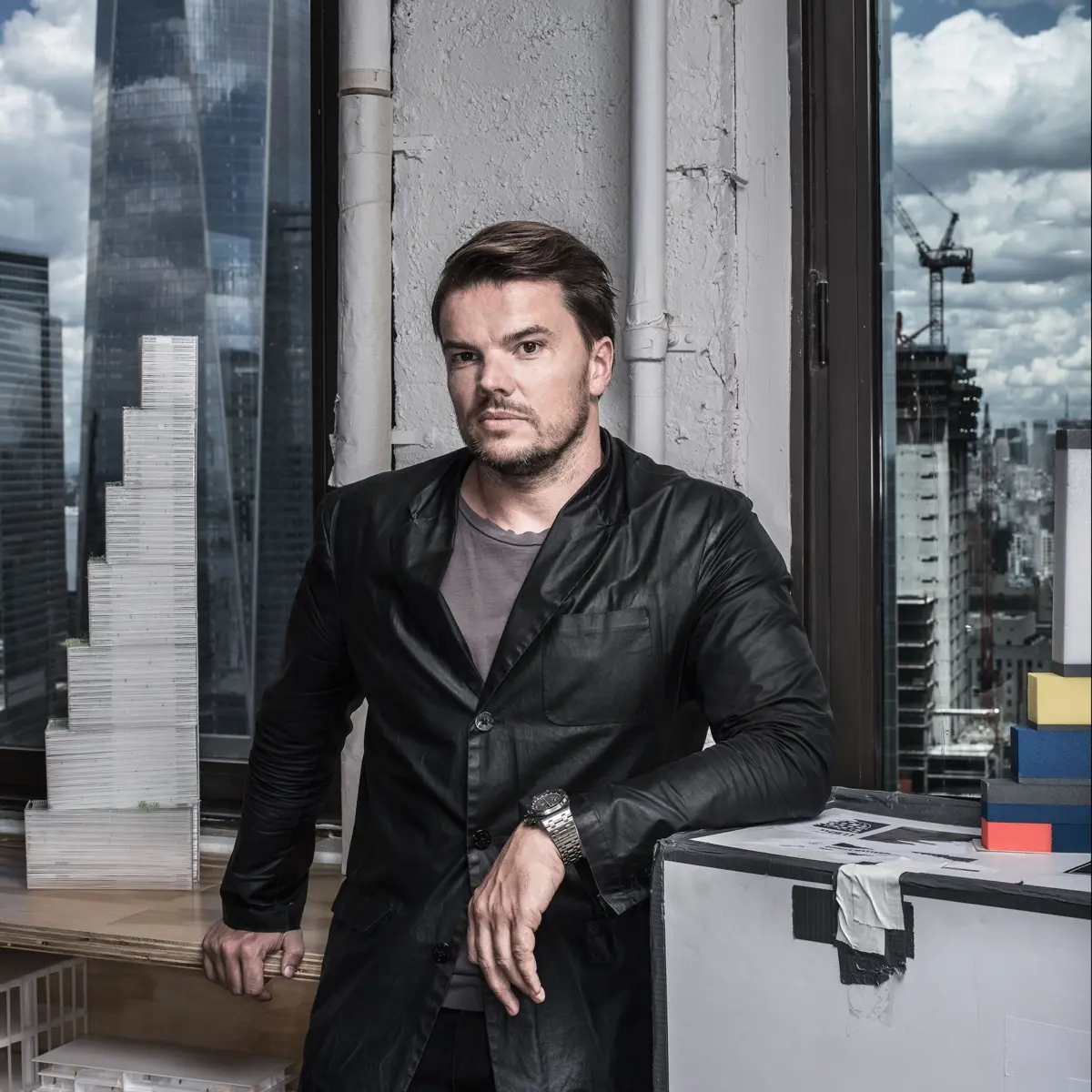
On a misty April morning in Lower Manhattan, Bjarke Ingels stood atop an old brick building with the collar of his black coat popped, filming a promotional piece for what would become the defining commission of his career. At just 40 years old, the Danish architect was aiming high—literally and figuratively. He was shooting a promotional video for his design of Two World Trade Center, a skyscraper that was still very much a work in progress. His primary client, media magnate Rupert Murdoch, had yet to fully sign off on the ambitious concept.
Yet, hyper-eloquent and brimming with confidence, Ingels refused to let doubt slow him down. He had obsessed over every line and image of the promotional campaign, telling his director that he wanted viewers to swoon. At the time, Murdoch’s plan to relocate his companies was still one of the worst-kept secrets in New York real estate, but Ingels was eager to shout the news from the rooftops. Between takes, he pointed toward a void in the densely packed Manhattan skyline, tracing the profile of a skyscraper visible only to him.

From that perspective, Ingels’ design resembled a stack of seven blocks, ascending like a staircase toward One World Trade Center, its monolithic neighbor. "In a way, it is almost like a physical manifestation of the spirit of America," he said, referencing the national motto: "Out of many, one." If completed, the tower would stand among the tallest buildings in New York City and serve as the final piece in the master plan for the redeveloped World Trade Center. The ensemble surrounds two cascading pools honoring the roughly 3,000 people who died in the terrorist attacks of September 11, 2001. But Ingels was not preoccupied with replicating the somber mood of the memorial. "The memorial is about the memorial," he noted. "The tower should be about the living city."
Ingels is fond of saying that architecture is "the art of turning fiction into fact." He possesses many talents—as a draftsman, a salesman, and a charming cultivator of his own winning public image—but his greatest asset is a remarkable gift for storytelling. He weaves compelling narratives around practical necessities, often sending his designs careering in fantastical directions.
Among his varied international portfolio, he designed a waste-to-energy plant in Copenhagen featuring a slanted roof that doubles as a recreational ski slope, complete with a smokestack engineered to puff a symbolic ring of steam every time a ton of carbon dioxide is emitted. For a proposed expansion of Google’s campus in Mountain View, California, Ingels collaborated with designer Thomas Heatherwick on an elaborate complex of geodesic domes, envisioning a lifestyle of biking, hiking, and coding beneath a sunlit glass terrarium. Such imaginative flights have made Ingels a global sensation—and highly sought-after—at an age considered precocious by the exacting standards of the architecture profession. However, fame can be a deceptive indicator in his field, where an architect’s built work often reaches the eye only after years of slow, grueling development.

Ingels’ largest completed project in New York at the time—a striking pyramidal apartment building along Manhattan’s West Side Highway at 57th Street—was only about one-third the size of Two World Trade Center. "At the moment we are working seriously on one of the most daunting buildings in downtown New York," Ingels acknowledged, noting that he had yet to complete a single skyscraper. With Two World Trade Center, he believed he had devised a way to create a high-rise work environment that transformed a fundamentally vertical, hierarchical form into a space for horizontal interaction. The hard part, however, was proving that he could translate that captivating story into physical reality on the ground.
Eclecticism on Demand
Ingels playfully calls his firm BIG, and his approach to architecture BIGamy. Rather than adhering to a single, rigid aesthetic, he tailors his ideas to meet the distinct demands of his clients—all in service of creating designs unlike anything seen before.
To realize his design for Two World Trade Center, Ingels had to continually prove its value to two hard-nosed octogenarians: Rupert Murdoch and Larry Silverstein, the developer who has overseen much of the World Trade Center rebuilding process. Murdoch and Silverstein still needed to finalize a long-term lease that would allow the $4 billion skyscraper to secure financing. "There’s a lot of drama with the deal right now," Ingels remarked on the day of his film shoot. "I don’t know how worried I should be." Even if the parties reached an agreement, other hazards loomed: a volatile real estate market, the political melodrama inherent in building on a site of mass murder, and an often intractable government bureaucracy embodied by the Port Authority of New York and New Jersey.

For 14 years, these factors had conspired to keep the redevelopment process lurching forward unpredictably, shelving many ambitious architectural concepts. Ingels’ design had actually displaced an earlier proposal by Lord Norman Foster, though turnabout was fair play, as Foster had previously pushed aside Ingels on a national library project in Kazakhstan. To avoid his predecessor’s fate, Ingels had to balance the sometimes conflicting demands of Murdoch and Silverstein, who planned to market the top half of the building as premium office space. At the same time, he had to manage a flood of new clients eager to hire BIG. While one triumphant building can make an architect’s reputation, it takes only one major disaster to ruin it.
Ingels, never short on bravado, claimed to relish the pressure, likening the process to a Zen exercise of "turning the force of your enemy into your own strength."
The first force Ingels had to overcome at the World Trade Center was institutional inertia. Silverstein initially believed he had a perfectly good design from Foster and harbored serious reservations about Ingels’ early drawings. He worried the stacked structure looked asymmetrical and teetering from certain angles. "He just thought, like, could he see it fit in? No," Ingels recalled. "Was it a nice design for another place? Maybe, but not here." Silverstein nearly rejected the deal outright until architects of other World Trade Center buildings stepped in with endorsements.

Following an initial tense meeting with Murdoch, where the media mogul fired off rapid-fire questions resembling "kangaroo boxing," Ingels had to explain why the building wouldn’t fall over. Assisted by David Childs, the architect of One World Trade Center, Ingels clarified that the leaning effect was an optical illusion. The unorthodox stepped form resulted from placing the elevator core off-center, which created expansive interior spaces for newsrooms, outdoor terraces, and views of the plaza from Fox News studios. Murdoch was ultimately sold.
Ingels also found a vital ally in James Murdoch, Rupert’s son and corporate heir apparent. It was the younger Murdoch who drove the decision to relocate 21st Century Fox and News Corp. from their aging headquarters near Rockefeller Center. Looking for an open, loftlike creative workplace, James was drawn to Ingels’ problem-solving abilities. "This is someone who can take a set of constraints and create something surprising and effective out of them," James noted.
Those constraints included the remnants of Foster’s original foundation, which had already been constructed to accommodate a $4 billion underground transportation hub. Piggybacking a new skyscraper onto pre-existing foundations created complex structural hurdles, particularly in the lobby and lower floors, where the new tower’s weight had to align with underground supports.

Soon, internal hurdles mounted. Ingels’ project manager, Ute Rinnebach, returned from a meeting with engineers bearing bad news: altering the underground walls and columns within the Port Authority’s domain was prohibited. Furthermore, a facade consultant informed Ingels that New York Police Department security standards required all World Trade Center facades to use heavier laminated safety glass, driving up projected costs significantly. Silverstein and Murdoch were already at a tense juncture in their financial negotiations, leaving Ingels’ architecture caught in the middle.
Despite these hurdles, Ingels navigated the crisis by agreeing to necessary structural adjustments while preserving the core visual identity of the design. When Silverstein executives and project partners praised his team for turning the project around, Ingels leaned into his philosophical view of architecture. "I really like this idea that architecture is the art and science of trying to make everybody happy," he said. "Potentially, somewhere out there, there’s a design that can actually satisfy every dream, by being different."
As BIG continued to expand—growing to 170 employees in New York and 100 in Copenhagen—Ingels took on the role of global brand ambassador while delegating authority to his partners and staff. Yet, the firm remained deeply personal, driven by his relentless enthusiasm and theatrical pitches.

By early June, a tentative deal between Silverstein and Murdoch was finally in place, allowing the public unveiling of Two World Trade Center. Before that could happen, however, Ingels sought a final blessing from architect Daniel Libeskind, whose master plan forms the template for the entire World Trade Center complex. Gathered in BIG’s conference room, Libeskind inspected the glowing model and delivered an enthusiastic verdict with a slap on the table: "Congratulations, that is a super building."
Though initial public reviews of the design were positive, Libeskind noted that the hard part was only beginning. Translating a model into reality meant navigating the complex realities of urban development: economics, society, power brokers, and politicians.
As negotiations continued, the tower’s design remained fluid, and minor adjustments shaved off height while altering some structural details. Yet, true to his philosophy, Ingels viewed these compromises not as defeats, but as part of the evolutionary process of building in a major metropolis. Sitting in his new Broadway office overlooking the Manhattan skyline, Ingels reflected on his rapid ascent and the epic scale of his ongoing projects. Whether designing flood defenses like the Dryline, master-planning the Smithsonian campus, or shaping a revolutionary skyscraper at the World Trade Center, Ingels remained steadfast in his mission to bridge the gap between pragmatic constraints and utopian ambition.

"Imagine, that’s where it’s going to sit," Ingels said, framing a box in the air with his hands. "I think it’s going to be pretty epic."