For more than four decades, the way human beings interact with digital software has remained fundamentally unchanged. Ever since the commercialization of the Graphical User Interface (GUI) pioneered by systems like the Xerox Star and popularized by the original Apple Macintosh in 1984, digital interactions have relied heavily on a point-and-click paradigm. To accomplish almost any task on the web—whether booking a flight, purchasing footwear, or searching for medical advice—users have been forced to navigate a maze of visual controls. The modern web user routine requires clicking nested drop-down menus, adjusting range sliders, completing multi-page forms, dismissing cookie banners, and managing dozens of open browser tabs simply to synthesize basic information.
In effect, digital consumers have spent decades learning to manage software rather than directly achieving their goals. The computer has operated as a relatively passive container of data, relying on the human user to act as a manual orchestrator, executing every single intermediate step along the way.
That fundamental contract between user and interface is now undergoing a dramatic transformation. Driven by rapid breakthroughs in artificial intelligence and large language models, a new generation of digital tools is popularizing a radical philosophy known as Intent-Driven Design. Rather than requiring users to learn intricate menu hierarchies or navigate multi-stage conversion funnels, intent-driven systems capture high-level human objectives and execute the mechanical steps silently in the background. The ultimate trajectory of modern web design is no longer to construct visually elaborate buttons or complex interface layouts, but to eliminate unnecessary interaction layers entirely, replacing manual software management with direct goal fulfillment.
The Death of the "10-Click" Process
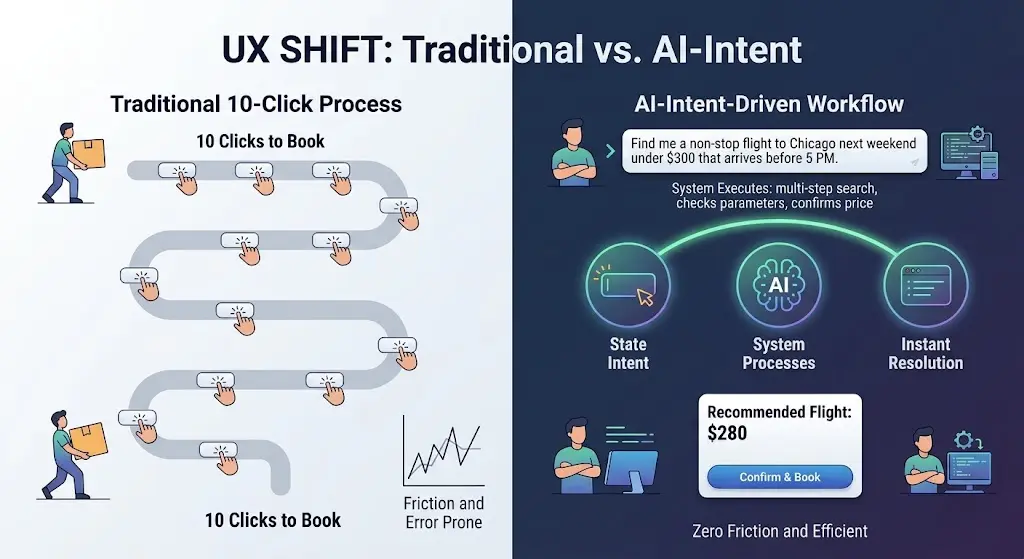
To appreciate the direction of modern web design, it is necessary to examine the friction that users have long accepted as standard behavior. Consider the traditional sequence involved in reserving an airline ticket online. Under the conventional point-and-click framework, the interaction is hyper-interactive and highly mechanical. A user must navigate to a booking platform, select travel types via radio buttons, input departure and arrival cities, interact with calendar widgets to set dates, choose passenger counts, apply price and airline filters, scroll through dozens of listed results, cross-reference options across separate browser tabs, select seating preferences, and navigate multi-step checkout screens.
This traditional workflow relies on a reactive computing paradigm. The interface demands that the human user break down a high-level goal into dozens of manual micro-actions, interpret intermediate data sets, and make step-by-step corrections.

Intent-driven design completely reverses this operational dynamic. Instead of requiring the user to execute the mechanical steps of how to find a flight, the system asks a fundamentally simpler question: What are you trying to accomplish?
When a user expresses a comprehensive goal—such as requesting a non-stop flight to Chicago next weekend under $300 that arrives before 5:00 PM—the underlying software interprets the intent directly. The AI system translates that single expression into a multi-step background query, queries available flight databases, evaluates constraints, filters out non-qualifying options, and presents a finalized, actionable outcome. The traditional ten-click sequence condenses into a single statement of intent followed by an immediate resolution.
This shift builds directly upon foundational principles in Human-Computer Interaction (HCI). It echoes ideas famously articulated in Golden Krishna’s design framework, The Best Interface Is No Interface, as well as Don Norman’s long-standing principles of human-centered design, which emphasize minimizing cognitive load and aligning technology with natural human thought processes.
Real-World Platforms Replacing Buttons with Intent
This transition away from rigid visual controls is not merely a theoretical vision for the distant future. several widely accessible web platforms demonstrate how intent-capturing systems are actively replacing traditional interface elements today.
Perplexity AI: Search Without the Open Tabs
Traditional search engines were originally architected as index directories. A user entered a targeted keyword, and the interface responded with a list of blue hyperlinks. The labor of opening five or six separate tabs, skimming long articles, navigating intrusive pop-ups, and mentally compiling a coherent answer was left entirely to the user.
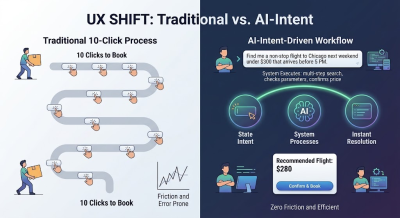
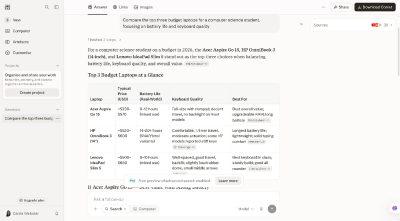
Perplexity AI alters this interaction model by operating on synthesis rather than directory listing. Instead of forcing users to click through external sites, the platform captures the user’s underlying information intent and synthesizes a direct answer tailored to the context. If a consumer asks the platform to compare budget laptops based on specific technical requirements, the system processes the request across multiple web sources simultaneously, returning a consolidated breakdown and dynamic comparison without requiring the user to navigate away or manually curate information.
Vercel v0: Web Design Without Dragging and Dropping
For web developers and digital designers, creating a user interface historically required hours of manual labor inside visual design environments like Figma or drag-and-drop page builders. Designers spent vast amounts of time manually creating layout frames, adjusting padding values, choosing color palettes, and translating visual mockups into frontend CSS code.
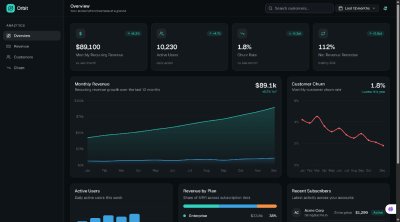
Vercel v0 replaces visual drag-and-drop mechanics with generative interface building. By entering raw intent—such as requesting an analytics dashboard complete with dynamic data charts and dark-mode styling—the platform interprets the prompt and instantly outputs functional, rendered interface code. The manual work of visual construction is replaced by high-level intent refinement.
Goblin.tools: Breaking Down Overwhelming Tasks
Conventional productivity applications typically demand significant setup and maintenance. Users must manually create task categories, drag cards across Kanban boards, assign priorities, and configure sub-task lists. For many users, particularly neurodivergent individuals experiencing cognitive overload, managing the interface itself creates a significant barrier to productivity.
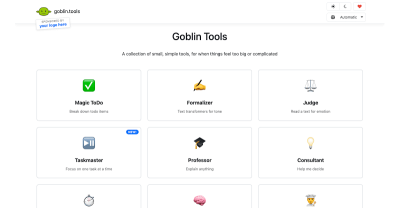
Goblin.tools presents a minimal, single-purpose interface that requires no registration or configuration. Users simply type a broad, potentially overwhelming goal—such as "prepare for a job interview"—and the underlying AI agent automatically breaks the task down into an actionable, bite-sized checklist tailored to the user’s requested level of detail. The tool absorbs the cognitive friction of planning, converting an abstract intent into a manageable task structure instantly.
The Core Pillars of Intent-Driven Web Design
To maintain usability when removing standard navigation menus, sidebars, and explicit form fields, product designers operating in this space rely on three foundational pillars that contrast sharply with traditional UX paradigms.
High-Level Goals and Ambient Context
Traditional user interfaces rely heavily on manual micro-actions, requiring users to explicitly configure dropdowns, toggles, and filters. Intent-driven architecture shifts the focus toward capturing natural language inputs and leveraging contextual data.
As outlined in Apple’s Human Interface Guidelines regarding Contextual and Ambient Design, advanced computing systems increasingly rely on background metadata—such as physical location, device state, time of day, and historical interaction patterns—to anticipate user needs. Rather than requiring explicit manual inputs for every parameter, the system uses ambient context to inform its decisions, allowing software to act proactively rather than reactively.
Generative UI and Dynamic Rendering
In classic web development, applications rely on static layouts where every user encounters identical visual architecture. An e-commerce platform typically presents the exact same homepage layout and top navigation bar to every visitor, regardless of whether they are a first-time browser or a returning customer attempting to track an active delivery.
In an intent-driven framework, computing shifts from command-driven operation to outcome specification, a transition noted in Nielsen Norman Group’s research on AI interaction paradigms. This shift enables Generative UI, where user interface components are rendered dynamically on the fly based on the user’s immediate context. If a user expresses a need to analyze financial data, the system instantly generates an interactive calculation widget tailored specifically to that data set. Once the task is resolved, the temporary interface component recedes, keeping the digital workspace clear of unnecessary visual clutter.
Execution by AI Agents and Reversible Actions
Traditional software designs are deeply conservative, prioritizing error prevention through constant confirmation modals and warning pop-ups that ask users to confirm routine actions.
Intent-driven design adapts Jakob Nielsen’s classic usability heuristics—specifically regarding user control and error recovery—by shifting the safety architecture from explicit front-end prevention to frictionless reversibility. Because autonomous AI agents perform multi-step tasks on behalf of the user, product designs emphasize immediate rollback capabilities over upfront friction. Instead of stopping users with intrusive confirmation prompts, platforms provide prominent undo functionality, transparent event histories, and simple inline revision prompts, ensuring users remain in control while allowing tasks to execute smoothly.
The Hidden Risks: Control, Transparency, and Ethical Pitfalls
While eliminating interface friction offers clear benefits, stripping away visible control mechanisms introduces significant design challenges and ethical considerations. When software operates on inferred intent rather than explicit button clicks, product creators must address critical usability risks.
The Illusion of Control
When digital systems make decisions autonomously based on interpreted goals, the experience can easily become frustrating if the system misjudges the user’s desires. Research from the Stanford Human-Computer Interaction (HCI) Group emphasizes that automated tools must establish explicit boundaries to prevent users from feeling powerless or alienated.
Furthermore, ethical frameworks published by organizations like the Center for Humane Technology caution against dark patterns and overly aggressive automated defaults. To maintain trust, product designers must carefully differentiate between routine micro-tasks that can be safely automated and high-stakes operations. Critical actions—such as executing financial payments, publishing public content, or modifying account security settings—must always require explicit, transparent user validation.
The Black Box Problem
In a traditional point-and-click interface, when an operation yields an unexpected result, the user can typically diagnose the failure point by reviewing their explicit inputs—such as a misconfigured search filter or an incorrect date selection.
Intent-driven interfaces make troubleshooting far more complex because the intermediate steps occur behind the scenes. To solve this "black box" challenge, the Google PAIR (People + AI Research) Guidebook recommends building transparent feedback loops directly into the user experience. Systems must explicitly display their interpretation of the user’s intent before or during execution—such as displaying a clear status indicator stating "Searching for non-stop flights to Chicago under $300"—enabling users to monitor the agent’s logic and correct misinterpretations immediately.
A New Mandate for UX Designers
As artificial intelligence reshapes software development, the day-to-day responsibilities of user experience design are undergoing a fundamental transformation. For decades, product design roles centered on crafting visual artifacts: wireframing button hierarchies, defining layout grids, mapping click-paths, and designing visually polished design systems.
In an intent-driven landscape, the focus shifts from designing static UI components to orchestrating dynamic, agent-led experiences. Designers must learn to map contextual flows, define safe boundaries for AI autonomy, and create clear ambient feedback mechanisms that explain machine reasoning without cluttering the screen.
Rather than defining fixed pathways that force users through rigid sales funnels, product designers are becoming system architects who establish the rules, safety nets, and ethical guardrails under which autonomous interfaces operate.
Measuring Success through Seamless Completion
For decades, the digital industry evaluated application success through engagement metrics: time spent on page, click-through rates, session duration, and overall page views. Web platforms were intentionally designed to capture visual attention and maximize the volume of manual interactions.
The intent-driven design movement, aligned with concepts like Golden Krishna’s The Best Interface Is No Interface and the Center for Humane Technology’s Time Well Spent initiative, flips these traditional metrics on their head. The ultimate metric for modern software design is no longer how visually engaging an interface is or how long it retains a user’s attention, but how quickly and invisibly it resolves the user’s underlying goal.
As software transitions from passive tools requiring constant manual direction to proactive agents capable of understanding context, the measure of great design is changing. The future of digital product development will likely belong not to the platforms with the most features or visually dense menus, but to the experiences that solve complex problems effortlessly and get out of the user’s way.