Every website reaches its absolute peak on the day it launches. The final code branch is merged, the site goes live exactly as designed, and for a fleeting moment, the digital presence is perfect. However, from that very first day forward, virtually every website begins a slow, inevitable decline.
This decline rarely happens because the underlying infrastructure breaks. The site continues to render, links continue to function, and servers continue to serve pages. Instead, the decay is subtle and strategic. Markets move, company messaging evolves, competitors introduce new offerings, and minor updates across a design system fail to reach every corner of the platform. A year after a high-profile launch, a once-pristine website turns into a historical artifact—not technically broken, but noticeably behind. While product and marketing teams universally recognize this gradual degradation, most accept it as an unchangeable law of digital operations simply because no team has the bandwidth to keep a site continuously current.
The emergence of autonomous websites powered by artificial intelligence agents promises to break this cycle. Rather than allowing a site to drift away from its launch-day standards, modern agentic platforms are designed to continuously optimize digital assets in the background. Yet, as developers and product leaders begin taking full website autonomy seriously, they encounter an obstacle that has little to do with technological capability: virtually no organization actually wants a website that changes entirely on its own.
Pierre Burgy, founder of the autonomous website platform Fimo, has spent significant time building and testing full website autonomy. Through real-world implementation, Burgy and his team uncovered a profound design challenge at the intersection of automation, organizational ownership, and human trust.
Why "Just Make It Autonomous" Is The Wrong Goal
When building with capable AI agents, the most straightforward objective appears to be complete handoff. The concept of turning over an entire site to intelligent agents—allowing them to write copy, update layouts, optimize performance, and deploy changes directly to production—serves as the default mental model for what an autonomous website should be.
In practice, however, complete autonomy is precisely what teams resist once it becomes a concrete reality.
This realization emerged directly from Fimo’s early operational testing. Burgy and his team set out to engineer fully autonomous websites, operating under the assumption that end-to-end automation was the end goal. But as real users interacted with the platform, a consistent pattern emerged: teams hesitated.
This hesitation was not driven by simple skepticism regarding the technical reliability of AI agents. Instead, it stemmed from organizational dynamics. A corporate website rarely has a single owner. It represents an intersection of interests spanning brand strategists, UX designers, front-end developers, product marketers, and accessibility specialists. Because distinct sections and attributes of a site belong to different stakeholders, every individual within an organization maintains a different tolerance for autonomy.
The core challenge facing autonomous platforms was never simply whether to trust AI agents. Rather, the true problem centered on determining exactly where to draw the boundary of control, for which specific tasks, and for which individual stakeholders. When examined through this framework, the work required to maintain a digital presence splits cleanly into three distinct categories.
Most Of It Is A No-Brainer
The vast majority of ongoing website maintenance consists of rule-bound, repetitive, and time-consuming labor. This layer accounts for roughly 80 percent of the operational burden required to keep a web presence healthy, yet it rarely leverages human creativity or specialized talent.
Consider the routine tasks that accumulate across a mature website:
- Enforcing web accessibility standards as new components and landing pages are introduced.
- Propagating design-system updates across secondary pages whenever a design token or global variable changes.
- Identifying and resolving broken metadata tags, uncompressed images uploaded during rushed release cycles, or links rendered invalid by recent URL restructurings.
No creative professional is hired for their passion for fixing missing alt attributes or manually optimizing image file sizes. These tasks are defined entirely by explicit parameters and measurable rules rather than subjective taste. Because clear criteria govern success, these operational chores represent the ideal use case for autonomous agents.
When an agent quietly maintains this rule-bound layer across an entire site without direct supervision, it does not displace human judgment or threaten creative control. Instead, it systematically eliminates the tedious maintenance backlog that human teams routinely lack the time to address. By identifying just how much of the maintenance workload falls into this administrative category, the concept of an autonomous site becomes far less daunting. Teams are not surrendering creative control; they are delegating chores.
Some Of It You Would Never Hand Over
At the opposite end of the spectrum lies a small but critical category of work that teams will not delegate at any price. While this creative core constitutes a smaller percentage of total site management, it represents the primary value of human design and brand strategy.
An AI agent can rapidly evaluate a new landing page against every technical constraint provided to it. It can verify that color contrast ratios meet regulatory standards, confirm that heading hierarchies are sequential, check that design tokens match the global stylesheet, and ensure copy adheres to basic style guide rules. However, an agent cannot evaluate how a page feels, nor can it determine whether a campaign possesses the emotional resonance and brand distinction required to succeed in a competitive market.
Subjective visual judgment, strategic positioning, and brand taste remain distinctly human domains. This high-leverage judgment is precisely what creative professionals are hired to exercise. When teams express initial resistance to website autonomy, this high-stakes creative layer is what they are seeking to protect. The fundamental error in early automation strategies was assuming that an entire website is composed of these high-level artistic choices. While very little of a website actually consists of pure subjective judgment, that small portion carries disproportionate weight, making blanket automation feel inherently risky.
And A Lot Of It Depends On Who You Are
Between mechanical chores and untouchable creative calls lies a vast middle ground. In this space, automated platforms cannot establish universal defaults because the line between an administrative task and a critical decision shifts depending on who is evaluating the work.
Burgy highlights a clear scenario to illustrate this friction: altering a site’s default theme to dark mode.
From a technical perspective, an AI agent can execute this configuration change across an entire codebase in seconds. The central question, however, is determining who has the authority to approve the change.
To a lead designer who owns the visual identity of a brand, the default color theme is far more than a technical setting. It represents a core brand statement that dictates how audiences experience the company upon first impression. Consequently, the designer demands explicit, manual oversight over that choice. Conversely, to a front-end developer focused on feature delivery and site functionality, that same default setting may represent a routine one-line parameter update with a clear structural rationale—a task they would gladly let an automated agent handle and deploy independently.
This divergence reveals a key insight into digital workflow governance: the two stakeholders are not divided by caution versus recklessness. Instead, the exact same site modification carries fundamentally different levels of strategic risk for each role. For one team member, the task is a high-stakes decision; for another, it is a operational task.
Because "correct" delegation depends on where an individual stakeholder derives their professional value, software platforms cannot ship a single, universal autonomy setting that satisfies every team. Control must be configurable at both the task level and the individual level, providing precise controls that mirror organizational responsibilities.
You Don’t Just Set The Autonomy: You Build The Agent
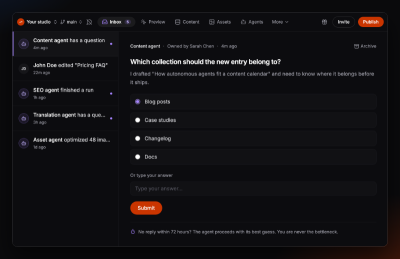
Accepting that boundaries of control are inherently personal forced a structural pivot in how autonomous website platforms are designed. A simple, platform-wide toggle between "require manual approval" and "fully delegate" is insufficient. Because control depends entirely on the specific task an agent performs, the primary unit of governance must be the agent itself.
This insight shifted Fimo away from global site settings and toward a modular system based on custom agent composition. Rather than selecting from a static menu of automated behaviors, users construct and configure specialized agents tailored to specific operational domains.
Within this framework, teams define precise operational boundaries for each discrete agent:
- Accessibility Agents: Configured with wide latitude to independently fix contrast issues, heading structures, and missing code tags across the site without requiring prior review.
- Asset and Performance Agents: Granted full autonomy to compress media, rewrite image paths, and prune unused assets in production.
- Content and Brand Agents: Kept under tight oversight, generating recommendations or draft revisions for brand-facing copy while leaving final deployment authority exclusively to human editors.
- Translation Agents: Tailored to update localized content based on defined translation frameworks, with approval thresholds varying by region or market strategic importance.
Furthermore, these agentic boundaries are not static. As agents execute tasks, process feedback, and demonstrate consistency over time, their operational parameters can evolve. A task that required manual sign-off during the first month of deployment can be transitioned to unattended execution once the agent proves its reliability. This dynamic boundary allows delegation to expand organically based on earned trust, systematically reducing routine work for human operators.
Start Narrow, and Widen As You Trust It
In practical deployments, adopting website autonomy rarely involves toggling a platform to full automation on day one. Instead, implementation follows a progressive model: teams delegate narrow, low-risk tasks, observe performance outcomes, and gradually broaden the agent’s operational scope.
To facilitate this transition, total transparency is required. Every execution run, historical log, and code diff generated by an agent must be fully auditable. By providing clear visual before-and-after comparisons of every proposed or executed change, teams build trust through direct verification rather than blind faith. When an operator observes an agent quietly resolving subtle design-system discrepancies or fixing edge-case accessibility errors that would have otherwise gone unnoticed, expanding the scope of delegation becomes a logical next step.
To prevent human review from becoming a perpetual bottleneck on semi-autonomous tasks, time-based deadlines can be assigned to review queues. If a human stakeholder does not intervene or raise an objection within a specified timeframe, the agent proceeds with the optimization. This structure ensures that essential human oversight remains available without allowing minor review queues to stall continuous site maintenance.
The Frozen Site Is The Real Risk
The primary fear surrounding AI-driven website autonomy is the prospect of an agent making an unauthorized or visually unappealing change without human intervention. Yet, as Burgy emphasizes, this focus overlooks the far greater operational hazard: the silent, continuous decline of a static website.
A frozen website does not preserve corporate value; it steadily degrades. Over time, an unmaintained site falls out of alignment with current product capabilities, brand positioning, and technological standards, ultimately presenting an outdated representation of the business it serves.
Ultimately, the goal of website autonomy is not to eliminate human participation from digital product development. Instead, its purpose is to eliminate systematic decay. By automating repetitive maintenance tasks, organizations ensure their launch-day quality becomes a baseline rather than a peak. Granting AI agents full responsibility over rule-bound maintenance frees human design and development teams to concentrate their expertise on high-value decisions, strategic creativity, and core brand taste.