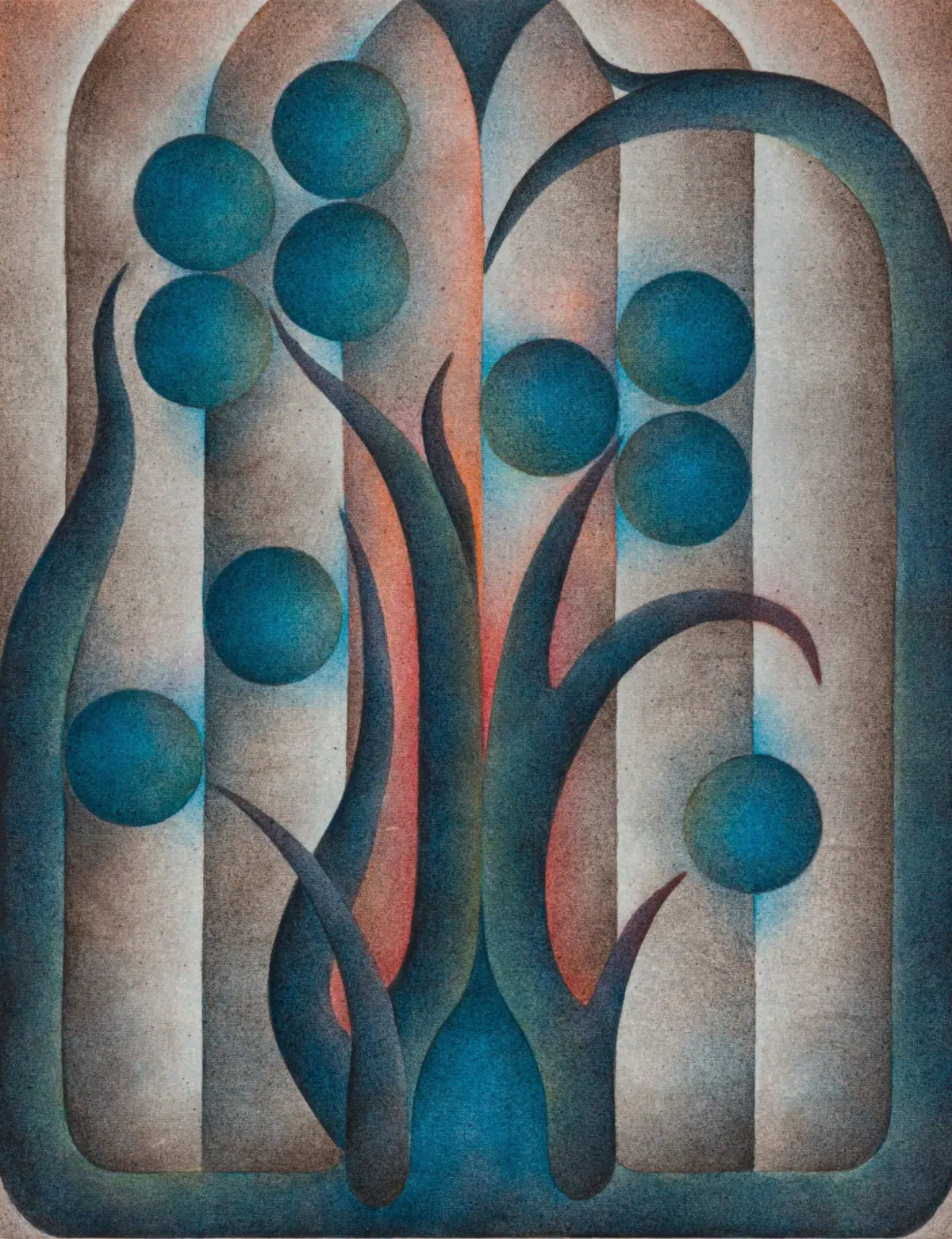
Through brilliant, searing oranges and moody, deep shades of blue, Los Angeles-based contemporary artist Roberta Gentry renders vivid, balanced compositions that take the senses seriously. For years, Gentry has cultivated an unmistakable artistic voice rooted in the fascinating relationship between the constructed and the natural. Her works manifest as abstract, biomorphic forms delicately scaffolded by tall, architectural columns, striking a careful equilibrium between precision and fluidity.

Gravitating naturally toward strict symmetry and tightly restricted color palettes, Gentry paints rhythmic pieces that firmly adhere to an underlying grid. Every individual painting is the meticulous result of multiple layers of thinned acrylic paint. Over time, these washes build upon one another into subtle, luminous gradients that softly dissipate across the expanse of the canvas. This layered technique creates a sense of depth and atmospheric resonance, drawing viewers into a visual space where rigid geometric structures and organic shapes converse.

The striking new paintings currently showcased in her upcoming solo exhibition, Blood Orange, represent a profound evolution of these ongoing themes. Lush with rich color and tactile texture, Gentry’s latest body of work directly references and reinterprets the iconic 16th-century La Dame à la licorne (The Lady and the Unicorn) tapestries. Universally celebrated as masterpieces of medieval fiber art, the original French tapestries comprise six distinct panels featuring a blond, lavishly dressed noblewoman flanked by a unicorn on one side and a lion on the other.

In the historic cycle, each of the first five main pieces correlates directly with one of the traditional human senses—sight, hearing, taste, smell, and touch. The mysterious sixth tapestry features a prominent inscription reading “À Mon Seul Désir,” which translates broadly to “to my only desire.” This enigmatic concluding panel has captivated art historians, philosophers, and viewers for centuries, sparking endless debates about its true symbolic intent.

While Blood Orange borrows heavily from the dramatic, bold color palettes of the historic tapestries, Gentry does not merely copy their subjects. Instead, she deconstructs and reimagines various elemental motifs depicted within them. The rich velvet gown worn by the noblewoman, the soaring verticality of a towering pipe organ, and the lush orange trees that anchor the serene backdrops of the original fiber works all become central, recurring forms within her contemporary abstract framework.

Art scholars have long debated the precise interpretation of the La Dame à la licorne series. While many traditional interpretations view the tapestries as a straightforward allegory for physical sensory stimulation and worldly pleasures, others take a broader, more nuanced approach. Contemporary scholars posit that the legendary fiber works speak more deeply to how human beings gather knowledge and construct information about the world around them. This intellectual inquiry finds a particularly powerful anchor in the mysterious sixth piece, which is widely understood to relate to emotion, inner desire, and human consciousness.

It is precisely at this intersection of perception and emotion that Gentry’s artistic interests deeply align with the medieval masterworks. The Los Angeles painter frequently contemplates how modern society constructs mythologies to interpret, rationalize, and explain lived experiences. In Blood Orange, this profound philosophical inquiry emerges visually on the canvas through a palpable tension. Viewers can witness an ongoing dialogue between the rigid, calculated order of the underlying grid and the roving, unpredictable, and untamed nature of organic botanical growth.

The exhibition Blood Orange is currently welcoming visitors and runs through October 24 at Track 16’s prominent East Hollywood gallery location. Art enthusiasts and followers wishing to view more of the artist’s process and recent portfolio can find additional updates and imagery from Gentry directly on her official Instagram page.