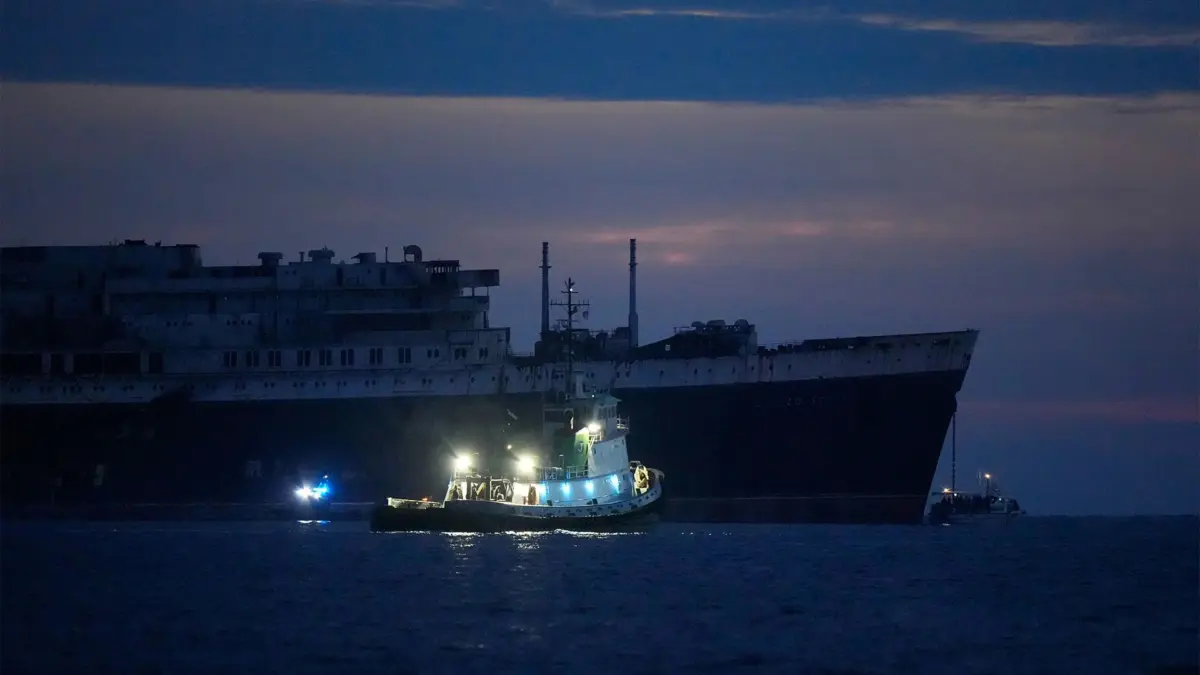
The historic SS United States, a legendary ocean liner that once held the title of the fastest ship on the seas and played host to world leaders, Hollywood icons, and generations of travelers, has made its slow and final journey beneath the waves.
The famous vessel—which is longer than the Titanic and crossed the Atlantic Ocean more than 800 times—was deliberately and meticulously sunk in the dark waters of the Gulf of Mexico. Rather than being broken down for scrap metal, the once-luxurious maritime behemoth is beginning a new chapter on the ocean floor as the world’s largest artificial reef, a $13.5 million project designed to draw diving and fishing enthusiasts from across the globe while fostering marine ecosystems.
It was a long and poignant goodbye. Hours after the controlled sinking began on a cloudy afternoon, much of the hulking ship’s silhouette could still be seen hovering in the deep waters off the coast of the Florida Panhandle as night fell. Organizers had initially predicted that the vessel’s descent might conclude in as little as an hour, but the sheer scale of the ship dictated a much more gradual process.
Finally, around 9 p.m., the massive vessel leaned definitively to one side before swiftly slipping beneath the surface, vanishing from the view of project organizers, maritime workers, and onlookers who had gathered to witness the historic moment.
“She is an amazing lady who will not lay down without a fight,” said Coleen O’Malley, president of Coleen Marine, the company tasked with sinking the ship, moments before the vessel disappeared entirely beneath the water. “Much like the amazing nation she was named after.”
The operation, classified by officials as a controlled sinking, represents the culmination of a long-planned initiative aimed at attracting more scuba divers and fishing enthusiasts to the region while simultaneously establishing a thriving undersea habitat for species such as tuna, marlin, and swordfish.
The slower-than-expected descent into the depths was partly attributable to the careful ballasting process required to ensure the ship rested evenly on the ocean floor. Crews filled 128 internal fuel and lubricant tanks aboard the liner with water to manage its weight and posture during the descent, according to Nick Tomecek, a spokesperson for Okaloosa County, which helped organize and spearhead the monumental project. He noted that the intricate procedure simply took longer than anticipated.
“She’s a big ship,” Tomecek remarked, underscoring the engineering challenges inherent in scuttling a vessel of such monumental proportions.
A Massive Vessel with a Long and Storied History
The ambitious reefing project successfully rescues what was once considered a breathtaking technological marvel during its debut decades ago from the ignominy of the scrapyard.
When the SS United States made its maiden voyage in 1952, it represented the absolute pinnacle of mid-century American engineering, industrial design, and post-war national pride. Over the course of its active operational life, its passenger manifests read like a veritable who’s who of international aristocracy, politics, and culture.
Famous passengers who walked its expansive decks included legendary Hollywood stars such as Grace Kelly and Elizabeth Taylor. The ship also welcomed prominent political figures, including U.S. Presidents Harry Truman, Dwight Eisenhower, and John F. Kennedy, alongside Britain’s former King Edward VIII. In 1968, a young Bill Clinton boarded the liner to travel to Europe as he headed to Oxford University, decades before he would assume the presidency of the United States.
Once aboard, discerning passengers were treated to opulent dining experiences featuring menus that included delicacies such as caviar, roast duckling, smoked ox tongue, and Calf’s Head en Tortue, reflecting the unmatched luxury of the golden age of ocean liner travel.
In careful preparation for the ship’s final transition into an artificial reef, organizers removed the massive 65-foot (20-meter) smokestacks. Plans are currently underway for these iconic funnels to anchor a brand-new museum dedicated to preserving and celebrating the rich history of the vessel.
Environmental Regulations Prohibited the Use of Explosives
Executing a scuttling project of this magnitude required navigating strict federal environmental and explosives regulations. According to Tomecek, these federal rules prevented Okaloosa County and its primary contractors from utilizing explosives to breach the hull and sink the ship. Furthermore, mounting concerns regarding approaching inclement weather forced local officials to accelerate the timeline and move the sinking up by a full day.
To facilitate the controlled flooding of the vessel without explosives, engineers relied on the ship’s historic infrastructure. The SS United States was originally equipped with internal pipes designed to pull seawater into tanks as part of the system that cooled its massive boilers. Those internal tanks were systematically removed so that once the sea valves were opened, water would freely and rapidly flood the hull.
In addition to configuring the internal plumbing, specialized workers cut massive 10-foot by 10-foot (3-meter by 3-meter) holes directly into the decks to allow water to circulate evenly and to provide safe access points for future divers. More than 400 portholes were also removed to assist in the flooding process and to ensure the interior remains accessible for exploration.
The ship was guided to its final resting place in approximately 180 feet (55 meters) of water. Once settled, its uppermost deck will sit roughly 60 feet (18 meters) below the surface—a depth carefully calculated to be shallow enough for intermediate and less experienced recreational divers to visit safely. The site is located in the waters roughly 25 miles (40 kilometers) southwest of Destin, positioned comfortably between Panama City and Pensacola.
Larger Than the Titanic and Record-Breaking from Day One
The creation of the SS United States was a monumental national endeavor that brought together more than 3,000 shipbuilders in Virginia throughout 1950 and 1951. When it finally embarked on its maiden voyage, its passenger list included prominent figures such as an Associated Press reporter and Margaret Truman, the daughter of the sitting U.S. president.
The ship’s performance on that historic first journey shattered expectations and global records. It maintained an average speed of almost 41 mph (66 kph) across the Atlantic, easily eclipsing the previous speed record set by Britain’s RMS Queen Mary in 1938 by a margin of 4.5 mph (7.2 kph), according to contemporary dispatches from the Associated Press.
Remarkably, the SS United States secured this enduring speed record despite encountering severe weather conditions toward the end of its journey, running straight into a full gale with winds reaching 69 mph (111 kph). The weather was described by the AP at the time as “so strong it blew a ping pong table off the deck.”
Measuring an impressive 990 feet (302 meters) in length, the vessel is 108 feet (33 meters) longer than the ill-fated Titanic, which famously struck an iceberg and sank during its maiden voyage across the Atlantic four decades earlier.
“She really embodies and expresses this country’s best,” said Susan Gibbs, the granddaughter of the ship’s visionary designer, William Francis Gibbs. “She represents pride and resilience and strength and beauty.”
A New Hub in a Region Rich with Artificial Reefs
The waters surrounding the new resting place of the SS United States are already home to more than 500 artificial reefs, making the Florida Panhandle a premier destination for marine conservation and underwater recreation.
Prior to this historic scuttling, the region’s largest artificial reef was created in 2006 with the intentional sinking of the USS Oriskany, a decommissioned aircraft carrier measuring 911 feet (278 meters) in length. The Oriskany was sunk in the Gulf off Pensacola, located close enough to the new SS United States site that experienced scuba divers will theoretically be able to visit both iconic military and maritime giants on the exact same day, according to Tomecek.
“We’re trying to be the best diving destination in the world,” Tomecek said, outlining the long-term tourism and environmental vision for the county.
Despite its glorious beginnings, the SS United States faced a prolonged period of decline following its commercial obsolescence. The ship was officially decommissioned in 1969 as commercial aviation came to dominate transatlantic travel. Over the subsequent decades, numerous revitalization efforts—including proposals by hotel magnates and cruise operators like Norwegian Cruise Lines to restore the vessel to active service—ultimately failed to materialize. From 1996 until recently, the great liner sat quietly and neglected along a pier in Philadelphia, its future uncertain.
Tim Mullane, a Navy veteran and chief operating officer of Coleen Marine, reflected on the physical remnants of the ship, referring to the massive, iconic funnels that were removed to serve as the centerpiece of the planned museum as true “works of art.”
For advocates like Susan Gibbs, who spent years fighting to save the vessel from the scrap heap entirely, seeing portions preserved and the ship given a dignified final purpose brought a sense of closure and relief.
“I’m just so happy that we are able to save parts of her,” Gibbs said.