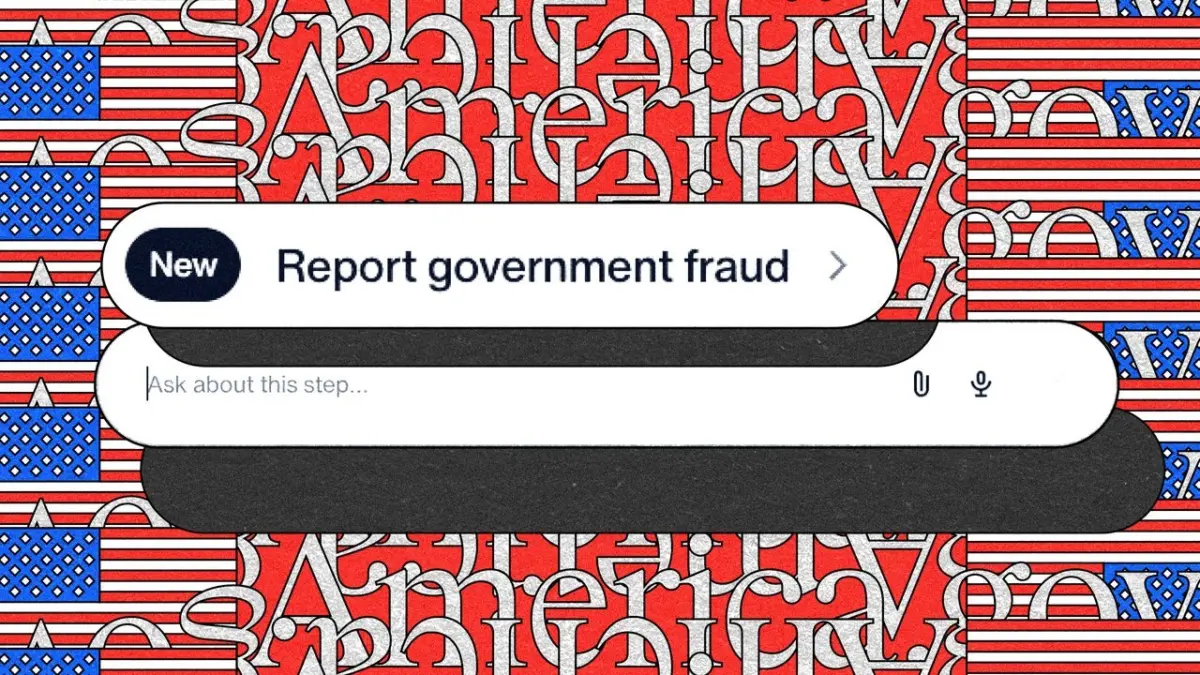
The Trump administration has expanded the digital footprint of its fraud-enforcement campaigns by integrating a new fraud-reporting tool directly into the federal government’s official artificial intelligence chatbot.
The feature marks the latest update to America.gov, a centralized online hub for official government information that launched in September. Created by the National Design Studio, the platform was designed to streamline public communication for the artificial intelligence age. The site’s home page features a prominent prompt box that answers user inquiries based on a machine-learning model trained on federal websites and official sources. With the introduction of this new user interface update, America.gov is increasingly mirroring the broader messaging and enforcement priorities of the Trump administration.
Late last month, designers introduced a new pill-shaped button positioned directly below the prompt box on America.gov, bearing the label “Report government fraud.” When users click through the interface, they are directed to a specialized page offering two primary reporting pathways. Visitors can choose either to report benefits fraud—specifically targeting programs such as Medicaid, Medicare, unemployment, or the Supplemental Nutrition Assistance Program, formerly known as food stamps—or to submit tips regarding voter fraud.
According to the informational “About” pages accompanying the reporting processes, the submissions are encrypted, and user identities remain optional. However, the system introduces an incentive structure by offering the possibility of financial cash rewards for individuals who choose to include their contact information with their tips.
The rollout of this new prompt functionality on America.gov arrives amid an escalating focus on fraud by President Donald Trump and follows the August launch of fraud.gov. That separate federal website utilizes figures compiled by the administration to claim that hundreds of billions of dollars in fraudulent activity have been uncovered during Trump’s second term.
However, those figures have faced scrutiny. An analysis by The New York Times revealed that the administration’s statistics included temporary funding pauses, cases that originated prior to Trump’s second term, and claims that had not yet been independently verified.
The digital update also coincides with heightened political directives regarding regional enforcement. On Thursday, President Trump posted on his social media network to announce that he was directing Vice President JD Vance to focus his complete and total attention on investigating crime and corruption within cities and states governed by Democrats.
This strategic focus has broad implications for how federal enforcement resources are deployed. The Trump administration’s approach to combating fraud heavily targets high-volume, low-dollar cases, frequently concentrating enforcement efforts in states that did not vote for the president or his party during the election.
Analysts note that focusing on high-volume consumer and benefits programs can generate quick, easily quantifiable metrics. The administration can then point to these figures as empirical proof that it is successfully rooting out waste, while simultaneously building a narrative regarding the administrative competence of Democrat-led states.
At the same time, this aggressive pursuit of low-level benefits and voter fraud stands in stark contrast to the handling of major financial crimes at the federal level. Many wealthy and well-connected financial fraudsters have managed to evade accountability during Trump’s second term, largely aided by presidential pardons and a distinct shift in the administration’s broader crime-fighting priorities.
Data from the Department of Justice indicates a notable divergence from past administrations. According to a comprehensive review conducted by Justice Connection, a advocacy and oversight group composed of former DOJ employees, Trump’s Department of Justice is bringing significantly fewer white-collar criminal cases forward compared to its predecessors.
Conversely, presidential pardons granted during the administration have carried substantial financial repercussions for victims and taxpayers. An internal review by Democrats on the House Judiciary Committee estimated that Trump’s pardons have cost American taxpayers and crime victims approximately $1.3 billion in unpaid restitution and court-ordered financial penalties.
In response to these developments, House Democrats have signaled their intention to launch formal congressional investigations. Lawmakers have stated they plan to scrutinize what they describe as the administration’s “pardon economy,” as well as any associated conflicts of interest, when the next congressional session commences in 2027.