As the bleakest month of the year approaches, renowned astrophotographer Andrew McCarthy has chosen to kick off his upcoming 2027 Cosmic Background calendar with an unsettling yet breathtaking glimpse into the distant future of our solar system.
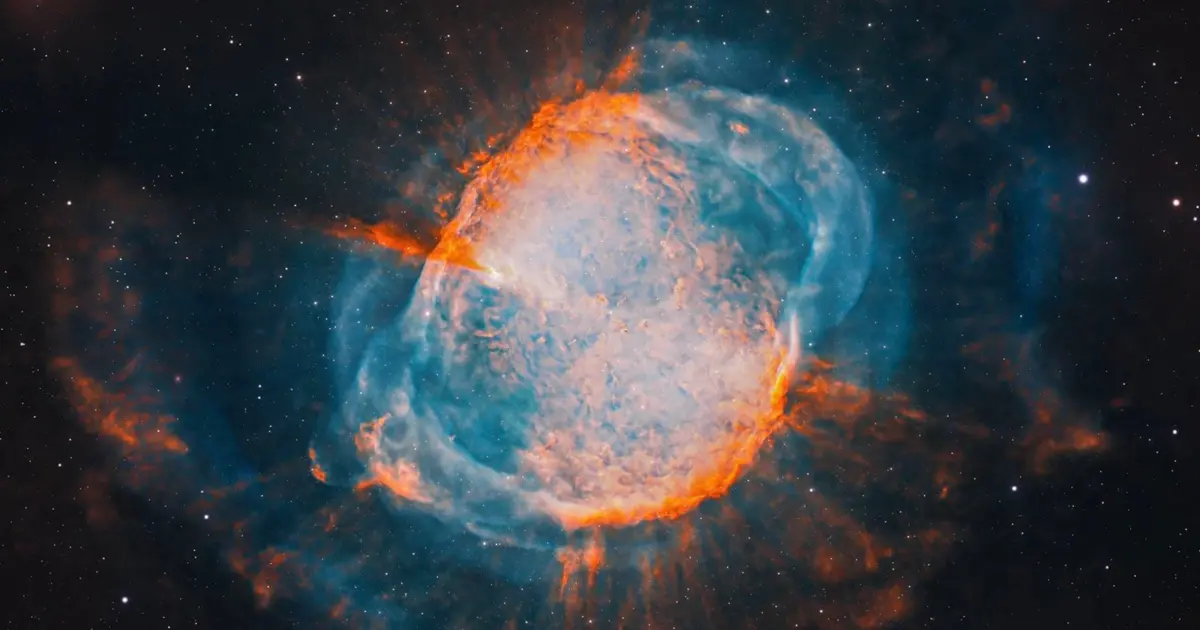
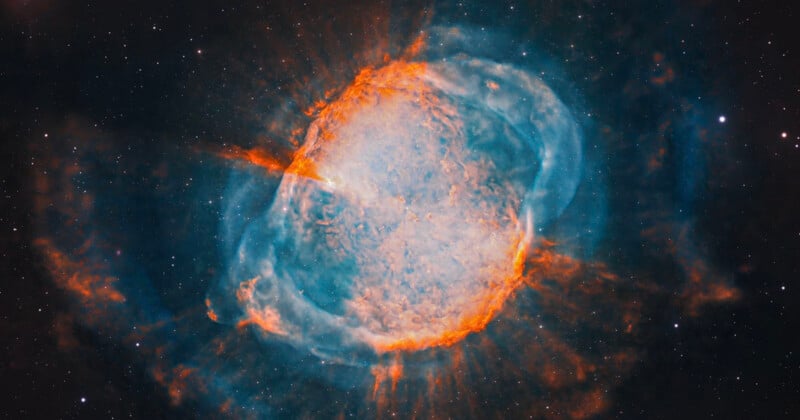
For the inaugural month of January, McCarthy selected a mesmerizing, highly detailed image of the Dumbbell Nebula, a celestial object he captured over the course of 30 arduous hours earlier this year. More than just a striking visual showcase of deep space, the photograph serves as a stark reminder that even our own solar system operates under a strict cosmic expiration date.
The Dumbbell Nebula, cataloged formally as Messier 27, is classified as a planetary nebula. Despite the misleading historical name—which stems from early astronomers who thought these round, glowing patches resembled planets through primitive telescopes—planetary nebulae have nothing to do with planets at all. Instead, they represent the expanding shell of glowing gas and dust cast off by a dying star that once bore striking similarities to our own Sun.
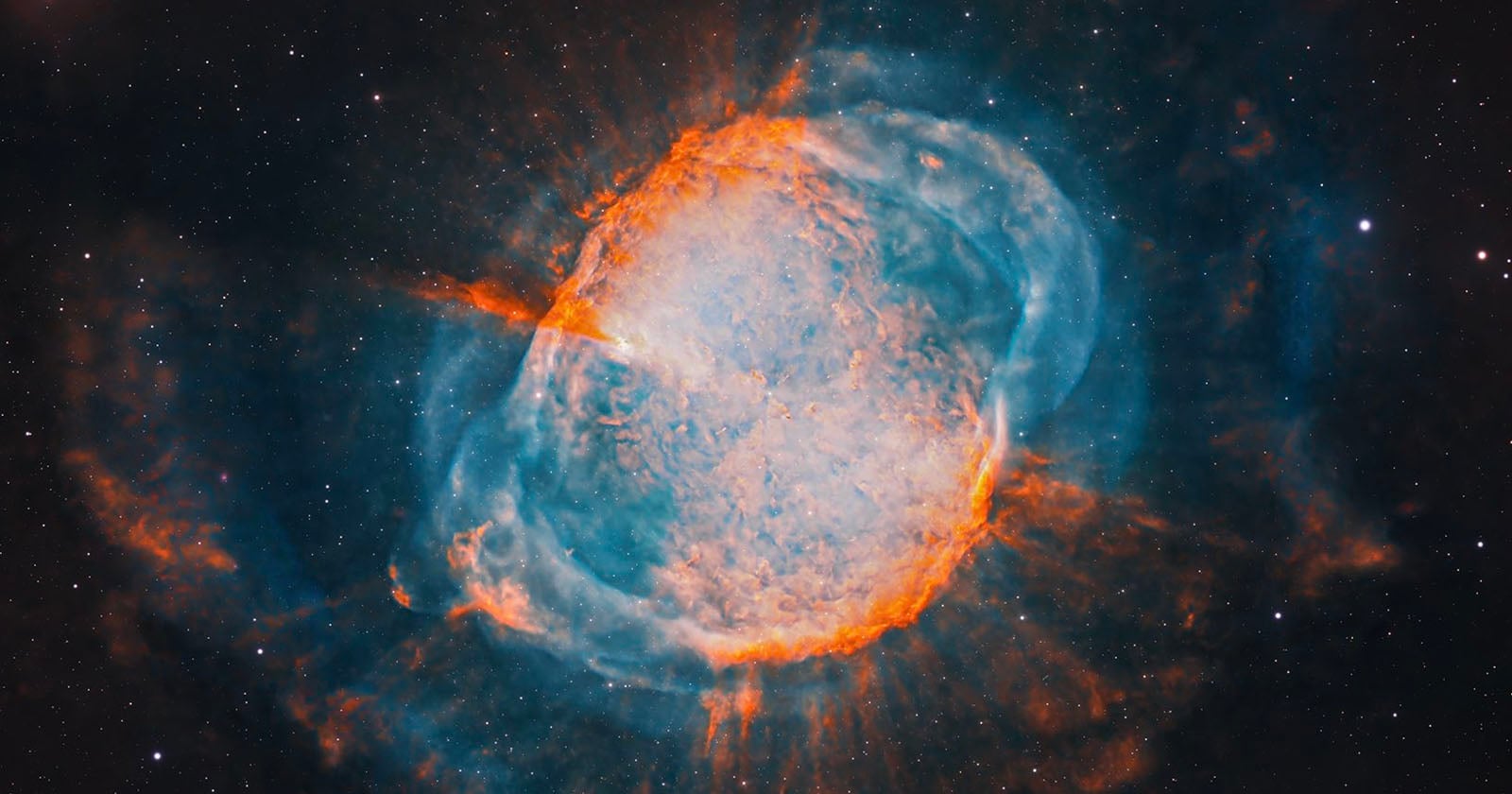
Located in the constellation Vulpecula, the Dumbbell Nebula is a favorite target among amateur astronomers and stargazers worldwide. Because of its intrinsic brightness, even modest backyard telescopes can pull the object into view, making it a familiar sight for those who gaze regularly into the night sky. However, the image crafted by McCarthy goes far beyond what a casual observer might see through a standard eyepiece, revealing intricate structures and delicate filaments that span light-years across the cosmos.
To achieve this level of depth and clarity, McCarthy utilized advanced equipment and a grueling multi-night imaging campaign. McCarthy explains in his newsletter that the 30-hour exposure was captured using his 17-inch telescope, allowing him to tell a much more complete and dramatic story of everything happening around the central stellar remnant.
The resulting composition highlights an expanding shell of ionized gases framing a bright inner core. Within this central region, material appears to be actively shredding away, driven by the immense pressure and violent dynamics of the stellar death event. Capturing such an intricate view requires immense patience and precise planning. McCarthy notes that he had to spread the 30 hours of imaging across multiple different nights, explaining that otherwise, the Sun and the Earth would simply get in the way of the deep-space target.
The resulting portrait carries profound existential weight, offering a clear window into the ultimate fate awaiting our own Sun. Once the solar system’s central star depletes the hydrogen fuel burning brightly in its core, it will follow the exact evolutionary path witnessed in Messier 27.
According to astrophysical models and McCarthy’s own breakdowns of the stellar lifecycle, the Sun will eventually swell outward into a massive red giant. In this bloated phase, it will consume the inner planets and drastically alter the outer realms of the system before violently shedding its outer layers into the void of space. What remains behind will collapse inward into a dense white dwarf. Over the course of many trillions of years, this leftover stellar cinder will slowly cool into a hypothetical black dwarf, while its expelled mass drifts further into interstellar space, eventually contributing its heavy elements to the birth of brand-new star systems and planets.
Achieving the vibrant color palette and striking contrast in his photograph required a specialized workflow that bridges the gap between scientific accuracy and aesthetic presentation. McCarthy cycled through dedicated Hydrogen, Oxygen, and Sulfur-tuned filters designed to isolate specific trace gases within the expanding nebula. By mapping those separate monochromatic captures to corresponding color channels, he constructed the final composite image.
McCarthy notes that the photo is presented as his own personal hybrid of the "Hubble Palette," a widely used method of integrating narrowband imaging to extract maximum color contrast and fine structural detail from a nebula. He is quick to stress that no artificial colors were ever painted into the image, and that all the color filters he utilized fell strictly within the visible spectrum.
Addressing common questions about the authenticity of colors in astrophotography, McCarthy acknowledges that while the image is technically false color due to the narrow spectral bands used to capture it, the result is not overly far removed from true color, which would simply feature the vibrant oranges appearing closer to a deep crimson.
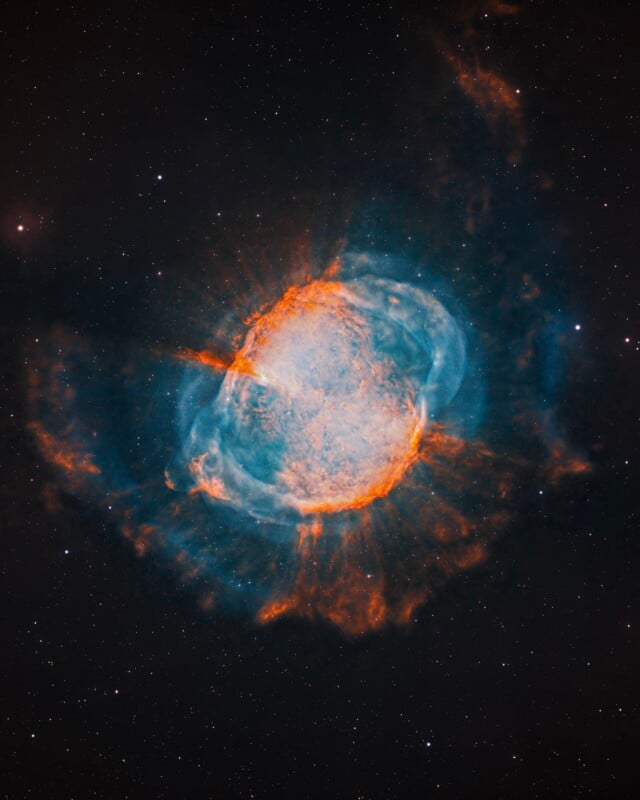
He explains that these narrowband filters are deliberately chosen to resolve better structural contrast, even if it comes at the expense of completely accurate color balancing. Notably, this image stands as one of only two false-color compositions featured throughout the entire 2027 calendar, with the remaining months showcasing true-color captures of the cosmos.
The Dumbbell Nebula image shares space with 11 other carefully curated photographs in the primary 2027 Cosmic Background calendar. Together, the collection showcases McCarthy’s diverse portfolio of deep-space astrophotography alongside stunning captures of celestial events much closer to home, including a remarkably rare photograph of an airplane transiting directly across the face of the Sun.
In addition to his flagship astronomical calendar, McCarthy has expanded his publishing lineup for 2027 to include two alternative editions. One calendar focuses exclusively on high-octane rocket launches, while the other features a lighter, more whimsical theme centered entirely around his cat, Gregory, blending distant space phenomena with feline companionship in a way that has become a trademark of his online presence.
Reflecting on the annual publishing process, McCarthy shares that putting together his cosmic calendars is one of his favorite activities of the year. It serves as a dedicated time to look back on what he has achieved over the preceding months and provides a unique opportunity to use his photography as a medium for storytelling, connecting everyday audiences with the grand scale of the universe.