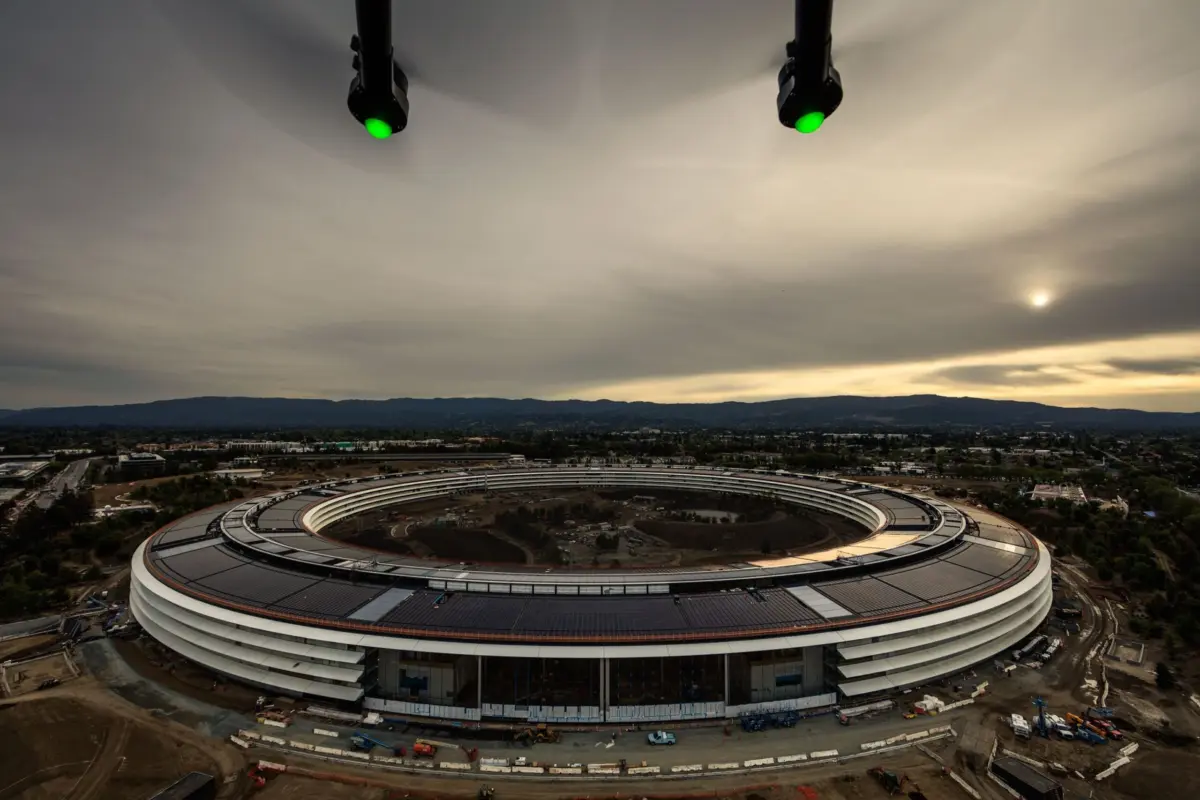
The new headquarters Apple is building in Cupertino has the absolute best door handles. They are precision-milled aluminum rails that attach to glass doors—sliding and swinging alike—with no visible bolts.
Everything in this building represents the pinnacle of meticulous design. The toroid glass of the roof curves scientifically to shed rainwater. And if it never rains again in California, an arborist has selected thousands of drought-tolerant new trees for the 175-acre site. Not every Apple employee will get to work in the new building—only 12,000 out of a larger regional workforce will secure a spot inside the ring. Of course, the campus provides 9,000 parking spaces, a figure intentionally capped to encourage people to take an Apple shuttle to work.
Once employees arrive, the amenities are designed to keep them on-site. The fitness center features a climbing wall with pre-distressed stone. The concrete edges of the parking lot walls are subtly rounded, and the fire suppression systems are borrowed from luxury yachts. Craftspeople harvested the wood paneling at the exact time of year demanded by the late Steve Jobs—mid-winter—so the sap content wouldn’t be ruinously high.
Whether you call it the Ring, the Death Star, or the Spaceship, something massive and otherworldly has alighted in Cupertino. No one can reasonably question the sheer elegance of its design and architecture. This $5 billion, 2.8 million-square-foot structure is an embodiment of Steve Jobsian, Jony Ivesian, and Norman Fosterian genius.
Yet, you cannot truly understand a building without looking at what surrounds it—its site. From that perspective, Apple’s new headquarters is a retrograde, literally inward-looking development that displays an inherent disconnect from the city where it lives and from urban centers in general. People rightly credit Apple for defining the look and feel of the future; its computers and phones often seem like science fiction. But by building a mega-headquarters straight out of the middle of the last century, Apple has exacerbated the already severe problems endemic to 21st-century suburbs like Cupertino, including transportation, housing, and regional economics. Apple Park is an anachronism wrapped in glass, tucked quietly into a residential neighborhood.
The Architecture of Isolation
Apple Park is not the first high-end, suburban corporate headquarters. In fact, that layout used to be the industry norm. Looking back at the 1950s and 1960s, prominent examples include the Connecticut General Life Insurance headquarters in Hartford and John Deere’s headquarters in Moline, Illinois.
"They were stunningly beautiful, high modernist buildings by quality architects using cutting-edge technology to create buildings sheathed in glass with a seamless relationship between inside and outside, dependent on the automobile to move employees to the site," says Louise Mozingo, a landscape architect at UC Berkeley and author of Pastoral Capitalism: A History of Suburban Corporate Landscapes. "There was a kind of splendid isolation that was seen as productive, capturing the employees for an entire day and in the process reinforcing an insular corporate culture."
By moving out of downtown skyscrapers and building in the suburbs, corporations reflected 1950s urban anxieties. Cities were often viewed as dirty, crowded, and unpleasantly diverse, whereas suburbs offered exclusive, aspirational, and architectural blank slates. Furthermore, suburban buildings were easier to secure, and isolated workers could not easily wander off for lunch where they might hear about other, better job opportunities. It was, in essence, corporatized white flight.
Silicon Valley, however, historically operated under a different model. While companies like IBM built a few research sites modeled on their East Coast redoubts, Silicon Valley generally thrived on interchangeable, modular buildings. A startup might begin in a garage, take over half a floor in a modest office park, expand to a full floor, then a whole building, and eventually move to a better office park after securing venture capital.
When an economic downturn hits or a new product fails, companies let leases lapse or sell real estate. More than half of the lot where Apple sited its new home used to belong to Hewlett Packard, just as the Googleplex formerly belonged to Silicon Graphics. It is the natural corporate circuit of life.
However, when a company builds a massive statement structure like the Spaceship, that circuit breaks. If Apple were ever to face severe financial decline, what would happen to the building? It would likely face the same fate as Union Carbide’s famously isolated headquarters, which is why few companies build such structures anymore. Successful buildings engage with their surroundings. To be clear, Apple is not located in some remote suburban arcadia; it is situated in a live city, directly across the street from houses and retail developments, near two freeway onramps.
Yet, the Ring is mostly hidden behind artificial berms, resembling an attraction at a theme park. "They’re all these white elephants. Nobody knows what the hell to do with them," Mozingo says. "You have a $5 billion office building, incredibly idiosyncratic, impossible to purpose for somebody else. Nobody’s going to move into Steve Jobs’ old building."
The Landscape and Housing Crisis
That remains a future problem for Apple. Today’s pressing issue is how the campus integrates into Cupertino and a crowded, congested, and expensive Silicon Valley.
Between 2010 and 2015, the San Francisco Bay Area added 640,000 jobs, with more than a third of that growth concentrated in the tech sector. Yet, the region failed to build nearly enough housing. With the exception of a brief spike during the boom years leading up to the 2008 recession, new housing construction in San Francisco and surrounding Bay Area cities has trended steadily downward. When supply fails to meet demand, costs skyrocket. The median price for a home in the Bay Area climbed to $800,000, with figures even higher in the heart of Silicon Valley.
Conditions are beginning to shift slightly. San Francisco has tens of thousands of residential units in its development pipeline, and San Jose is adding thousands annually. However, the smaller towns along major corridors like Route 101 and Interstate 280—the home turf of Apple, Google, and Facebook—have been notably reluctant to build new houses or apartments. Cupertino, Mountain View, and Palo Alto house tens of thousands of tech workers and continue to add more, yet they have resisted significant residential expansion.
As Cupertino’s assistant city manager, Aarti Shrivastava, notes, the city recognized that Apple’s arrival would bring unique demands, including heightened security concerns that eventually led to public access restrictions and the closure of a major road.
Early in the planning process, reports suggested Apple was initially hesitant to participate in financial community benefits, while Cupertino’s city council was reluctant to pressure one of its largest employers and taxpayers. Over time, however, Apple committed to providing funding to help mitigate traffic and parking impacts. "We had to bring them into our world. They don’t do urban design. They don’t do planning. We needed to talk to each other," Shrivastava explains.
Under its previous incarnation as an HP facility, the site accommodated about 5,000 workers. The new Apple complex will more than double that population. While only about 10 percent of those workers live in Cupertino, an Environmental Impact Report indicates that the demand for Cupertino housing will surge by 284 percent.
To address this, Apple is paying a Housing Mitigation Fee calculated on overall square footage. Because Apple is only adding about 800,000 square feet of building space beyond what previously existed on the site, the company agreed to double the usual fee. However, because the city had previously halved the standard rate, the resulting payment amounts to roughly $5 million.
Simple math reveals that with only 10 percent of employees living in Cupertino, 90 percent must commute from elsewhere, primarily San Jose to the east and San Francisco to the north. The lack of a cohesive regional transportation network heavily favors automobile travel, prompting tech companies to deploy private shuttle fleets.
Apple operates a comprehensive shuttle network spanning the peninsula and the East Bay, aiming to increase non-single-occupancy vehicle commutes to 34 percent. According to the environmental report, only 1.5 percent of commute trips to Apple’s existing facilities rely on public transit, leading the company to argue that the existing public bus system is adequate. Critics note the circular logic: without robust transit infrastructure built into the equation, ridership will not materialize.
Beyond transportation and housing, Apple collaborated with Cupertino on other fronts. Because the new campus subsumed planned public space, Apple paid $8.2 million for the city to build a park elsewhere. The company also funded traffic studies and intersection improvements, including $250,000 for one feasibility study and $1 million for another. To counteract neighborhood parking overflow, Apple allocated $250,000 to Santa Clara and $500,000 to Sunnyvale in parking restitution.
Furthermore, Apple restructured its local tax contributions. The city previously forgave all of Apple’s business-to-business sales tax, but under the new arrangement, Cupertino will retain 65 percent of it. Apple also constructed a $5 million system to pipe recycled water from Sunnyvale to hydrate its extensive landscaping, infrastructure that future nearby developments may also utilize.
Still, against the backdrop of Apple’s massive financial reserves, these community benefits appear modest to urban planning advocates. Critics point out that the company could have helped fund major regional upgrades, such as doubling CalTrain commuter rail frequency or building a dedicated transit center in Cupertino, which currently lacks one.
"Apple could have done anything. Money was no object," says Allison Arieff, editorial director for the San Francisco Bay Area Planning and Urban Research Association. "They want to be innovative in everything, and they’re not innovative in this thing." Instead of addressing root regional problems like housing shortages and traffic congestion, Arieff argues, the focus remained inward.
The structural challenges facing California are complex. A 1978 law known as Proposition 13 severely limits annual property tax increases, cutting state funding for public education and basic services while transforming real estate into the primary vehicle for personal wealth accumulation. Consequently, long-term homeowners have strong financial incentives to oppose new residential developments that might alter neighborhood dynamics or property values.
Concurrently, California cities grapple with rising pension obligations for retired municipal workers. Lacking the ability to raise property taxes on older homes or easily build new ones, cities often view commercial developments and tech booms as fiscal saviors. "It’s a lot to ask a corporate campus to fix those problems," Arieff acknowledges.
Yet, other companies take different approaches. Cloud storage provider Box situated its main building directly across the street from the Redwood City CalTrain station and opens its parking lot to the downtown community on weekends. Urban planners consider this contemporary, integrated model far more effective than concealing a massive campus behind hills and away from public transit.
Global technology corporations often operate with a degree of detachment from local civic conditions because their markets are worldwide, notes Harvard economist Ed Glaeser. Because they have fewer ties to local suppliers or immediate consumers, their incentives to solve local municipal planning problems are inherently limited. Market-based solutions alone cannot resolve systemic infrastructure deficits like transit frequency or the jobs-to-housing imbalance; those require coordinated government intervention.
Contemporary commercial architecture increasingly favors building upward rather than outward. While Apple’s ring places 2.5 million square feet across 175 suburban acres, San Francisco’s 60-story Salesforce Tower houses 1.5 million square feet on roughly one acre, offering direct connections to a major transit terminal at a fraction of the land footprint.
Looking Forward
Cupertino is frequently described in technology reporting as once-sleepy or nondescript. Yet, the city is evolving through mixed-use developments like Main Street Cupertino, which combines restaurants, retail shops, and multi-story residences around a central gathering space. Directly across the street, the aging Vallco Mall—a traditional, car-centric shopping center surrounded by vast parking lots—stands as the city’s most hotly debated site for future redevelopment.
Transforming these suburban environments takes time, a process slowed when major businesses remain reluctant partners. In earlier eras of industrial capitalism, business leaders frequently collaborated with municipal governments to co-finance public infrastructure, recognizing that robust transit, water systems, and public utilities supported mutual economic growth.
Modern tech companies are taking preliminary steps in similar directions. Google integrated nearly 10,000 apartments into the planning package for its North Bayshore headquarters in Mountain View. Facebook designed its Frank Gehry-penned headquarters to feature greater community openness, and Amazon embedded terrarium-like domes into its downtown Seattle footprint.
What could Apple have built? A taller, truly mixed-use development might have faced strong local opposition, but the world’s leading designers and architects could have attempted a fundamentally different paradigm. Instead, the company produced a monument tailored to a vanished corporate era rather than the demands of a complex urban future.
As observers have noted, Apple Park stands as Steve Jobs’ final major project, reflecting his distinct vision of his corporate domain. While it is shaped like a circle, its inward focus resembles a pyramid—a monument more suited to the past than to the evolving needs of the region around it.