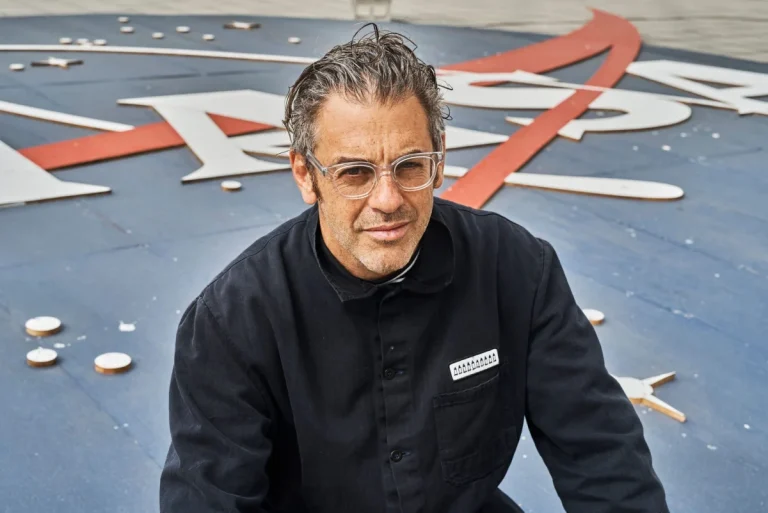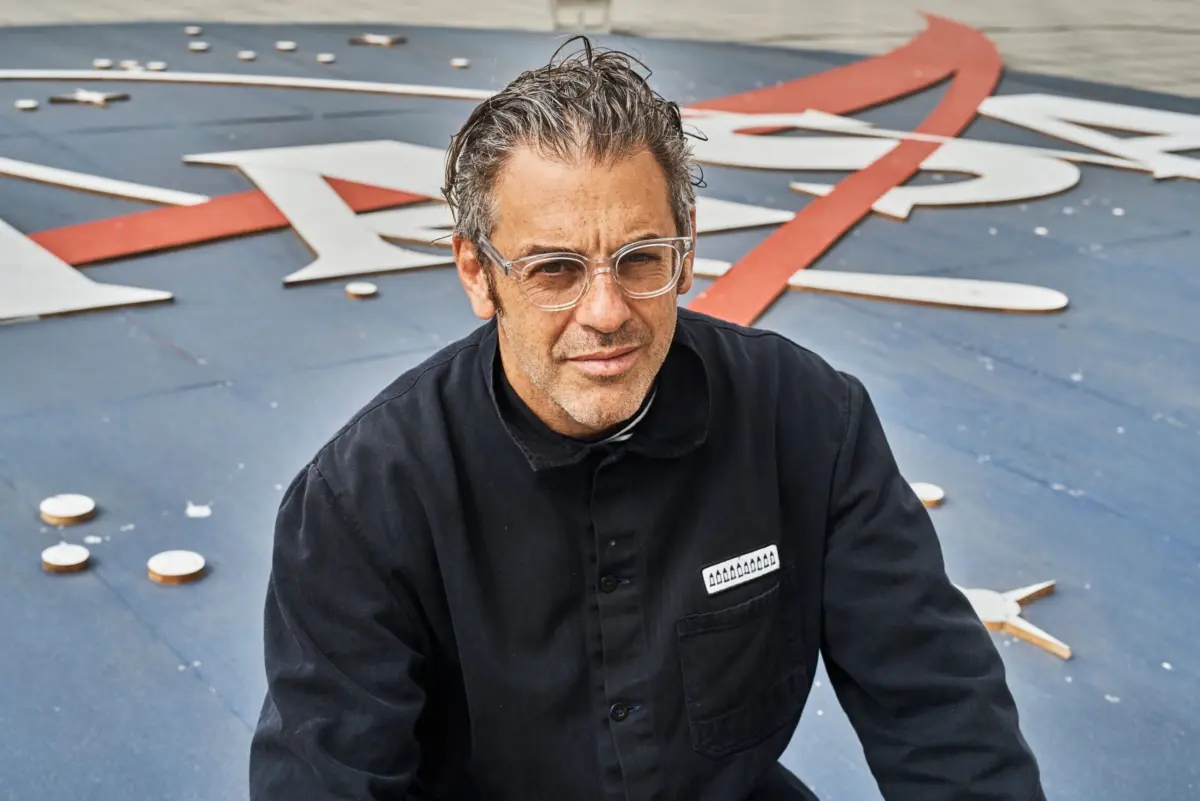
Tom Sachs’ workshop in lower Manhattan is a warren of rooms jammed with cabinets, shelves, work tables, and sorting systems—all of them customized. Even the lowly drill press is heavily remade, with two machine lamps spidering off its top, a brush on a retracting cord to clean away debris, and a chuck key and center punch stuck to magnets on the machine’s face. For Sachs and fellow makers, these kinds of rituals, taken together, represent a shop’s philosophy of work.
Sachs is a sculptor, but he prefers to call himself a bricoleur. It is a term, he explains, for someone who cobbles together functional contraptions out of received or collected materials. A decade ago, galleries and curators began noticing his provocative works, such as a cardboard hand grenade housed in a mock Hermès box, or a Glock pistol decorated and branded as Tiffany. Today, he and his 12-person team mount elaborate exhibits in museums around the world, and art lovers collect his work faithfully.

During a visit to his studio, the team was busy prepping for a large-scale installation at San Francisco’s Yerba Buena Center for the Arts that would send two "astronauts"—played by studio assistants—in a plywood mock-spaceship on a simulated mission to the Jovian moon Europa, which scientists believe might harbor life. It marks the third installment in his ambitious series of Space Program pieces. As we toured the studio, Sachs’ assistant Sam Ratanarat was trying to stabilize a cart the astronauts would wheel out onto the simulated surface, a task that required her to weld the titanium rods holding it together.
Sachs inspected the work, telling Ratanarat that her first weld looked gorgeous. "Talk about material bragging rights," he said. "Titanium is up there!" However, Sachs was less impressed with their old MIG welder, noting that the machine was beaten up and asking if they could get rid of it.

When Ratanarat defended the equipment protectively, noting that they still use it, Sachs shifted his focus to something edgier. "When we went to the moon, Spyderco made us white Delicas," he said, referencing a folding knife beloved by knife enthusiasts, which Sachs had previously engraved with NASA’s iconic 1970s logo.
Europa, however, demanded a different kind of tool. "Europa is a mission about imperialism. We go to another planet, find some Europans, and abduct them," Sachs said. "So what’s the knife of colonialism? A machete!" True to form, he was in the process of milling his own from a Japanese lawn-mower blade.

With three concurrent shows in New York and the Europa landing opening soon at Yerba Buena, Sachs stood at the peak of a two-decade career. His cobbled-together, rough-edged, joyful contraptions have cemented his reputation as arguably the most famous bricoleur in the world.
The Evolution of a Maker
Sachs was a peculiar kid. He bought his clothes at Goodwill and had them tailored, was a solid D-minus student, was unpopular, and struggled with sports, ultimately repeating the ninth grade.

Somehow, he managed to gain admission to Bennington College. It was there that he met Babs, a senior who taught him how to weld and introduced him to the works of Constantin Brancusi and Richard Serra. He fell in love, though things took a turn when she promptly dumped him for a trust-fund kid with dreads. Still, the encounter left a lasting mark. "She showed me a more complex way of working, to make these objects and talk about them politically, socially, how objects could be used in the rituals of our lives," Sachs recalled. He nursed his broken heart with an angle grinder.
Years later, writer and former MythBusters host Adam Savage saw a video of a replica Landing Excursion Module on a mission to a fake Mars. Unsure of what he was looking at, Savage sent the link to fellow space geek Tom Hanks. Hanks outgeeked him, not only knowing the work but knowing the artist personally, and subsequently introduced Savage to Sachs.

The two found they had a lot in common. They are both obsessive organizers and enthusiastic makers of replicas. When they find themselves in the shop unable to think of what to work on, they build infrastructure—stands, shelves, and benches. Sachs later noted that he had even cribbed construction ideas from MythBusters. Over time, their professional and personal relationship grew to the point where they frequently share workshop spaces on opposite coasts.
When Savage looked at Sachs’ workshop, what felt most familiar to him were not just the tools, but the rituals and the physical evidence of how Sachs turns prosaic objects and materials into art. Savage’s own obsession involves building replicas of objects from movies and television shows, such as the pistol from Blade Runner, the spacesuits from Alien, or the mecha-glove from Hellboy. In doing so, he feels he is speaking to his 10-year-old self, building things that child would have wanted, but executing them with enough realism to fool his adult self.

When Sachs replicates something for a gallery display or sale, Savage believes he is also talking to his 10-year-old self, but through a different conversation—gifting that child all the art supplies anyone could ever ask for and letting him play. While Savage tells stories with objects by layering on narratives through a patina of age, wear patterns, and use, Sachs builds narratives directly into the construction. Observers can see the exposed edges of plywood, visible screws, marks from greasy hands, or a stray tool mark. You always know an object is made. Sachs’ pieces become art because his rituals of manufacture tell stories about the artist himself.
Rituals, Tea, and Space Hardware
This philosophy extends beyond the workshop. At the Noguchi Museum in Long Island City, about 20 minutes outside Manhattan, Sachs constructed a teahouse out of plywood and resin. There, surrounded by a small group of museum donors, Sachs served as tea master.

In a classical tea ceremony, guests shed what they won’t need—keys, coats, and shoes—and put on tabi, traditional Japanese footwear. At Tom Sachs’ tea ceremony, guests received sneakers cut into sandals, while their smartphones and wristwatches were locked away in a Faraday cage.
Sachs delivered the ceremony earnestly, frothing the tea powder and pouring the water, but the performance departed from tradition. Guests smoked from a pipe crafted by Sachs, drank sake from cups made of stacked plywood circles coated in resin, and ate Oreos followed by Ritz crackers with peanut butter.

"People are into tea for three reasons," Sachs explained later. "Spirituality, like Zen. Sensuality, like the tea itself, the smell, the charcoal, the caffeine high. The third reason is the architecture—the teahouse, the kimonos, the bowls, the whisks. Obviously, I’m into it for that."
Sachs compared the experience to his obsession with NASA. "Some people are into astronomy because they’re into navigation. Others are interested in where we come from, where science and religion meet," he observed. "And then other people are into it for things that go boom, and space suits and rovers and rockets, and it’s all about the hardware."

The marriage of hardware and ritual is central to his work. As Dave Lavery, a NASA roboticist, noted regarding Sachs’ space missions, "It’s always intriguing to go beyond the roughly cut plywood edges and half-worn paint, and discover that all the details are technically traceable back to the reality of actual spaceflight hardware." The missions are playful, but they are not parodies.
Bringing Europa to Earth
Astronauts practice for every eventuality, and NASA routinely examines its structural, personal, organizational, and philosophical failures to prevent their recurrence. In many ways, Sachs’ space missions embrace that same potential for failure.

For the Europa installation, astronauts were slated to start in a quarantine trailer before transferring via scissor lift to the landing module. A model rocket would perform the liftoff, filmed with a miniature camera at the exact angle NASA uses for its launches to give audiences a realistic view. The rocket would then travel along a length of yarn toward a spinning globe.
Landing remained the most precarious part of the performance. One of the astronauts would play the classic Atari game Lunar Lander. If she failed—running out of fuel or crashing the module—a TV screen would display a Nixon impersonator reading the speech he would have prepared had the Apollo astronauts perished, bringing an immediate end to the show.

Success, on the other hand, meant the astronauts would exit the lander in suits cooled by ice-water tanks in their backpacks. They would shuffle to an ice-covered pool, drill through the ice under guidance from mission control, and capture the "aliens" they found. While Sachs debated whether to use crawfish or shrimp, his primary logistical hurdle remained ensuring the choice would draw minimal criticism from animal welfare organizations, as the astronauts planned to eat the alien specimens.
Setting up these intricate, temporary worlds is deliberately difficult. The materials are far from ideal, the spacesuits are challenging to keep cool, and switches and hatches are prone to breaking. Transporting and assembling the pieces across the country for just a few days of performances is an integral part of Sachs’ process.

Ultimately, while he appreciates the philosophical questions behind space travel, the endeavor primarily fuels his fundamental drive to make things with his hands. "I love getting my hands dirty. I only feel good if I have a cut somewhere," he said. "If I have a little burn, it means that I’m probably doing something right."