Japan has long understood the power of a good mascot. While branding consultants in the West often lean toward sleek typography, minimalist logos, and sterile corporate identity systems, Japanese municipalities and corporations have embraced the undeniable charm of oversized, plush, and occasionally absurd characters. Now, an unlikely gathering in Frankfurt suggests that Western cities might want to embrace their softer side, too, finding new ways to foster civic pride through a bit of theatrical warmth.
A curious gathering took place on a recent afternoon at Frankfurt’s historic Dippemess funfair. The event brought together a delegation that would normally never be seen mingling in a single space. Represented at the gathering were the local basketball club, the ice-hockey team, the municipal rubbish collectors, the public-transport operator, and the youth fire brigade. Even Germany’s central bank had sent someone along to join the festivities. The only unusual thing was that none of them had come in human form. Frankfurt was holding its annual mascot summit, bringing together the city’s most visible, albeit fuzzy, public ambassadors.
Bembli served as the host for the gathering. A plush, oversized version of the grey-and-blue stoneware jug traditionally used to serve Frankfurt’s local Apfelwein cider, Bembli welcomed the attendees with the silent, permanent grin characteristic of its kind. The idea for the summit had been dreamt up rather spontaneously at the previous year’s event.
"It seemed obvious: mascots just bring good vibes," Patrick Hausmann, one of the organisers, told the Frankfurter Allgemeine Zeitung. That simple realization proved infectious. This year, 15 local plush stars turned up to the funfair grounds, drawing curious glances and fond smiles from passersby of all ages.
The roster of attendees varied wildly in terms of experience and frequency of public appearances. Some, such as Dunking Kong the gorilla and Trevor the lion, are seasoned professionals, well-accustomed to working the crowds and hyping up sports fans at high-intensity basketball and ice-hockey games. Others keep a considerably lower profile. Lisa, the public-transport operator’s mouse, is a shy creature who reportedly leaves her burrow only once or twice a year for special occasions. The rest of the delegation formed a menagerie that included a meerkat, an eagle, a bee, a dragon, and, perhaps most uniquely, a walking euro.
Germany has historically had a complicated, sometimes fraught relationship with mascots. Things started out promisingly enough with Waldi, the cheerful, striped dachshund created by Elena Winschermann under the direction of Otl Aicher—the legendary designer behind Lufthansa’s landmark 1960s corporate identity—for the 1972 Munich Olympics. Waldi was resolutely unheroic, colorful, and friendly, quickly becoming an endearing ambassador for a newer, softer postwar Germany on the international stage.
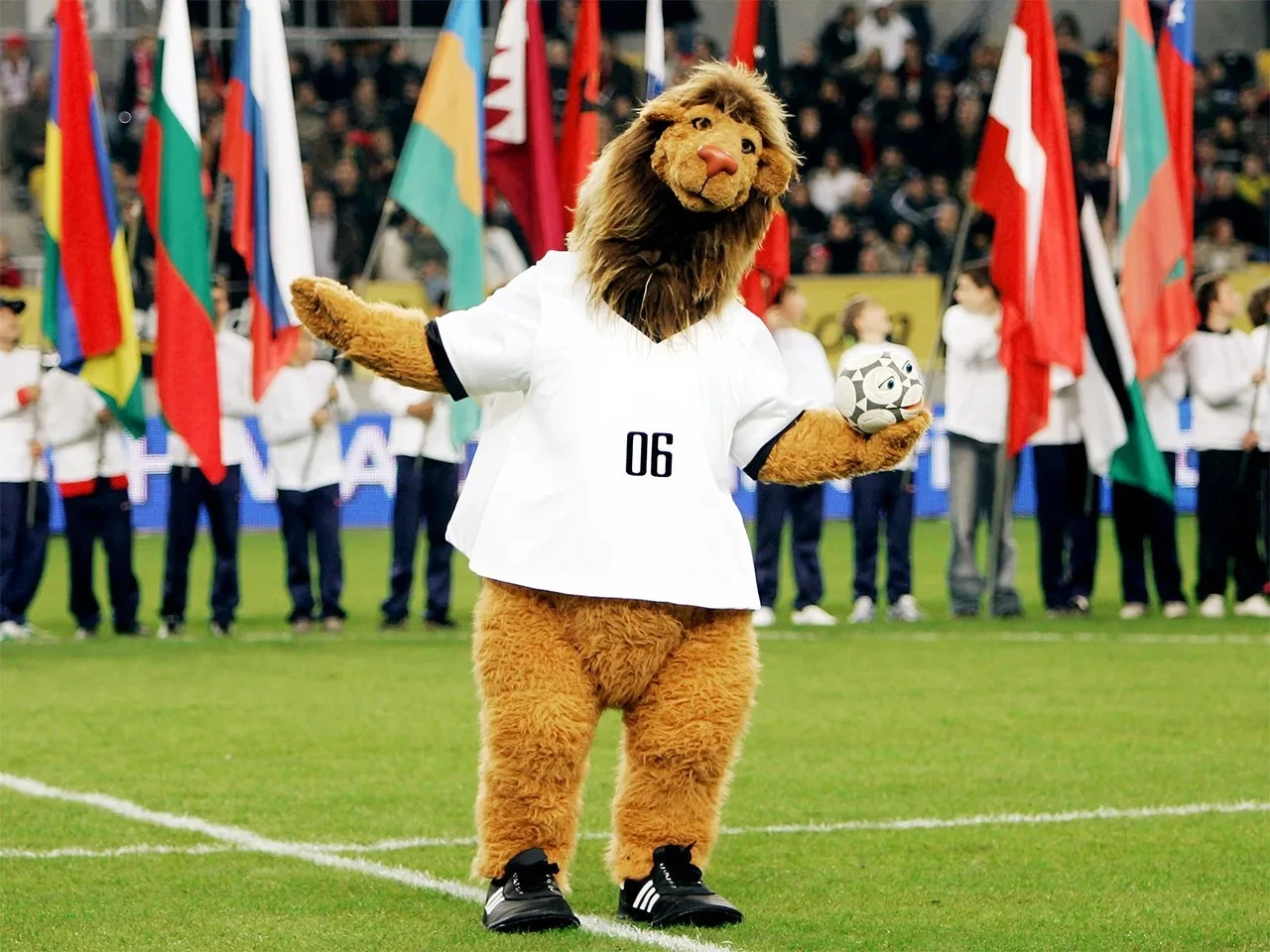
Decades later, however, the country’s last major national mascot fared considerably less well. Goleo VI, the shaggy, enthusiastic lion of the 2006 World Cup, wore an official Germany football shirt but, rather infamously, no trousers. That stylistic choice sparked a weeklong national debate across talk shows, newspapers, and living rooms, dividing public opinion over what a national sports representative ought to look like.
Goleo VI more or less killed off Germany’s remaining corporate and civic enthusiasm for mascots, which was a genuine pity because the country once boasted a rich and varied cast of characters. Organizations that had long kept a character on the payroll—including many of the nation’s regional public broadcasters—gradually retired their mascots in the years that followed or simply let them fade into obscurity. As marketing budgets moved online and digital strategies took over, these slow-burning, physical characters fell out of fashion, largely replaced by social media influencers with ready-made audiences and immediate algorithmic reach.
At about the same time, however, Japan went in the exact opposite direction. From the mid-2000s onward, local mascots began multiplying at an extraordinary speed, complete with elaborate regional dance competitions, online popularity contests, and massive fan conventions. These yuru-chara, which translates loosely to "loose characters," now represent almost every facet of Japanese civic and commercial life. They can be found promoting cities and prefectures, railway companies and police departments, local tax offices, and even correctional facilities.
Over the years, some yuru-chara have transcended their local duties to become bona fide celebrities in their own right. Kumamon, the rosy-cheeked, startled-looking black bear created to promote the city of Kumamoto, became a national phenomenon with a lucrative merchandise empire, eventually being sent abroad on official diplomatic and tourism missions. Funassyi, an unofficial pear fairy from the city of Funabashi, built a wildly successful career on being deliberately chaotic, high-energy, and eccentric, even landing a record deal with Universal Music Japan.
The emotional attachment these characters command can be intense. When railway operator JR East announced that its much-loved Suica Penguin would be retired, fans reacted with the genuine grief and shock usually reserved for the passing of a human celebrity.
In Japan, mascots are treated as a foundational element of the civic public relations playbook. Alongside their obvious utility in promoting regional tourism, they serve a deeper psychological function: they make sprawling, bureaucratic institutions feel far less remote. By giving an otherwise abstract, faceless organization a tangible, friendly physical form, they humanize authority.
It might be a particularly opportune moment for Western cities to take note. At a time when urban identity is wavering, civic budgets are tight, and public trust in institutions is wearing thin, citizens are increasingly looking for things that feel tangible, approachable, and unmistakably local. A slightly ridiculous, oversized furry creature can often do far more for genuine civic affection and community bonding than a six-figure, corporate rebranding exercise cooked up by an external agency.
Western Europe still has a few distinct lessons to learn from Japan’s masterclass in mascot culture. First, institutions need to tolerate a little silliness. Western city governments and corporate boardrooms often worry that being playful means risking their professional credibility, fearing they will not be taken seriously. Japan demonstrates daily that professional competence and cheerful absurdity can happily coexist.
Second, cities must keep it local and stick with the character for the long haul. The best Japanese mascots are deeply rooted characters whose designs and personalities draw directly from local food, regional folklore, history, and inside jokes shared by the community.
Third, Western societies need to let adults enjoy them, too. Japan has successfully made kawaii aesthetics completely respectable well beyond childhood. Mascots should not merely be wheeled out for school fêtes and suburban funfairs; they should be allowed to exist in everyday urban life, bridging generational divides.
For mascots to truly catch on across the West, a cultural rethink may be required, but Frankfurt’s recent gathering offered an encouraging glimpse of what that future could look like. Throughout the afternoon, people stopped naturally to take photographs with the characters or simply lingered around them in the spring air. There was no awkward small talk required, and no complex policy to explain.
Several of the city’s furry ambassadors carry stories of grown adults approaching them simply to ask for a long, quiet hug because they were having a difficult day. Try getting that level of emotional resonance from a corporate logo or a municipal pamphlet.